The brass bands were loud. The audience at the Pennsylvania Convention Center was larger than you might expect for a math award ceremony. But when the president of the International Mathematical Union finally stepped up to the microphone in Philadelphia, the noise stopped.
Four young researchers received the Fields Medals today.
They are Hong Wang, Yu Deng, John Pardon, and Jacob Tsimerman. Their work ranges from how fluids move to the tangled geometry of knots. These aren’t just prizes. They are the highest honors in the field, often called the “Nobel Prizes of Math,” even though the name comes from John Charles Fields, who pushed for them in the 1920s.
There is a catch, though. You can only win if you are under 40. And you can only win once every four years. That restriction makes these wins even more significant.
How did Hong Wang solve a 50-year-old knot and space problem?
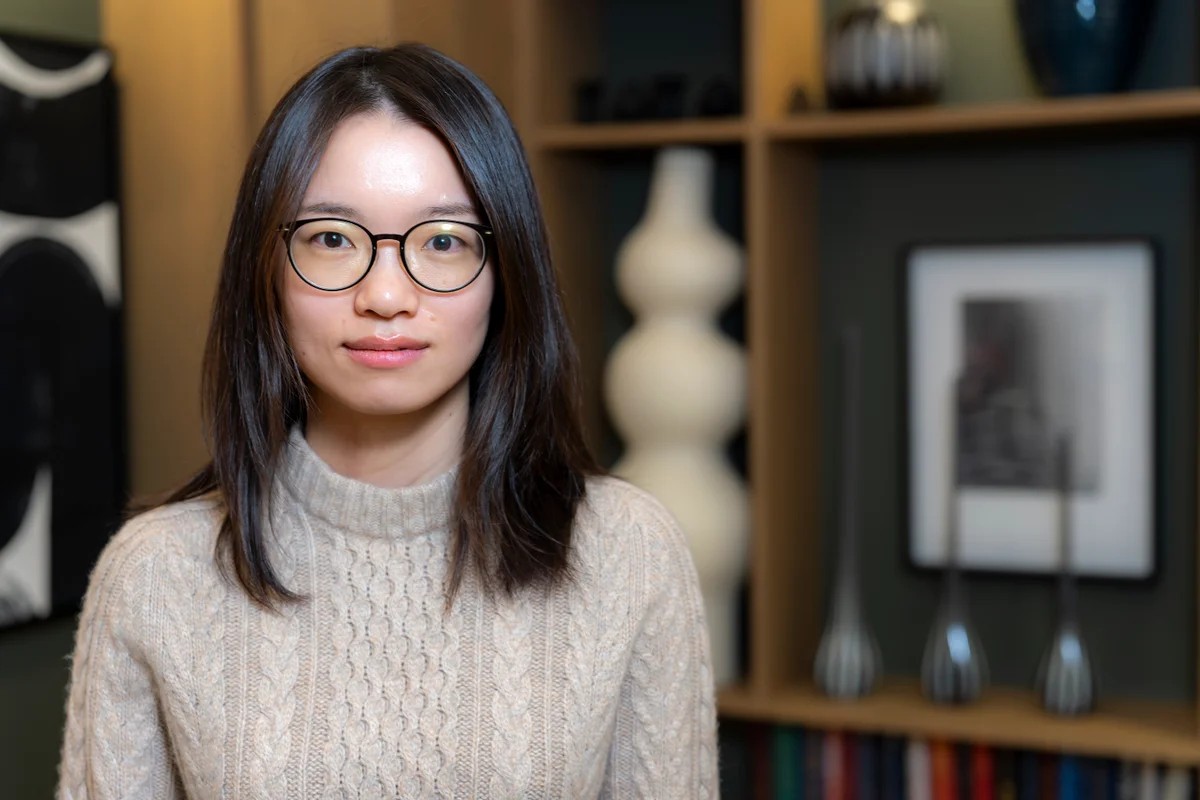
Wang is already making history. In the medal’s 90-year run, she is only the third woman to receive it. Maryam Mirzakhani was first, in 2014. Maryna Viazovska was second, in 2022.
Wang, who works at New York University and France’s Institut des Hautes Études Scientifiques, didn’t seem to dwell on the gender aspect. She started her acceptance speech in Princeton back in February with a humble joke about being out of place on the speaker list. But her math doesn’t joke around.
Her breakthrough involved something called the three-dimensional Kakeya conjectare.
Imagine swirling your pencil in the air. You want it to point in every direction exactly once. You also want to do it in the smallest amount of space possible. It sounds like a parlor game. It is actually a deep mathematical puzzle about shapes filling space.
For 50 years, mathematicians tried to figure out the limit. In 2025, Wang and her colleague Joshua Zahl proved it. They showed you cannot shrink that space below a certain point. It is a “holy grail” result, according to Nets Katz at Rice University.
“She solved the ‘holy grail’ problem… This is only one of the accomplishments that has made her a central figure in the area.” — Nets Katz, Rice University
The win highlights a shift in the math world, too. Along with Deng, Wang is one of the few Chinese-born Fields Medalists, alongside Shing-Tung Yau from 1982.
Why Yu Deng’s work on fluids changed physics
Deng, a professor at the University of Chicago, didn’t celebrate wildly. He told himself to act like nothing changed.
He got the news in January. Instead of throwing a party, he walked the shores of Lake Michigan for days to calm his nerves. Then he went back to his desk.
His papers, released in 2024 and 2-025, are massive. They tackle a problem that has bothered physicists and mathematicians for over a century. Fluids are weird.
On a tiny scale, water is chaos. Molecules bounce off each other like billiard balls in a random mess. On a big scale, water flows smoothly. It follows laws as if it were a single, continuous whole.
How do you get one from the other? For a long time, no one could mathematically reconcile the two. Deng and his co-authors proved that the equations for the chaotic micro-scale and the smooth macro-scale are actually the same. They bridge the gap.
“It would have been a disaster had he [Deng] not won,” Scott Armstrong at N.Y.U. said. He called it a singular, spectacular result.
This achievement also adds to the list of Chinese-born medalists. It reflects decades of investment in education in China. Deng says he is just working as himself, but he is happy to represent a new generation.
Which knot theory discovery made John Pardon famous?
Pardon was only 21 when he first shook up the math world. He was an undergraduate at Princeton in 2010.
He was working on knot theory. This field studies how strings can be tied up. You take a string, tie a knot, and glue the ends together. There are infinite ways to do this. Some look different but are actually the same if you twist them enough. It is incredibly hard to tell them apart.
Pardon focused on “distortion.” This measures how hard it is to get from one part of a knot to another. Imagine an ant crawling along the string versus a grasshopper jumping straight across. The ant has a harder time.
Pardon showed that for certain knots, this distortion can be arbitrarily large. You can make the knot infinitely more complicated for the ant to navigate relative to the jump. It was a problem that had interested mathematicians for 25 years.
David Gabai at Princeton noted how unusual it is for an undergraduate to topple such a “Goliath.” Pardon wasn’t even sure it mattered at the time. It only later became clear that solving this simple-stated problem was significant. Since then, he has tackled other major geometry conjectures at Stony Brook University.
How Jacob Tsimerman used math to look at AI
Tsimerman of the University of Toronto loved numbers before most kids know they exist.
His parents realized this when he was three. His grandfather gave him puzzles. His mother gave him a high school textbook when she saw he liked negative numbers. It became a hobby before it became a career.
In 2021, he and two collaborators proved the André-Ourt conjecture.
This is advanced stuff. The conjecture deals with “Shimura varieties,” which are rare mathematical objects. It helps mathematicians understand their complex structure. It is crucial for the field of arithmetic geometry, where variables are whole numbers.
Jonathan Pila at Oxford University calls him brilliant and resourceful. He also noted that Tsimerman is easygoing.
Tsimerman has done important work in “Hodge theory” too. This area connects to one of the famous Millennium Prize Problems, which comes with a $1 million reward.
The Fields Medal itself doesn’t pay much money. You get a 14-karat gold medal and about 15,000 Canadian Dollars. Tsimerman isn’t using it to buy a yacht. He wants to put that prestige and some of the funds into understanding artificial intelligence.
“We don’t really understand the system very well,” Tsimerman said. He thinks pure math can help us make sense of the scary, rapid changes AI is bringing to the world.
Four medals. Four distinct paths. One shared recognition that the future of mathematics is young, global, and relentlessly curious.
The brass bands stopped playing. The mathematicians went back to work.