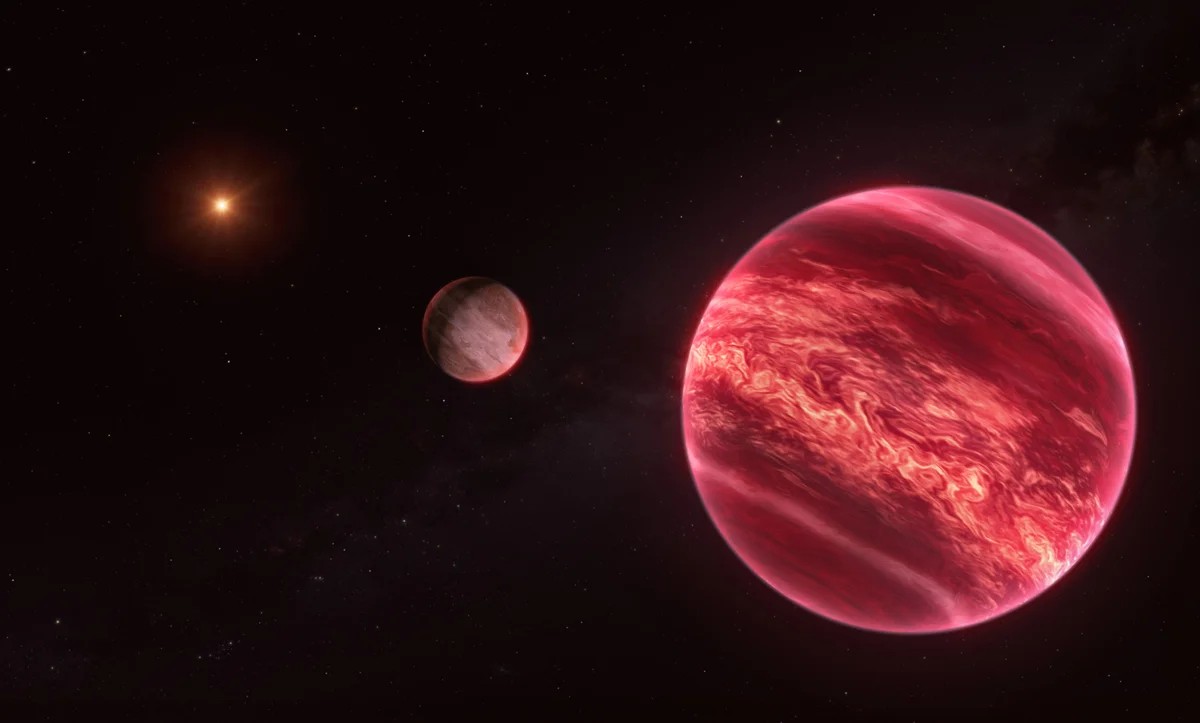
A moon that’s nearly the size of Jupiter?
That’s the riddle. And it might break astronomy.
CD-35 2722 is 73 light-years away. It’s a small star. It has a companion. This companion, CD-35 22 B, is a brown dwarf. It weighs about 30 times Jupiter. It has its own satellite.
We don’t have a word for this.
The object orbiting the brown dwarf has a minimum mass at 90 percent of Jupiter. That’s huge. If it orbited a real star, we’d call it an exoplanet. Just a gas giant. Nothing special. But here? It orbits a “failed star.” So, is it a moon? Or a planet? Or something else entirely?
How radial velocity detection solves the mystery
The search started at the Keck Observatory in Hawaii. Early data hinted at an exomoon. But hints aren’t proof.
Kevin Hoy took over. Hoy is a Ph.D. student at the Instituto de Astrofísica de las Islas Canarias (IAC). He turned to Chile. Specifically, the Atacama Desert.
He used the Very Large Telescope (VLT). And a powerful instrument called CRIRES+. This spectrograph splits starlight into a rainbow.
Why does this matter?
Gravity pulls.
When an object orbits, its mass tugs on its parent. The parent star wobbles. That wobble changes the light. Move toward Earth? Blue. Move away? Red.
Blueshift. Redshift.
Hoy tracked these shifts over two and a half years. He finished in February 2026. The results? CD-35 2222 B wobbles. It has an unseen partner circling every 170 days.
The detection was clean. Hard to ignore.
Why the exomoon classification fails for giant bodies
This isn’t the first time we’ve looked for exomoons. We’ve found thousands of exoplanets. But a definitive moon? No.
Take HD 20689 b. It’s 129 light-years away. It wobbles too. It looks like a 28-Jupiter-mass planet with a smaller companion. But the data is fuzzy. A paper in January suggested other explanations for the wobble. It’s a “candidate.”
CD-35 22 22 B’s satellite is different.
David Kipping from Columbia University studies these things. He didn’t work on this paper. But he’s skeptical of everything. Until now.
“It’s a candidate object,” Kipping says. “But it probably is real.”
He calls the detection “clean.” The wobble is strong. The mass is massive. The object is likely all gas. No rock. No ice. No metal. Just a big ball of hydrogen and helium.
So what do we call it?
A moon implies smallness. Earth’s moon is tiny compared to Earth. Mars’ moons are pebbles. Jupiter’s moon Ganymede is huge, but still smaller than Mercury.
This new object? It’s 90 percent the mass of Jupiter.
That’s not a moon. That’s a binary planet system. Or a rogue planet captured by a brown dwarf.
Where the definition of a moon breaks down
Brown dwarfs exist in a gray zone.
They are gas orbs. Bigger than Jupiter. But they failed. They didn’t get heavy enough to fuse hydrogen like a star. They just glow faintly.
If a moon orbits a planet, and a planet orbits a star, the hierarchy is clear.
Star → Planet → Moon.
Here we have:
Star → Brown Dwarf → Super-Massive Satellite.
Is the satellite a moon? By orbiting a non-star, yes. But by mass? No. By size? No.
“It’s a perfect test bed for arguing,” Hoy says.
The star is a star. The brown dwarf is a brown dwarf. The third object? It sits in the blur.
We need better definitions.
Hoy suggests a neutral term. Exosatellite. It describes the geometry without assigning status. It doesn’t imply the object should be classified as a planet or a moon based on its parent’s nature.
As telescopes improve, we will find more. More weird objects. More borderline cases.
Do we redefine the moon? Do we expand the definition of exoplanet?
Probably not.
The line between a binary planet and a moon is already fuzzy. This discovery doesn’t clear the fog. It just highlights how thick it is.
Maybe the answer isn’t in the mass. Or the distance.
Maybe it’s just in the name. And names change when the universe gets too big to fit our boxes.
We’re running out of boxes.