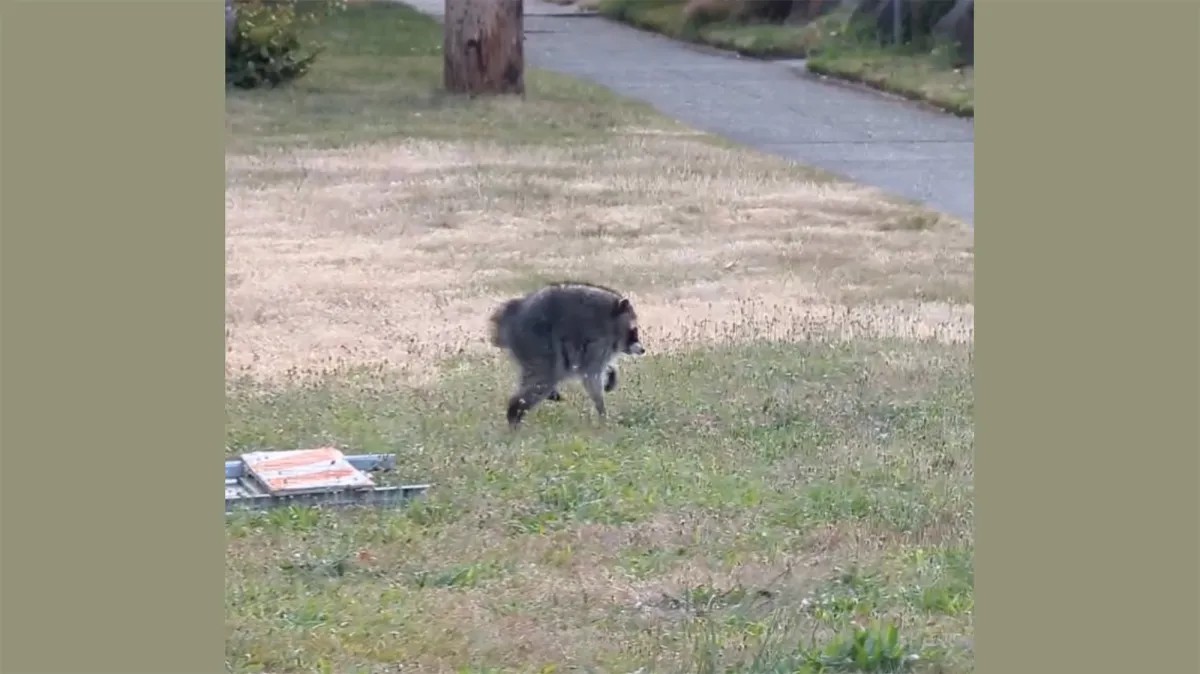
Jimothy isn’t just a raccoon. He’s a viral sensation, a tattoo design, and the face of a “summer” named after him. Seattle locals know him well. The internet knows him better. His compact, round shape has stolen the show. But behind the cuteness lies a rare medical condition: short spine syndrome in raccoons.
Kiana Hall spotted him near a Goodwill in Ballard, Washington. She thought it was a cat under a car. Then she realized it wasn’t. It was a raccoon. A weirdly shaped one. No neck. Just a ball of fur on legs.
“He just looked like a Jimothy,” she said. Simple. Accurate.
Now he has millions of views. People call him King Jimothy. Some compare him to cryptids like Bigfoot or the chupacabra. Why? Because his silhouette is unmistakable.
The Genetics of a Short Back
So what is wrong with Jimothy’s back?
According to Julian D. Avery, an ecologist and professor at Penn State University, short spine syndrome is genetic. It’s rare. A faulty recessive gene is responsible. For the condition to show up, an animal needs two copies of that gene—one from each parent.
That doesn’t happen often.
“Avery says the odds of two carriers mating are slim,” he explained. “And animals with this condition face huge challenges.”
A spine forms like a long tube. During development, it pinches into segments. Vertebrae. Distinct blocks of bone. In animals with this syndrome, that process fails. The spine doesn’t differentiate properly. It stays fused or compressed. Like pressing down on a tube of dough and ignoring the markings.
Jimothy’s spine is shortened. Compressed.
Why don’t we see this more? Because it’s dangerous. In the wild, a compressed spine limits mobility. It makes hunting harder. It makes running from predators harder. Most don’t make it to adulthood.
Jimothy seems to have avoided those fatal pitfalls.
“I don’t think anyone knows if he’s male or female,” Avery noted. But he is alive. Active. Foraging. Climbing. He moves with ease. That is luck. And it is impressive.
Will Jimothy Survive?
Here’s the good news. His brain works fine. His lungs work fine. Internal organs seem normal.
“There’s no reason to think his lungs are compromised,” Avery said. “I’d expect a normal life for him.”
Raccoons are resourceful. They are adaptable. They survive in cities. They survive in woods. They survive on trash and fruit and whatever they can scavenge. Jimothy fits right in. His generalized diet helps. His cleverness helps.
But there’s a bigger threat.
Not his spine. People.
Feeding wild animals changes everything. Habituation starts small. A bag of chips. A piece of pizza. Then the raccoon stops being wary. It stops seeing cars as threats. It starts lingering in unsafe areas.
Wildlife officials step in. They remove “problem” animals. Jimothy could end up displaced or hurt because someone decided to be nice with leftovers.
“Habituated animals become more likely to be hit,” Avery warned.
Leave Jimothy Alone (But Watch)
The best thing you can do for Jimothy is nothing.
Avery recommends a hands-off approach. Let nature take its course. Natural variation in populations is healthy. Removing or aiding a wild animal disrupts that balance.
Washington’s Department of Fish and Wildlife agrees.
“We do encourage folks to leave the animal alone,” a spokesperson told CBC News. “He appears to be getting around fine.”
So, admire him. Keep your distance.
If you go out and see a raccoon with a short spine, don’t feed him. Don’t try to pet him. Just watch. Learn from it. Maybe it inspires you to look for porcupines next. Or robins.
“It gets people invested,” Avery said. “It gets people caring about what’s going wrong.”
Jimothy’s fame brings joy. And maybe that’s the real win. Seattle City Councilmember Alexis Mercedes Rinck is planning a proclamation. A “Jimothy Summer.” Art competitions. It’s happening.
Hall hopes for simple things.
“That Jimothy keeps bringing people joy,” she said. “And that people look out for him.”
Walk outside. Look at the wild. That’s all it takes.