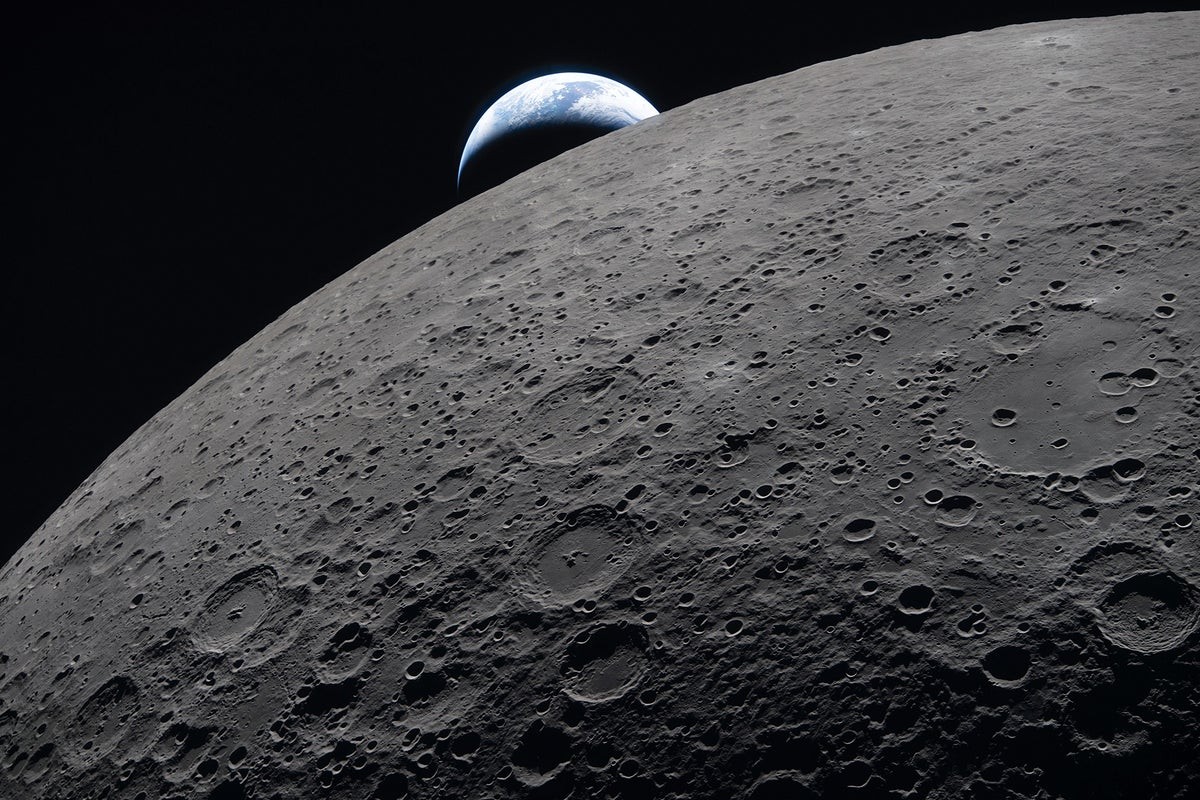
August 5, 2026. 2:34 A.M. EDT.
A 10,800-lb chunk of metal is coming home. Or rather, crashing down.
Astronomers are prepping for something weirdly specific: a SpaceX Falcon 9 rocket body smashing into the moon. Not a planned landing. A stray collision. And it might actually be visible from Earth.
Scientists see this not as a cleanup failure, but as a rare scientific opportunity. The impact could tell us what happens in the split seconds after an object hits the lunar surface. It could also highlight just how dangerous space junk is for our neighbor in the sky.
Twenty-three researchers, led by amateur astronomer Bill Gray, have already published a paper on arXiv.org. Their request? Watch the sky. Record the flash. Document the aftermath.
How Did a SpaceX Rocket End Up Heading for the Moon?
It started in January 2025.
A Falcon 9 launched, carrying two landers to the lunar surface. Firefly Aerospace’s Blue Ghost and Japan’s ispace’s Hakuto-R rode this booster. That part of the job went according to plan.
The upper stage? Not so much.
Normally, that metal tube burns up in Earth’s atmosphere upon reentry. It’s the standard cleanup protocol. But this time, it didn’t.
Instead of vaporizing, the spent rocket stage entered a chaotic orbit around Earth. It’s hanging out at roughly the same distance as the moon, but its path is anything but predictable.
Gray calls the tracking a nightmare. Why?
Two forces are tug-of-war-ing on that metal tube. Gravity. And solar radiation pressure.
Solar radiation is subtle. It’s a gentle push from sunlight, but it’s enough to nudge the object’s trajectory in ways that ground-based telescopes can’t easily forecast. This makes the fragment hard to pin down. Hard to predict.
Until now.
Gray has crunched the numbers. He believes this 5.4-ton hunk of space junk is on a collision course. It’s aiming for the edge of the moon. Near Einstein Crater. From our perspective, it will skim the limb.
Why This Impact Is a Big Deal for Lunar Science
Here’s the problem with watching an impact on the moon.
Usually, you watch the dark side.
The moon is half-lit by the sun at all times. Most impacts happen on the shadowed side, making the flash of light against black sky relatively easy to spot. This crash? It’s happening on the sunlit hemisphere.
No one has ever seen an artificial or natural impact flash on the lit surface. It’s too bright. The contrast is terrible.
But there’s a twist.
Because the crash is so close to the edge—the limb of the moon from Earth’s view—the ejected rocks might have a fighting chance at being seen.
Gray notes that debris flying off the moon will form a plume. Against the dark void of space behind the moon, that plume might actually show up. It’s a gamble. A hopeful one.
Maybe we’ll see the flash. Maybe we’ll see rocks ejected from the impact site. Maybe both.
Probably neither.
Still, the data potential is massive.
Where and When to Watch the Collision
If you’re in the Americas, you’re in luck. Or at least, in the right timezone.
The impact window is tight. The rocket is moving at 5,400 mph. That’s several times the speed of sound. The energy? Equivalent to three tons of TNT.
You won’t feel the earthquake. The moon is dead rock. But you might see something.
Ground-based amateurs with good equipment can try their luck. The arXiv paper points to guides for these observers. If you have a telescope, point it at the moon. Keep an eye on that dark edge.
But the real science is happening in orbit.
NASA’s Lunar Reconnaissance Orbiter (LRO) is already prepped. It’s scheduled to image the impact site before the crash. Then, immediately after, it’ll snap photos of the crater. Comparing the before and after shots will reveal exactly what this high-speed collision did to the regolith.
South Korea’s Pathfinder Lunar Orbiter is also in the mix. They’re attempting to track the fragment as it approaches and survey the damage post-impact.
This is a coordinated effort. Space agencies, amateur astronomers, and independent researchers all looking at the same patch of sky.
What We Might Learn From the Debris Field
Why do we care about a crashed rocket?
It’s about preservation. The moon is pristine in ways we don’t fully understand. Cratering history. Composition of the crust. These are locked in the dirt.
Every impact adds data. Most are too small to measure precisely. This one is huge. Heavy. Fast.
By observing how the 5,400-mph fragment interacts with the lunar surface, we learn about shockwaves. Dust propagation. Material ejection.
It’s a free experiment. We didn’t launch the probe. We didn’t pay for the fuel. A company did. We just get to watch the show.
There’s an odd poetry in it. We built a machine to deliver goods to the moon. It failed to burn up on return. Now, it delivers itself to the ground. Literally.
Is this how we clean up our orbit? By smashing space junk into celestial bodies?
Probably not the intended long-term strategy. But for one night, in August 2026, it’s a spectacle. And for scientists, it’s a data goldmine.
Keep looking up.
If the plume holds. If the cameras catch it. If the timing holds.
We might just see a crater appear out of thin air.