Nerd jokes aren’t rare on TV anymore. You see them in The Simpsons, you see them everywhere. But Futurama? Futurama went nuclear on the gag.
Take “The Prisoner of Benda,” a standout episode where writer Ken Keeler hit a wall. He needed a plot solution that required a genuine, original mathematical proof. Not a prop. Not a joke. An actual proof. And it had to work in the show’s logic.
If you enjoy deep dives into the intersection of pop culture and hard science, you’re in the right place. This isn’t just about cartoons. It’s about how a writers’ room accidentally solved a problem in permutation theory.
The Swap That Broke The Universe
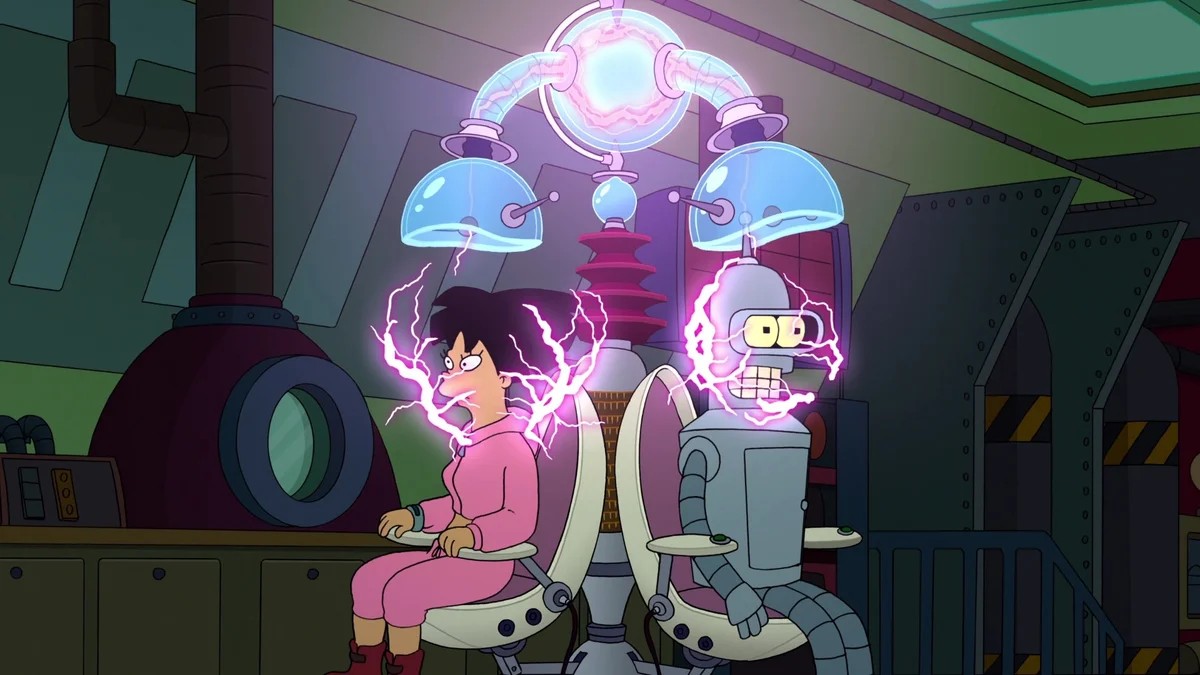
The premise starts simple. Professor Farnsworth invents a mind-swapping device. He swaps with Amy, who wants to eat junk food without the calories. Classic Amy.
But there’s a catch. The machine is a one-time deal for any given pair. If A swaps with B, you can’t just swap them back directly. The lock is engaged.
Chaos ensues. Seven different pairs are used up. Nine characters end up in a tangled mess of bodies. Who is who? Nobody knows. Not even the writers, initially.
Bender steals a yacht. Leela hunts for romantic clues in Fry’s brain. Fry, in a bizarre revenge move, swaps into Dr. Zoidberg’s ugly lobster form because he hates himself? Or maybe he just wanted to be weird.
The goal is simple: everyone goes back to their own body. The problem is impossible under the rules established. You can’t undo the swaps with the existing cast.
Keeler, who holds a PhD in mathematics, stared at the board. He realized he needed new characters to fix the mess. But how many?
Could the number of helpers grow with the group size? Or was there a fixed, small number that always worked?
He dug into the literature. Nothing. The problem of how to solve the body-swap paradox had not been addressed in academic journals.
So Keeler wrote it out. And he proved it.
The Math Behind The Madness
Here is the abstract version of the problem.
Imagine $n$ items in a scrambled order. The goal is to return them to order (1, 2, …, $n$) using swaps. The catch: you can only swap two items at a time, and you can’t reuse a pair.
Keeler found that by introducing just two extra characters (let’s call them $x$ and $y$), you can solve the scramble for any number of initial characters $n$.
This is known as the Futurama Theorem. It sounds like trivia, but it’s legitimate group theory.
Keeler’s method works by splitting the scrambled set into two halves. One half goes from 1 to $i$, the other from $i+1$ to $n$. Then, using the two new variables $x$ and $y$, he permutes the items.
The process looks like this:
- Swap misplaced elements of the first half with $x$.
- Swap elements of the second half with $y$.
- Swap $x$ with $i+1$.
- Swap $y$ with 1.
The result? The original order is restored. The extra variables $x$ and $y$ cancel out. They are left behind, swapped with each other, but everyone else is home.
The Globetrotters Save The Day
In the episode, the Harlem Globetrotters—yes, the real NBA entertainment team—arrive to help. Two players, Sweet Clyde Dixon and Bubblegum Tate, step up to the blackboard.
They write out Keeler’s proof.
The math checks out. For Fry and Zoidberg, who are stuck in a simple two-way swap, the Globetrotters use four steps. They treat the pair as $(2, 1)$ and apply the algorithm.
The total steps for all nine characters come to 13 using this method. The minimum possible is 9, but 13 is clean and works within the narrative constraints.
By the end of the episode, every mind is in the correct body. The Globetrotters remain swapped with each other. They could switch back, but it doesn’t matter. The mission is complete.
Why This Matters (Beyond The Gags)
Keeler was happy with his proof. But he didn’t submit it. He thought it was a curiosity, not a contribution to the field.
He was wrong.
In 2014, mathematicians Ron Evans, Lihua Huang, and Tuan Nguyen took Keeler’s logic and formalized it. They published an improved nine-page proof in the American Mathematical Monthly.
They didn’t just cite the episode. They validated it. The “Futurama Theorem” is now a recognized result in combinatorial group theory, specifically concerning permutations and cycle decomposition.
It raises an interesting question about creativity. Sometimes the best way to solve a rigid academic problem is to approach it from a cartoon.
The episode holds up. The math holds up. The Globetrotters are still cool.
But here’s the lingering thought: We treat these fields as separate. Math is in the ivory tower. Comedy is in the living room. When they intersect, the result is usually a gimmick.
Keeler proved that the intersection can be structural. Real. Useful.
The next time someone tells you pop culture has no depth, remind them of the Globetrotters. Remind them of the blackboard. Remind them that sometimes, you need two extra characters to fix a problem you didn’t know you had.
And maybe, just maybe, the solution isn’t to go back. It’s to keep going forward. With two new friends.