It’s not a barracuda.
Not a shrimp either.
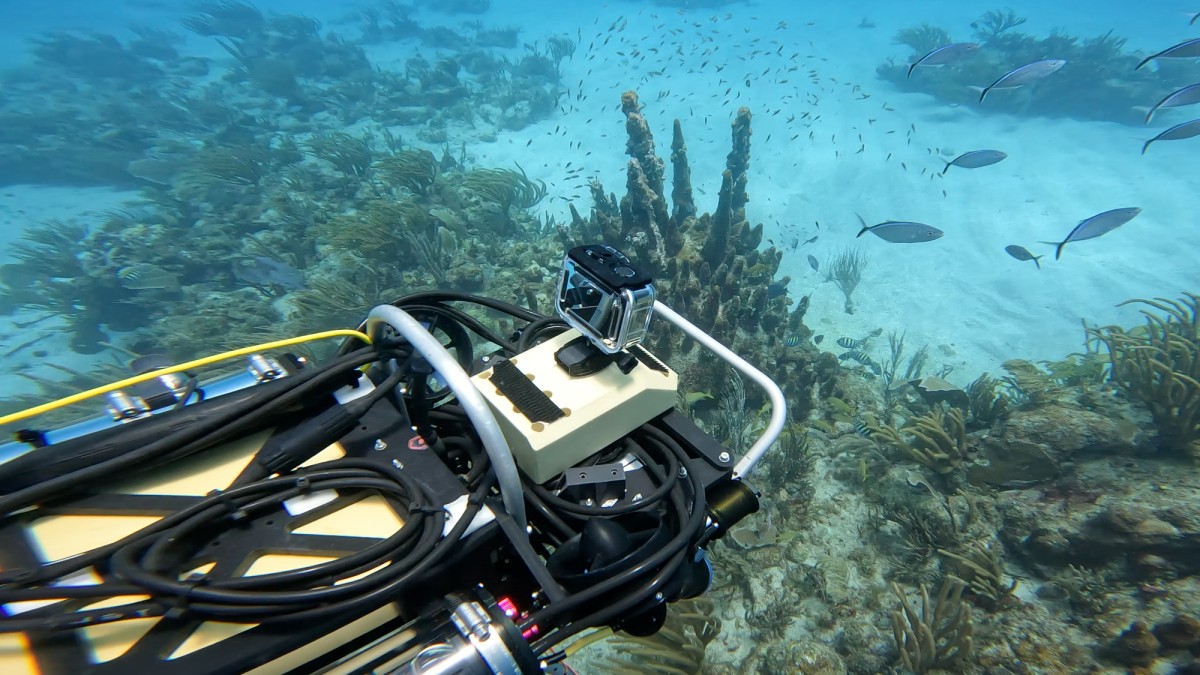
It is a robot.
And it wants to see how coral reefs really work.
Woods Hole Oceanographic Institution (WHOI built something called the Curious Underwater Robot for Ecosystem Explanation or CUREE if you must say it all out loud. The idea is simple. Give a machine eyes. Give it ears. Let it wander into the ocean’s crowded neighborhoods.
Who needs divers?
Divers are expensive.
They run out of air.
Reefs are tiny slivers of the ocean—less than 0.1% of the space yet they house about a quarter of marine species. A bustling bar underwater.
Now that bar is getting noisy from climate change and overfishing. Scientists need better data. Faster data. The kind you can’t get when a human has forty-five minutes to hold their breath before swimming back up to the surface for a panic attack or more air.
The ears of the robot
CUREE doesn’t just guess. It listens.
It carries hydrophones and cameras and an onboard computer.
First it hears the faint crackle of shrimp. Maybe a fish calling a mate. The robot triangulates that sound. It drives toward the noise.
If the audio says something is there, the robot looks.
Vision is short range but sharp. Sound is far reaching but blurry.
“Passive acoustics gives you broad sense of environment, while vision is short-range, but this is really information rich data stream” — Seth McCammon, WHOI
Compliments? Maybe. They work together.
Hunting the apex predator
The test site was Joel’s Shoal in the US Virgin Islands.
CUREE spotted signs of fish up to eighty-two feet away. Then it did something wild.
It found a barracuda.
And it followed it.
For almost ten minutes.
Nine minutes fifty-five seconds to be precise.
The barracuda was looking for lunch, weaving around reefs, startling snappers, doing that predatory thing predators do. CUREE stuck to its side like a shadow.
Human diver?
Barely needed. The diver helped start the tracking and had to hit re-lock a few times. But for nearly nine minutes? The robot handled it. Eight minutes fifty-nine seconds of pure autonomy.
That matters.
Previous underwater robots are usually specialists. CUREE wants to be a generalist. Drop it in the water. Let it survey.
Let it find the hotspots we keep missing.
The paper landed in Science Robotics.
The robots keep getting smarter. The oceans stay mostly hidden.
How many secrets are they hiding from us still?