Paralysis is supposed to be a full stop. Not always anymore.
Back in 2023 surgeons at the Feinstein Institutes in New York pulled off something that looked like science fiction. Fifteen hours of open brain surgery. Two neural bypasses installed. A brain computer interface mapped onto the nervous system of a quadriplegic man named Keith Thomas. It worked. TIME Magazine even put the tech in its Hall of Fame which feels appropriate given the gravity of what happened.
“There was a time I didn’t know if I wanted to live. Now I can feel a hand holding mine. It is overwhelming.”
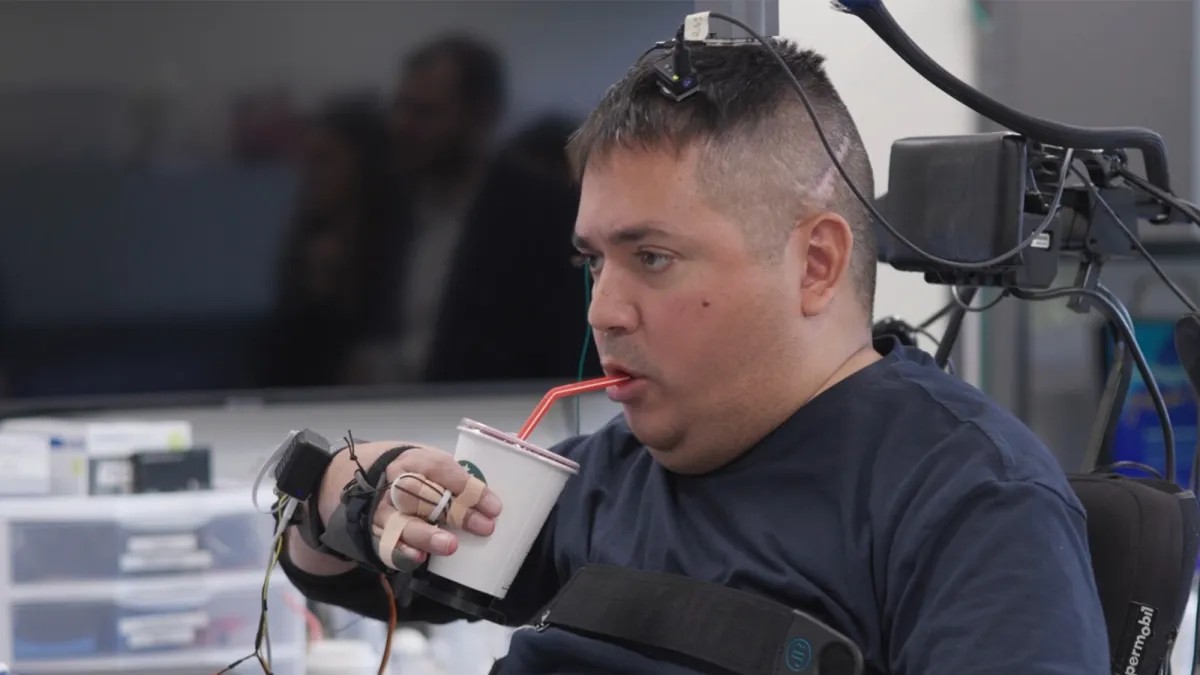
Thomas said that four months in. Today he is three years out from the cut and the results are holding steady. He published updates in Nature Medicine today showing he can actually feed himself. Drink from a cup. Feel things. Real feeling not just vibration.
Here is how the hardware works:
- Five microelectrode arrays sit inside Thomas brain.
- Machine learning guesses his movement intent about 85 percent of the time.
- Those signals spark electrical stimulation in his forearm muscles.
- He moves them.
- A 3D printed brace has sensors that measure grip strength.
- Those readings loop back to stimulate his sensory cortex.
It is a loop. Input and output stitched together by code and wires. The system handles cognitive load better than previous iterations which is huge. Most people have to stop thinking about everything else just to make a cursor move or grab a coffee cup. Thomas can do this stuff while talking. He picked up a hollow eggshell recently and did not break it ninety percent of the time which requires a kind of finesse paralysis usually destroys.
Chad Bouton who helped design the setup calls it a new treatment path. We are not just jumping over the injury. We are rewiring the nervous system entirely. That quote sounds familiar because Bouton basically said the exact same thing twice in the press materials but the repetition highlights how radical the mechanism is. It is not a bridge. It is a renovation.
So what does rewiring look like for Thomas? Scratching his face. Wiping his own eyes. Feeling his dog fur when he pets her. Reclaiming his sister handshake. These seem small. They are enormous. Connection and sense of self are two things that usually go with the spine damage.
“Beyond the study sessions I can scratch my face. The tech gave me back connection and a sense of self.”
The team is pushing further now. Trials are expanding to cover different levels of spinal damage. They recently tried something wild: an interhuman neural bypass. Thomas felt what another patient was feeling when that person touched objects. It raises more questions than answers honestly. Where does one mind end and the next begin in these setups? Is this a cure or a cyborg prototype?
Only time tells. But millions of paralyzed patients are waiting for the answer and this research might be the key.