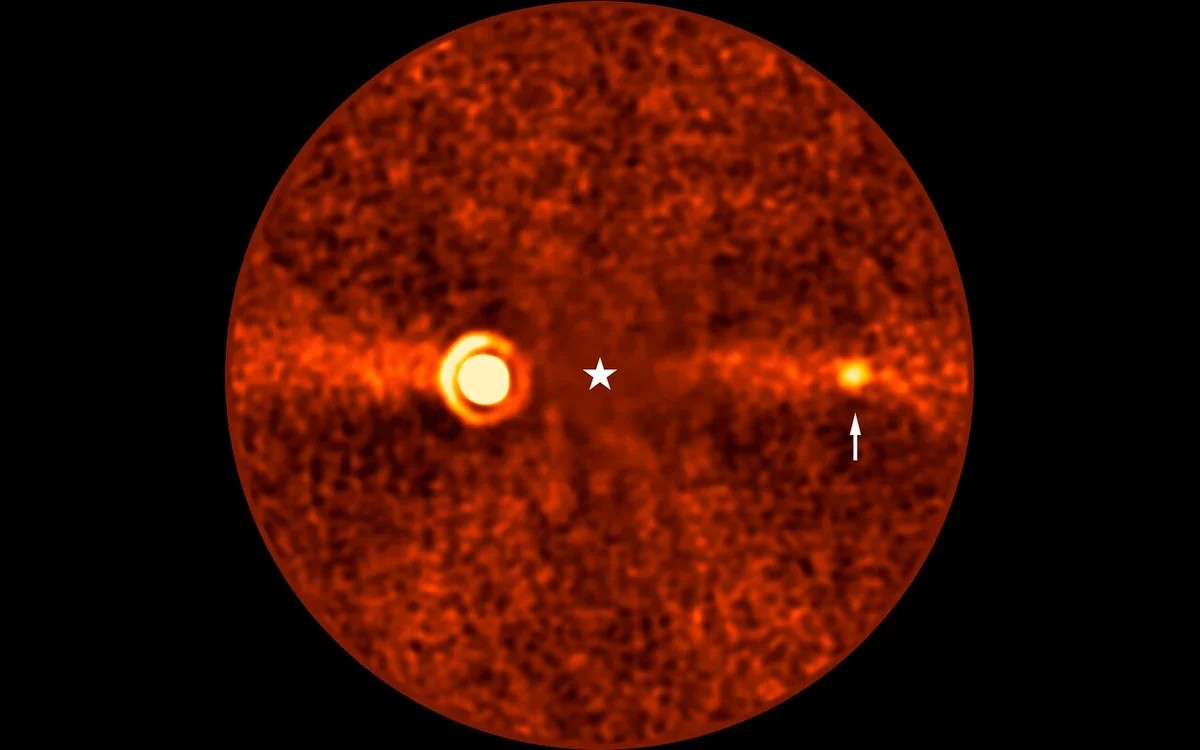
Ben Sutlieff didn’t want another planet.
He was looking for atmosphere. Specifically, the murky gases surrounding Beta Pictoris b. It’s one of two known worlds in a famous system. He had the Very Large Telescope in Chile locked on the target. Mid-infrared scanners. Standard procedure for a postdoc at the University of Edinburgh.
December 2025. The data came through. And there was a speck.
Just a smudge. Tiny. Barely visible even where the other planet sat. “Usually those are ghosts,” Sutlieff said later. “Noise that vanishes when you clean it up.”
He didn’t throw it away. He passed it to Markus Bonse at the European Southern Observatory. Bonse ran the machine learning scrubbers. Algorithms ate the noise.
The speck stayed.
Was it real? Maybe. Or just a background star masquerading as a companion. The location helped. It sat inside the star’s dusty disk—that leftover debris field from planet birth. Good sign. But you need motion. Orbits don’t lie. Stars in the background just… drift.
“We had to watch it,” Sutlieff says.
Waiting years for the VLT to swing back? Not an option. So they went to the archives. They dug up old photos. Images from the James Webb Space Telescope too. There it was. Hiding in the residual heat of a body born twenty million years ago.
“It’s been hiding in plain sight all this time.”
The hunt felt less like science and more like a decade-long game of hide and seek. That’s exactly what Sutlieff and Bonse called it in The Astrophysical Journal Letters. They named the new world Beta Pictoris d.
So what is it?
Gas giant. Mostly carbon dioxide. A splash of water and methane. It weighs in at roughly 2.4 Jupiters.
Small.
Wait, listen. That’s tiny. In this system, anyway. The sun here is nearly double our Sun’s mass. The other two planets? They’re both ten Jupiters heavy. Beta Pictoris d is the runt. Orbiting wide. Taking ninety-one years to loop the track.
Does it matter if we’re finding it?
Thousands of exoplanets already known. Trillions likely in the Milky Way alone. The JWST helps. Sure. But it’s pricey. Bonse says ground telescopes are about thirty times cheaper.
Cheaper means greedier.
“You can look for more,” Bonse said. “Be bold.”
And the tech is catching up anyway. The Extremely Large Telescope wakes up in 2029. John Monnier, a professor at Michigan, called this discovery an appetizer. He’s probably right. The main course involves the ELT. We’re expecting a flood of these faint things.
We’re ready to dig.
But what else is hiding in the dust?