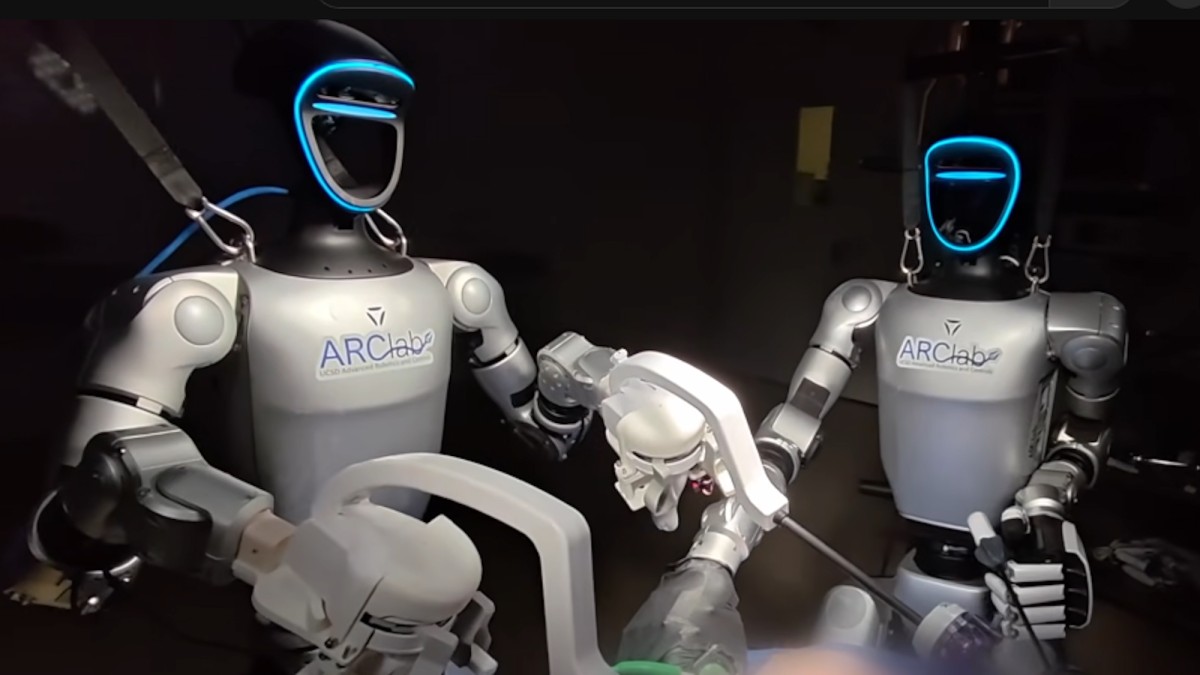
Two of them.
It happened for the first time in medical history. Humanoid robots, remotely controlled from a distance, removed gallbladders from large, non-primate mammals during preclinical trials. One procedure used a robot teaming up with a human assistant. The other relied solely on a pair of bots. No hands inside. Just precision engineering.
We already know robot-assisted surgery.
But those systems are beasts. We’re talking over 1,800-pounds of multi-armed metal that require specially retrofitted rooms and specialized teams just to install them. They are expensive, immobile, and usually designed for one specific job. If it’s not their procedure, they are useless.
Enter Surgie.
Named appropriately for its purpose, these bots are only five feet tall. They weigh sixty pounds. You could probably pick one up. They are nimble. Customizable. And significantly cheaper than the heavy machinery currently dominating operating theaters.
Michael Yip, an engineer at UC San Diego, sees a bigger picture than just smaller equipment. He sees accessibility.
Remotely operated and autonomous humanoid robots can amplify access to critical surgeries for patients who would otherwise be left behind. This addresses the healthcare crisis, here in the US and worldwide.
The study, published in Nature, details the trial. It wasn’t perfect out of the gate, obviously.
The operators had to use adapters to fit standard surgical tools onto the robotic arms. Yet, surgeons were surprised by the feel of the control. It felt natural. Unexpectedly intuitive, really.
Nikita Thareja, a UC San Diego surgeon, noted how well the Surgie bots integrated into their existing workflow. Shanglei Liu, also a surgeon and co-author on the study, focused on the logistics. It’s a fraction of the space. A fraction of the cost. You could deploy it in rural areas. On a battlefield. Maybe even on a space station.
Did they have trouble? Sure.
Calibration issues slowed things down. The robots needed realigning multiple times. That killed the efficiency compared to current systems. There’s latency too—delay between the button press and the bot’s move. It’s noticeable. But look at robotic laparoscopic surgery’s history.
The first procedure took six hours.
Today it takes thirty minutes.
Technology scales. Yip’s team believes these bots will follow that curve.
And Surgie isn’t just about the surgeon’s hands.
Imagine a future where a bot fetches your scalpel. Cleans the spill. Holds the light. Yip calls it the autonomous surgical assistant. Many communities lack staff. Not doctors, necessarily, but the support team that keeps an OR running.
Who’s left when the staff is gone? Patients, waiting for care they never get.
Yip wants an integrated team. Human and robot working side-by-side.
It’s a start. A shaky, calibrated, latency-ridden start.
But the door is open now.