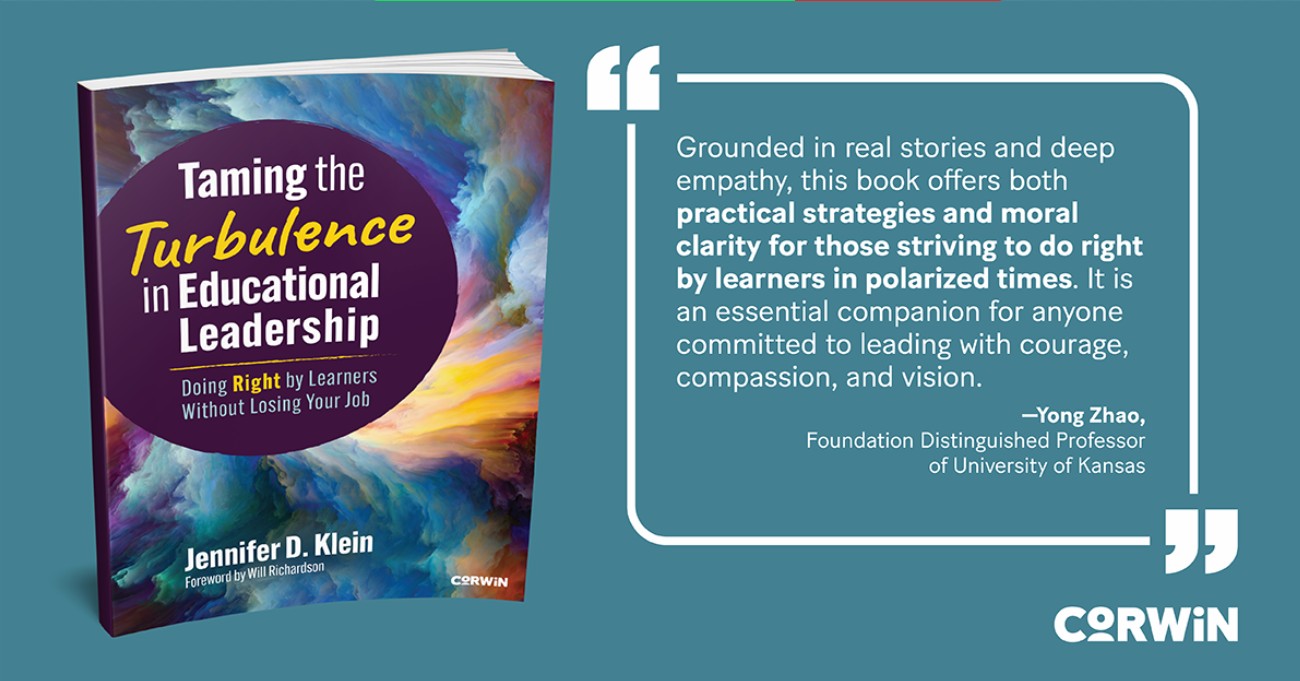
By: Jennifer D. Klein (Excerpted from Taming the Turbulence in Educational leadership )
Fall 2023. I started calling educational leaders globally. Sixty-seven voices. The result? A book called Taming the Turbulence. It’s about managing resistance when you know something is good for kids, even if it costs you your reputation. Maybe your job.
We’re in the storm now.
Expectations are polarized. Fear is real. Legislation is tightening, especially around marginalized students. Educators need armor. Good leaders don’t just give orders; they watch each other’s backs. You want people to take risks? Protect them from the fallout.
Fear shuts down courage. You can’t bring your whole self to the room if you’re worried about parents, politicians, or local boards. Change work needs courage. Not fear.
Former leader Iesha Small puts it well in The Unexpected Leader (2019): education is fundamentally human. It’s not just data. It’s people. Even the teachers. We focus on cultivating students’ talents and character. Do we do the same for staff? Often, no. The pressure strips them of their humanity. Small had to leave leadership for her own well being. I felt that in Latin America, too. Our work is about human development. For adults first.
“I often fear that, under various pressure, the system is not allowing to teachers to develop as happy an round people in the same we hope students will.”
The Interdependence of Prep and Protection
Jill Ackers, Director at VS America, sees prep and protection as one thing. If you don’t prepare your staff, you can’t protect them. But if you prep everyone from classroom to board, you create alignment. Less conflict. Fewer teachers taking bullets for bad ideas.
Systems don’t change on their own. Time, curriculum, money—it all needs negotiation. Daily if necessary. A well-prepped school is a protected school.
Transform the Professional Learning
Most PD sucks.
There’s the “spray and pray.” Hire consultants, dump info on teachers, leave. No follow-up. There’s the “drive by.” Conference talks that vanish as soon as you drive home. Neither changes practice.
And we don’t model what we preach. We lecture about active learning while teachers sit in passive rows. I go to many conferences. Count on one hand how many speakers actually let us reflect. If you want change, show it. Don’t just talk it. Let educators ideate, apply, test, evaluate.
Ackers says we spend too much time on why. Teachers need to know how.
Most weren’t trained as learning designers. Many just follow scripts or textbooks. In tight spots, we get “warm bodies” because we lack qualified hires. That’s not their fault. The system failed them. To fix equity gaps, they need skills: personalized pathways, handling discord, championing all identities.
Understanding why transforms thought. Understanding how transforms practice.
Fix the Systems That Block Innovation
I tell leaders: your systems are in the way.
In Texas, a principal I know works with a scripted state curriculum. Teachers can only offer choice at the end of class. Or after quick finishers are done. Who finishes fast? Usually not the struggling learners.
That’s an inequity. Built-in.
Scripted curricula offer consistency but kill creativity. Leaders can’t just wave this off. Adapt the schedule. Change age groupings. Hire teachers who share student backgrounds. If the system blocks the mission, break the system.
Arnie Langberg talks about “disposable structures.” He got it from Warren Bennis. Build things with an expiration date. Check regularly. Is this working? No? Trash it. Start fresh. Keep it flexible.
Look at your school. What systems are cumbersome relics? What supports you? What gets in the way? Even small shifts matter.
Shield Your People When They Come for You
High stakes breed opposition. Educating kids is high stakes. But fighting it alone breaks teachers.
I know educators who faced attacks with zero support. Traumatic stories linger. Laws offer some protection, but social tides and bad politics don’t care. Good leaders step in front. Especially when staff are targeted for initiatives the leader pushed.
Years ago, I asked Langberg how he ran a grade-free school in a grade-obsessed district.
He buffered them.
He took the authentic data—the qualitative, human stuff—and translated it into the quantitative metrics the district demanded. He handled the pressure. Teachers didn’t have to think about compliance. They could just teach. Authentically. Without fear.
This isn’t lying. It’s translation. It protects the integrity of the work from the rigidity of the bureaucracy.
In Colombia, I backed my teachers. Consistently.
Parents complained about pedagogical shifts? I took the heat. Parents loved it but criticized every minor stumble in project-based learning? I absorbed that criticism. I viewed my staff through an asset lens. Maybe naïve. Maybe naive. But I believed they were doing their best. They deserved protection while learning to do something different.
Leadership is a buffer. It’s a shield. You have to stand between the chaos of the world and the sacred work of the classroom.