Most of us assume the solar system is ancient. It isn’t, really.
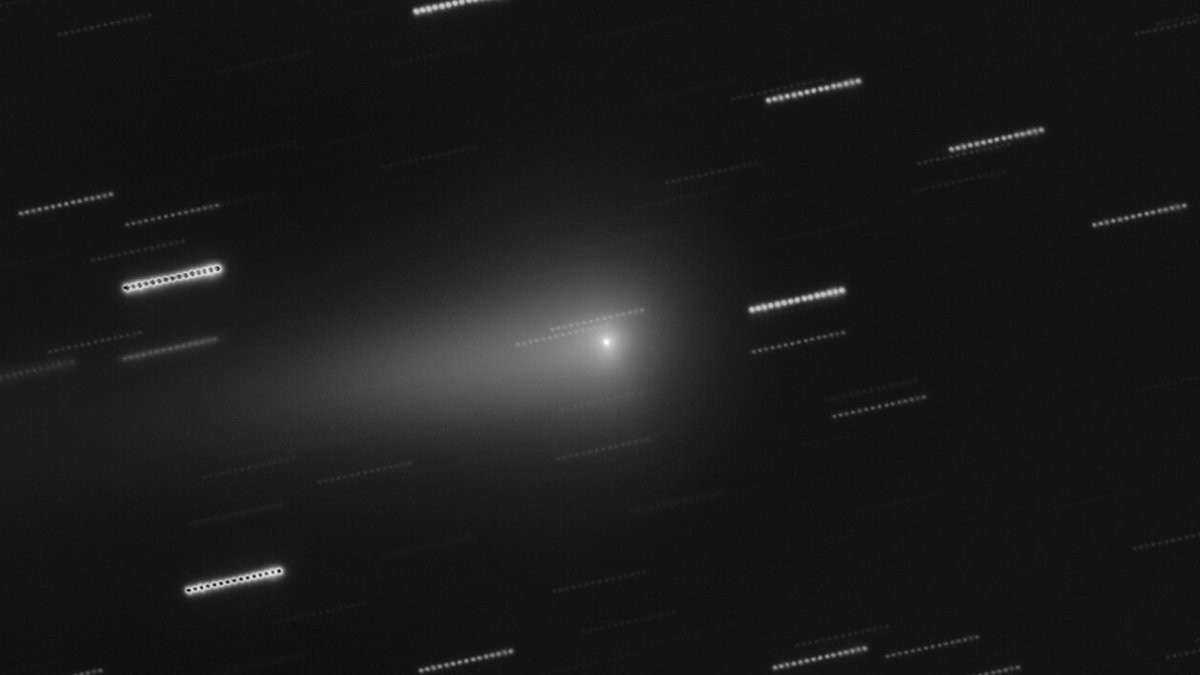
Comet 3I/ATlas proved it during its brief, brilliant flyby last summer. Only the third known visitor from beyond our stars to pass Earth. The first two—’Oumuamua and Borisov—were dull, dark ghosts. This one? It screamed in brightness. That made a difference.
It let astronomers actually see what they were dealing with.
They didn’t just watch it fly. They dissected its gas cloud. Using the European Southern Observatory’s Very Large Telescope, Rosemary Dorsey and her team zoomed in on cyanide molecules. They measured isotopes. Specifically the varying ratios of carbon and nitrogen.
Isotopes don’t change much once a comet forms. They get locked in. Like fingerprints pressed into clay.
So when you find the right ratio, you’re seeing history.
The numbers came back strange. Unusually high nitrogen. Distinct carbon signatures. Not the stuff made here, near a star like our sun.
“3I/ATLAS is really an exciting opportunity to probe another planetary system that formed before the sun existed.” — Rosemary Dorsey
This comet was born far away. Around an old star. One with very few heavy metals. Stars like that only existed in the very young universe. Before space got cluttered with heavy elements.
That means the rock is old. Really old.
Twice the age of our sun? Possibly. Over nine billion years. It’s basically a fossil from before our neighborhood existed.
Why does it matter? Because usually, we can only look out there and guess. With interstellar visitors, the fossil comes to you. You just have to look hard enough while it passes.
Cyrielle Opitom, another co-author from the University of Edinburgh, called it exactly what it is: a time capsule. Delivered right to our doorstep.
But it’s already leaving. Fading back into the dark. The data is there now, sitting on hard drives. Enough to keep astronomers busy for a long time.
Until the next one comes. Will we be ready?