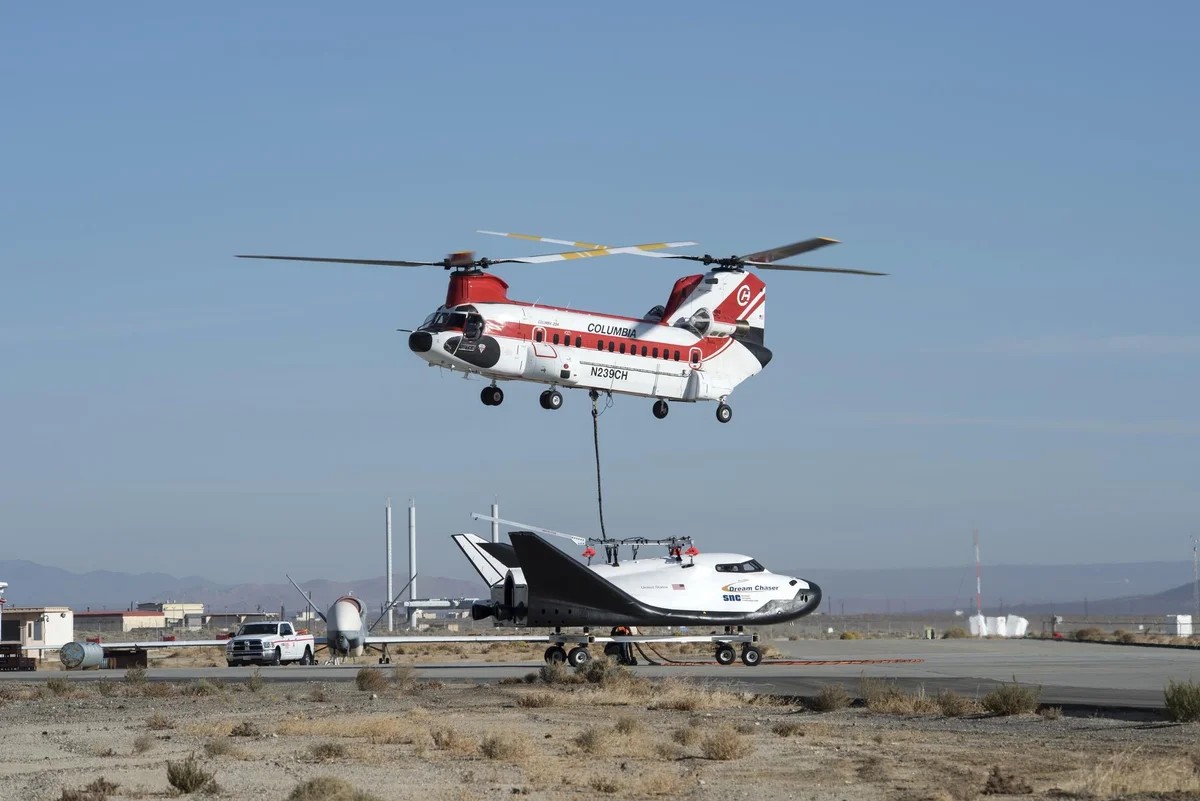
The Dream Chaser, a commercial space plane designed to bridge the gap between orbit and Earth, currently finds itself at a crossroads. Despite decades of development and a lineage tracing back to NASA’s early research, the spacecraft was conspicuously absent from NASA’s recent “Ignition” briefing—a roadmap focused heavily on the agency’s ambitious return to the Moon.
As NASA pivots toward lunar exploration, the Dream Chaser faces a landscape of shifting priorities, intense competition, and a fundamental question: does the world still need a space plane?
A Long Road to Orbit
The concept of a reusable space plane has long been a cornerstone of aerospace ambition. NASA’s Space Shuttle program proved the viability of orbital flight, but its high costs and safety concerns eventually led to its retirement in 2011. The Dream Chaser project was born from the ashes of that era, evolving from NASA’s 1980s HL-20 design into a private venture spearheaded by SpaceDev and later acquired by Sierra Nevada Corporation.
Now operated by Sierra Space, the project has faced a grueling development cycle. The spacecraft has struggled with several technical hurdles—most notably heat shield issues—and has missed multiple deadlines. While an unpiloted demonstration flight is tentatively targeted for later this year, many analysts wonder if this will be the project’s final attempt to prove its worth.
The Competitive Challenge: Capsules vs. Planes
The primary obstacle for the Dream Chaser is the success of more conventional technology. While the Dream Chaser offers the “gentle” landing of an aircraft, the industry has largely moved toward capsule-based systems, which are often simpler and more cost-effective.
The economic math is a significant hurdle:
* SpaceX’s Dragon: Costs approximately $90,000 per kilogram to reach the ISS.
* Northrop Grumman’s Cygnus: Costs approximately $130,000 per kilogram.
* Dream Chaser: Theoretically could drop costs to $40,000 per kilogram due to its high cargo capacity (up to six tons per module), but these savings rely on a high frequency of flights that have yet to materialize.
With NASA’s focus shifting toward the Moon—an environment where aerodynamic flight is useless—the “utility gap” for a space plane is widening.
Potential Lifelines: Defense and Commercial Stations
Despite these headwinds, the Dream Chaser is not without potential niches. Sierra Space has begun pivoting toward national security and defense applications, a move backed by a recent $550 million funding round.
The military interest in space planes is driven by their unique capabilities:
1. Precision Landing: The ability to return to a runway like an airplane allows for the recovery of sensitive payloads.
2. Strategic Maneuverability: The U.S. Air Force already utilizes the secretive Boeing X-37B, and China is developing its own Shenlong space plane, signaling a global interest in orbital maneuvering.
Furthermore, the future of the International Space Station (ISS) offers a glimmer of hope. If the U.S. Congress extends the ISS’s lifespan toward 2032, NASA will require new resupply contracts. There is also the prospect of the Orbital Reef commercial space station—a project involving Sierra Space and Blue Origin—where the Dream Chaser could serve as a primary transport vehicle for private orbital habitats.
“If Sierra Space can demonstrate Dream Chaser’s design and make it cost-effective, I believe there will be many commercial markets that will emerge.”
— Phil McAlister, former NASA project manager
Conclusion
The Dream Chaser’s future depends on whether it can transition from a legacy NASA concept into a specialized tool for national defense or commercial orbital stations. If its upcoming demonstration flight fails to prove its economic and technical viability, the era of the commercial space plane may end before it truly begins.