In the complex world of biological mimicry, animals often evolve to look like something else to survive. While we are familiar with insects that look like leaves or spiders that resemble ticks, a newly discovered strategy by the European blister beetle adds a sophisticated olfactory layer to the evolutionary playbook: chemical mimicry.
The Art of the Floral Deception
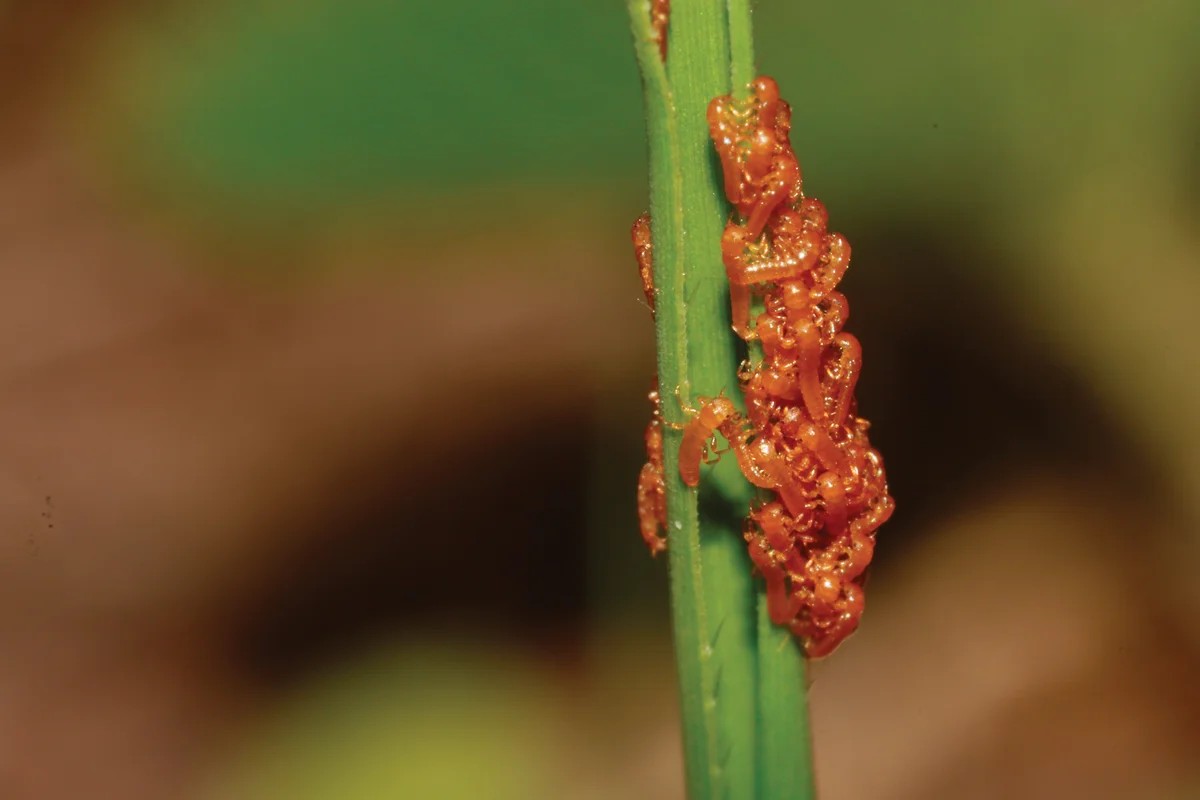
Every spring, the European blister beetle produces thousands of eggs. When these hatch, they emerge as bright-orange larvae that employ a highly specialized survival tactic. Rather than searching for food on their own, these larvae climb flower stems and cluster together in groups.
Recent research led by chemist Ryan Alam at the Max Planck Institute for Chemical Ecology has revealed why these clusters are so effective. The larvae do not just sit there; they actively emit a distinctly floral scent.
By releasing a cocktail of 17 different scented compounds —including linalool oxide and lilac aldehyde—the larvae effectively “smell” like the very flowers the bees are looking for. This makes them the first known animals to use scent mimicry to impersonate flowers.
A Parasitic “Free Ride”
The goal of this olfactory trick is to deceive solitary bees. The process works as follows:
- Attraction: The floral scent draws a passing bee toward the larval cluster.
- The Hitchhike: Using specialized hooklike appendages, the larvae latch onto the bee.
- Infiltration: The bee, deceived by the scent, carries the larvae back to its nest.
- The Payoff: Once inside, the larvae feast on the bee’s most precious resources: eggs, pollen, and nectar.
The larvae remain in the safety of the nest until they pupate, eventually emerging as adults to begin the cycle anew.
Beyond Attracting Hosts
The study, recently shared on the preprint server bioRxiv, suggests that this scent serves a dual purpose. Beyond deceiving the bees, the “perfume” appears to act as a social signal for the beetles themselves. The chemical trail helps other larvae find one another, allowing them to form the dense, flower-like aggregations necessary to maximize their chances of being picked up by a host.
While many species use visual mimicry—such as the orchid mantis, which looks like a petal—or olfactory mimicry for different ends—such as the corpse flower, which smells like rotting meat to attract flies—the blister beetle’s ability to mimic a sweet, floral aroma is a unique and highly specialized evolutionary feat.
“The beetle larvae are mimicking flowers chemically, and perhaps visually, so as to deceive and attract bees,” notes evolutionary biologist Jim McLean.
Why This Matters
This discovery highlights how deeply “sensory deception” is embedded in nature. It raises fascinating questions about how much of the animal kingdom’s behavior is driven by invisible chemical signals that humans are only just beginning to decode. It also underscores the intense evolutionary arms race between pollinators and parasites, where even the smell of a flower can become a weapon for survival.
Summary: By chemically mimicking the scent of flowers, European blister beetle larvae successfully trick solitary bees into transporting them to nutrient-rich nests, marking a rare and sophisticated instance of olfactory mimicry in the animal kingdom.