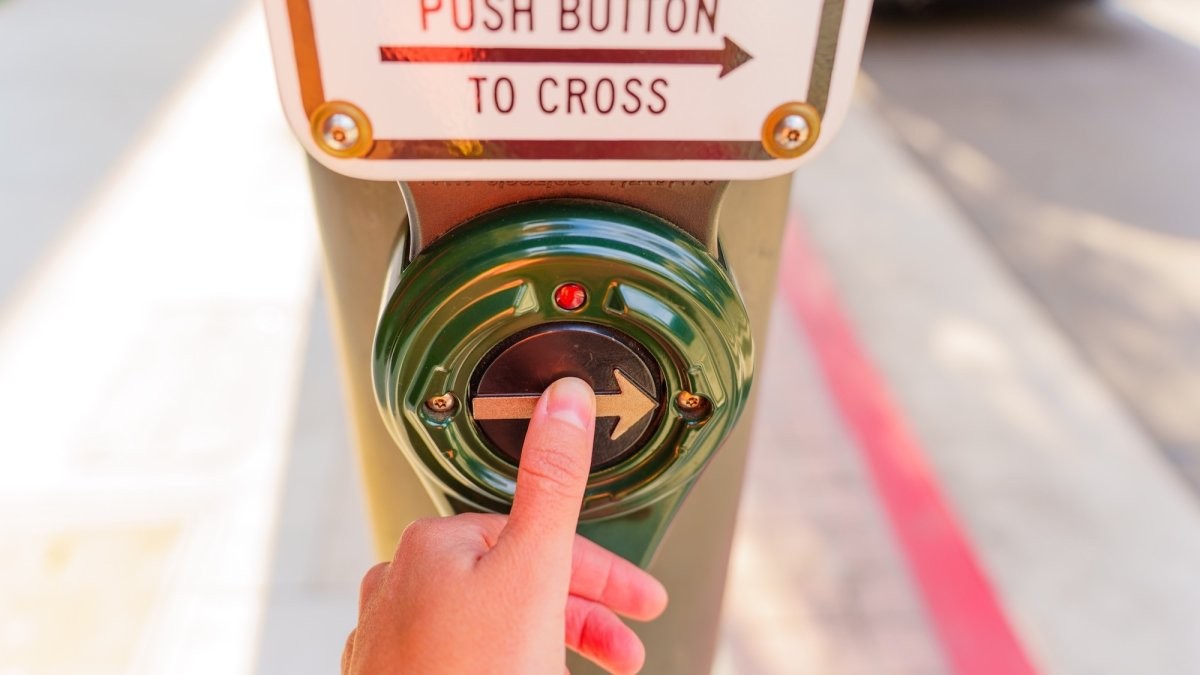
Three buttons. None of them do what you think. You push them with intent. The world pretends to listen.
Placebo buttons are everywhere. Some exist because of lazy engineering. Others are planted to sell you the illusion of control. It’s hard to spot them. They blend in. They feel real under your finger. But the machine doesn’t care.
The crosswalk dilemma
In New York, a city official admitted only about 100 of its 1,000 pedestrian buttons actually work. In Boston? The downtown buttons are dead weight. London’s central lights ignore your taps during peak hours. They run on a strict timed routine. Press the button all you want. Nothing changes. At night, though, traffic dies down and the buttons might actually trigger a cycle change.
Why? Efficiency.
Modern traffic engineering chases a steady flow. Cars should hit greens. Pedestrians are secondary in that equation. In dense downtown cores, constant manual triggers would shatter that rhythm. So they automate it.
Suburbia is different. If you live where foot traffic is sparse, the button probably does something. The light stays red until someone asks. The problem? You never really know which zone you are in. If the light turns green after you press, your brain credits your thumb. Confirmation bias in action.
The only way to know is to wait. Long enough to prove yourself wrong. Or right. Which nobody has time for.
Most people just press it. It feels good to act. If it worked, fine. If not, ignorance is bliss.
Elevators that wait for you
Hit the close door button. Nothing happens. The doors hang open. You tap again. Frustration mounts.
In the US, this isn’t a malfunction. It’s the law. The Americans with Disabilities Act passed in 1991 mandated specific open times. Elevator doors must stay open for a minimum of three seconds after a call. More distance from the hall button? More time. Calculated based on a walking speed of 1.2 feet per second. If the button is far away, the door waits for six or seven seconds. Non-negotiable.
So the close door button? Useless for the first few seconds. Some systems disable it entirely for the whole wait period. Others simply ignore the input until the timer expires.
Why keep a button that does nothing? Psychology. We hate feeling helpless in metal boxes.
Does it stop guys from mashing the button? No. It never stops them.
The thermostat deception
Your office is too cold. Or too hot. You adjust the dial. Satisfaction?
A 2003 Wall Street Journal investigation sparked the rumor. One HVAC installer claimed 90 percent of corporate thermostats were fake. That number is inflated. Most experts peg it under two percent. But here’s the twist. Fake ones do exist.
Why install a prop? Silence the complaints.
Vaughn Langless, an electrical inspection contractor, admitted installing dummy units to stop service calls. He quoted a client who installed fakes after staff whined about temperature. “Our service calls disappeared,” Langless said. “The system hasn’t changed since 1988.”
It works. Not for comfort. For peace of mind.
Research backs the absurdity. A famous 1976 nursing home study showed residents given control over trivial things—planting flowers, choosing TV times—were healthier. They even died at lower rates than the group told to “wait for instructions.” Agency matters. Even fake agency.
Designers know this. They give us a button that looks like power. Real control costs money. Complex HVAC systems cost money. A plastic plate? Cheap.
Is it brilliant design or manipulative nonsense? Depends who you ask. The button is right there. Ready to press. You’ll probably push it. You’ll feel something happen. You won’t check the wiring.