The Flyby
It was just hours away. Eclipsing the view. Swallowing the probe. But NASA’s Psyche spacecraft paused, pointed a lens, and snapped a souvenir.
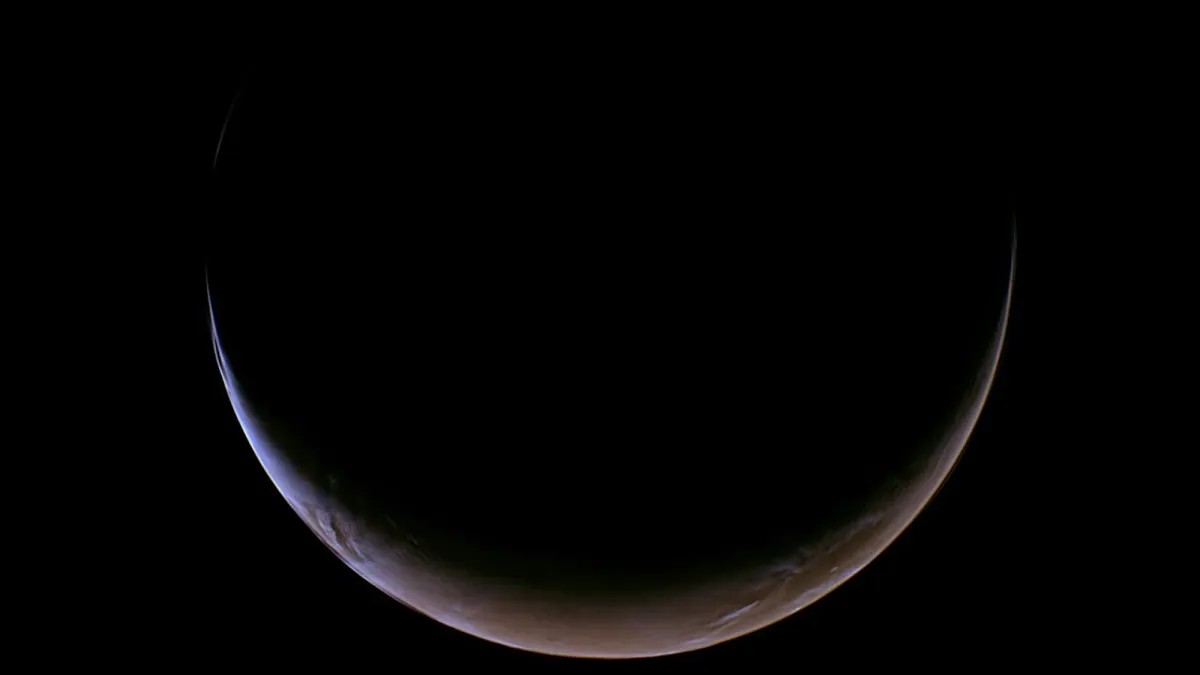
Released on May 20, the image shows Mars in all its eerie glory. A thin, glowing slice of red. Ethereal is the word the press release used, sure. But looking at it, you just see a ghost. A warning, maybe. The probe barely made it past the planet. A 3,600-pound speck of metal surfing the gravity of a giant.
2,800 miles. That’s how close it got to the surface. At 12,330 miles per hour? Don’t blink. If you blink, you’re gone. This was the gravity assist. The cosmic slingshot that kicked the 2.2-billion-mile journey into gear. Without this hug from Mars, the trip would take forever. Or it wouldn’t happen at all.
“The fingernail slice… looks brighter and wider than expected.”
That brightness isn’t just light. It’s dust. Martian atmosphere scattering photons like confetti. High phase angle. The spacecraft came in hot, looking sideways at the planet, and caught this crescent moon moment.
What You’re Actually Seeing
Your eyes wouldn’t see it this way. The raw data? A mess. Unfiltered sensor noise. Bland. Useless to us carbon-based creatures who like color. So, the team at NASA fixed it. They took the red, blue, and green filter data and mixed it. Natural colors. Almost. It’s a reconstruction of reality. A polite lie that helps you understand where you are in space.
Is it real? Sort of. The brightness is real. The crescent is real. The fact that Psyche is now sailing toward a completely different world? Absolutely real.
Launched last October. Heading to 16 Psyche. A 140-mile-wide hunk of metal sitting out in the asteroid belt. Maybe Jupiter’s neighborhood. It might be a planet that got peeled. The crust stripped away, leaving just the core. The iron heart. Psyche will land by 2029 if it stays on course. It’s going to check the magnetic field. Scan the chemistry. Touch the ancient rock.
For now, Mars is just a waypoint. A photo op. A beautiful, dusty obstacle in the sky that pushed the ship further than its engines alone ever could.
We love a good photo. It grounds the impossible in something pretty. But out there, nothing is soft. It’s just physics and time, moving very, very fast.
Where are we heading next? Nobody’s asking. The ship keeps moving.