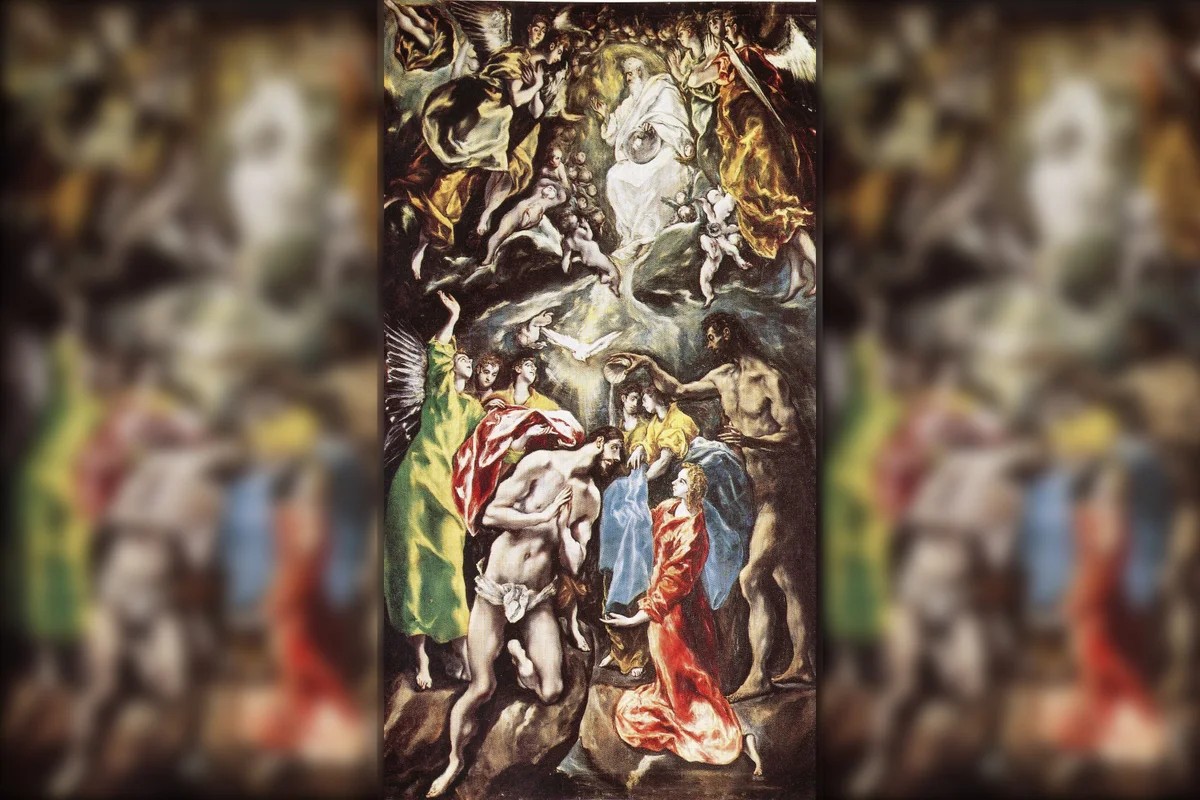
New research utilizing artificial intelligence may have just overturned decades of art historical consensus regarding one of the Spanish Renaissance’s most enigmatic works: El Greco’s The Baptism of Christ.
For years, scholars have operated under the assumption that this monumental painting was unfinished at the time of the master’s death in 1614, likely completed by his son, Jorge Manuel, and various workshop apprentices. However, a recent study suggests a different reality—that the painting may be far more cohesive and largely the work of El Greco himself.
The Microscopic Detective Work
Traditional art history relies on “connoisseurship”—the ability of experts to identify an artist’s hand by analyzing brushstroke styles and textural patterns. While effective, this method is subjective and can lead to disputes over whether a work is a “solo masterpiece” or a “workshop product.”
To move beyond human subjectivity, researchers led by Andrew Van Horn of Purdue University turned to machine learning. Their approach involved:
– Microscopic Analysis: Examining the texture of paint at the resolution of a single paintbrush bristle.
– Pattern Recognition: Using an AI model trained on student paintings to detect “signatures” in how paint is applied.
– Comparative Testing: The AI compared The Baptism of Christ against Christ on the Cross with Landscape, a work widely accepted as being solely by El Greco.
While the AI confirmed that Christ on the Cross was the work of a single hand, its analysis of The Baptism revealed an underlying uniformity across segments previously thought to be the work of different artists. On a microscopic level, the “hand” of the painter appeared much more consistent than the naked eye could perceive.
Why This Matters for Art History
In the Renaissance, the “workshop model” was the industry standard. Masters would direct apprentices to mix pigments, stretch canvases, and fill in secondary details. Distinguishing between a master’s brush and an apprentice’s mimicry is one of the most difficult challenges in the field.
If the AI’s findings hold true, it suggests two fascinating possibilities:
1. Technical Variation: El Greco may have used different tools or brushes for different parts of the composition.
2. Physical Decline: The variations seen by the human eye might actually be the result of the artist’s aging hands, rather than the presence of other painters.
“What helps us is that we can look at a really fine scale, and so we’re able to see some things that maybe you can’t see with the naked eye,” says lead author Andrew Van Horn.
A Note of Scientific Caution
Despite the excitement, the scientific community is urging tempered expectations. Experts from MIT and the University of Oregon have pointed out several critical limitations in the current study:
– Small Dataset: The AI was trained on a relatively small sample of 25 student paintings, which may not capture the complexity of centuries-old masterworks.
– The Mimicry Problem: Apprentices were specifically trained to mimic their masters, making “signature” detection incredibly difficult.
– Environmental Factors: Centuries of conservation, physical damage, and aging can alter paint texture, potentially confusing the AI.
The Future of Art Attribution
The goal of this research is not to replace the art historian, but to provide them with a more powerful lens. Van Horn envisions a future where AI can track “phantom” artists—apprentices who move between different workshops—by identifying their unique, microscopic “fingerprints.”
If these findings are validated through larger, more diverse datasets, they could fundamentally shift our understanding of El Greco’s final years and the true value of the works produced in his studio.
Conclusion: While AI has provided a compelling new lead suggesting The Baptism of Christ is largely a solo work by El Greco, further large-scale validation is required before historians can officially rewrite the textbooks.