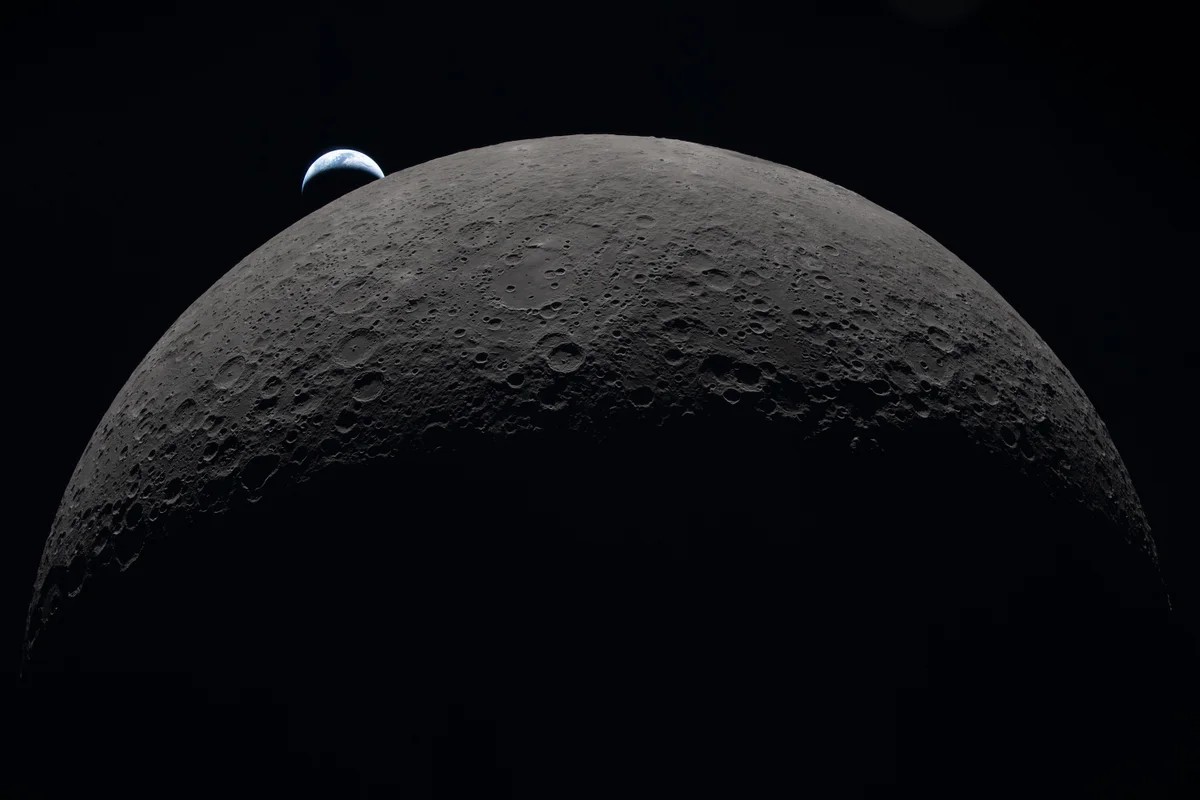
I love looking at it. Familiar? Sure. But also strange. Those dark spots aren’t shadows. They are scars from impacts that happened billions of years ago. Ancient wounds frozen in time.
What happens next? In the deep, distant future.
It depends on how the moon got here. And where we go from here. The sun has final say.
Born from Chaos
We know the story. It’s well-documented in the rock record. Not long after Earth formed, something massive hit us. A planet-sized object. A glancing blow. It didn’t crush the Earth. It knocked off chunks of debris. A mix of us and the attacker. That debris clumped together. The moon.
Back then. The moon was close. Too close. About 20,000 km away. Half its current distance. It would have looked huge. Roughly 10 degrees across. Like holding your fist at arm’s length against the sky. Intimidating. Bright.
But gravity doesn’t let you stay put.
The Tidal Lock
Earth pulled. Hard. Tides. Not just water. Tides in rock. The side of the moon facing us gets pulled harder than the far side. It stretches the satellite. Subtle egg shapes. Bulges.
The moon was spinning fast. Inertia kept those bulges ahead of the straight line to Earth. Earth grabbed the bulge. Yanked it back. Slow rotation. Lengthy days. Energy transferred. Orbital speed up. Distance increases.
Fast at first. Then slower. Eventually? Spin matches orbit. One face only. We see the same side today because the moon forgot how to rotate any faster than it travels around us.
Tidal locking isn’t an end state. It’s just a pause in the conversation between gravity and momentum.
Earth gets tides too. The moon pulls our oceans. Our spin sweeps the ocean bulge ahead of the moon. The moon pulls back. Friction. Earth slows. Days get longer. Two milliseconds per century. You won’t need an alarm clock adjustment. Yet.
But this pushback helps the moon move away. Four centimeters a year. Steady. Quiet. Inevitable.
The Boiling Point
So. Simple math, right? The moon keeps receding. Slower and slower. Until Earth stops spinning relative to the moon. Tidal lock between planet and satellite. No more rising or setting for the moon. Just a frozen companion in the sky.
If we lived that long.
We probably won’t.
Oceans make this work. Water absorbs energy. Sloshes around. Creates friction. No water. No friction. The process stalls.
And the oceans? Gone. In a billion years.
The sun is aging. Getting brighter. Fusion creates helium ash. Ash builds up. Pressure increases. Temperature rises. Light intensifies. Earth heats. Water boils away. A barren rock.
No oceans means the moon stops moving away efficiently. The timescale stretches. Billions more years needed for tidal lock. Time we don’t have.
The End of the Sun
Six or seven billion years out. The sun runs out of fuel. Core collapse. It swells. A red giant.
Will it eat the Earth? Scientists argue. It hardly matters. We burn anyway. Cooked. Dry. The fate of the moon is the last thing on our mind when our atmosphere ignites.
Later. Much later. The sun sheds its skin. Half its mass vanishes. What’s left? A white dwarf. Small. Dense. Cooling slowly over eons.
Does the story end? No. The sun creates tides too. Right now, they’re half the strength of the moon’s tides. Later? Complex physics. Mass is lower. Tides are weaker. But time is infinite. Or close to it.
The white dwarf’s tides might destabilize everything. The moon could break free. Or crash into the Earth.
Does it matter? We are gone. The Earth is a broiled shell. The sky is dark except for a fading star.
Which outcome happens? Who knows. Tens of billions of years away. A tick on a clock that will never run down.
Look up tonight. Enjoy it.