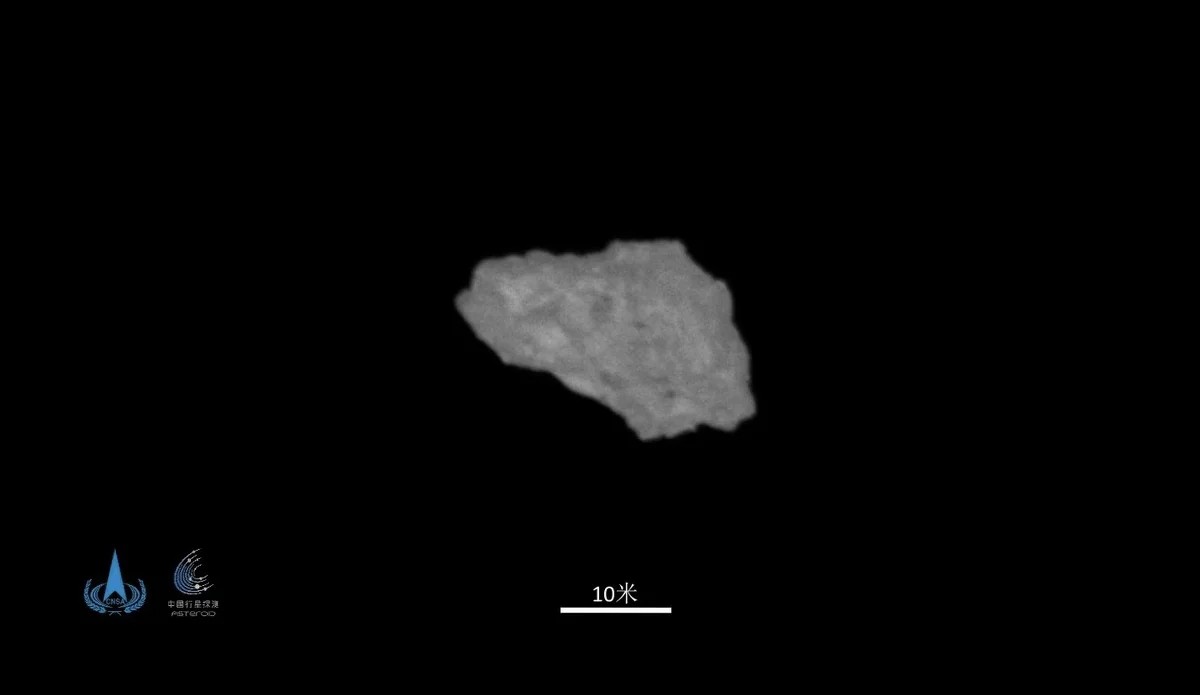
A Chinese ship just beamed back the first photo of it.
Tianwen-2 is on the move. The target? Kamo‘oalewa. It’s one of those strange space rocks that hangs around Earth but technically orbits the Sun. Astronomers call them quasi-satellites. There are only eight known ones. They follow our planet like shadows.
Some scientists love the nickname. “Mini moon.” Quasi-moon. It sounds cozy, almost friendly.
The reality is messier. Kamo‘oalewa might be a chunk of our actual Moon, blasted out by some ancient impact event. A cosmic refugee. James Webb data suggests otherwise, of course. The evidence is split. It creates a nice debate, even if the rock itself isn’t participating.
China didn’t wait around for the paperwork to settle. They built a probe. It traveled for 400 days. Around 621 million miles of empty space. Just to say hello to this 66-foot rock. It’s bigger than a school bus. It spins on its axis once every 28 minutes. Discovered in 2016. The probe launched May 28, 2025. It returns the payload in 2027, dumping it right into the atmosphere.
Getting samples is hard work. There is no single button. Tianwen-2 has three plans, ready to go.
- A touch-and-go approach, similar to what NASA’s OSIRIS-REx or Japan’s Hayabusa2 did.
- Anchoring itself directly onto the rock, drilling down for surface and subsurface bits.
- Hovering nearby and using a robotic arm to scoop material from above.
By late June, the probe was twelve miles away. That’s close. Closer than you can drive to the moon, metaphorically speaking.
The China National Space Administration was pleased. Or at least, their statement said so. They’re mapping the morphology and structure now. Checking the internal layout. Building a case for where to drill.
The probe will progressively conduct more detailed scientific explore to acquire data… laying the groundwork.
Routine stuff, until it isn’t.
Here is the part they don’t put in the headlines usually.
Once the samples drop, Tianwen-2 doesn’t retire. It has more travel in it. A long jump to comet 311P/PanSTRSSR. It will go there and observe. Watch it. Maybe understand it a little better.
We keep sending machines into the void. We grab pieces of rock and comet ice. We bring them back. Or we look at them from far away.
Kamo‘oalewa keeps spinning. The Earth keeps turning. The photo was taken, but the question of where that rock truly came from? It lingers. Just like the rock itself.