


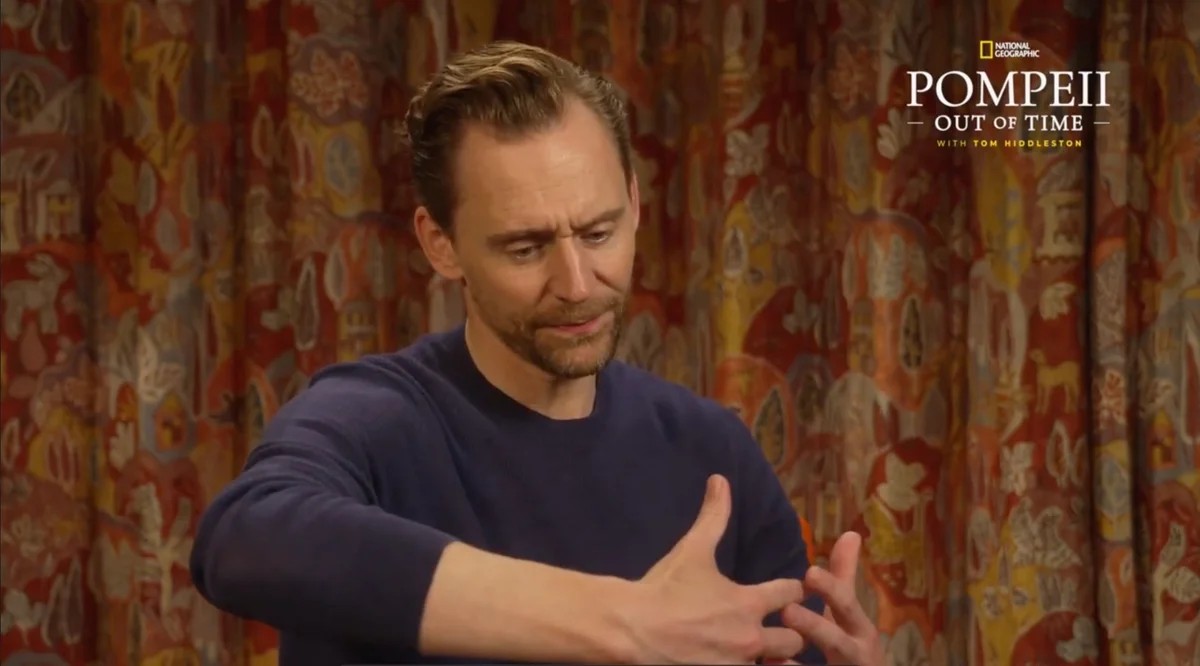
It is easy to view Pompeii as a ruin. A tourist trap with good wifi and bad coffee. Tom Hiddleston sees ghosts. Not the spectral kind that rattles chains. The living, breathing humans who died in AD 79.
He was seventeen when he first visited the site. His friends were studying art history. He was grinding through Latin and Greek. He loved the ancient world because it felt distant yet impossibly close. The architecture, the politics, the theater—it is the bedrock of the Western mindset. But Pompeii is different. It is a thriller with a volcano.
The past is a living, breathing thing… as if the volcano erupted last week.
That compression of time hit him hard. Two thousand years vanished. It felt like yesterday.
What the plaster casts reveal about human loss
Here is the hard part. Pompeii is not just history. It is a mass grave.
Hiddleston talks about the plaster casts in his new docuseries. These are not artifacts. They are negative spaces where bodies once lay. Ash poured in. It hardened. The bodies rotted or burned away. The shell remained. Then archaeologists poured plaster in. What you see is the final pose. The last moment.
It is complicated to visit. You walk through streets that were once busy markets. Now you see people frozen in pain.
Hiddleston recalls one specific cast. An adult. A child. They are locked in an embrace. The adult—presumably a parent—is wrapping arms around the kid. Trying to shield them. It is an intimate image of protection. It breaks you.
Next to them? A dog.
Hiddleston had a dog at seventeen. That detail bridged the gap. These are families. Just like us.
The casts are shapes of human beings. Real lives. He wanted the show to communicate that these were ordinary people. Not statues. Not symbols. Real people living through an extraordinary moment.
Why does this matter? Because empathy requires connection.
How ancient Romans lived just like modern families
We change technologies. They didn’t have smartphones. No airplanes. No internet. But they had families. They cooked. They slept. They had pets. They had jobs. They had teachers and pupils. They played in playgrounds.
The essential essence of being human hasn’t shifted.
When you see handprints from young kids on walls, it lands. Or the bread baking in the oven found in Herculaneum. That place is just over the hill. The pyroclastic surge—waves of ash, pumice, molten rock—preserved it perfectly. You can sense who they were.
Hiddleston studied the classics to feel less alone. It turns out he is right. The hopes and fears of a Roman citizen are not alien. They are ours.
Sure, our technologies have changed… but they lived and they loved, and they took after each other.
Why some chose to stay in Pompeii during the eruption
Did everyone run? No.
Why do people stay when the sky turns black? Fear? Confusion? Faith?
In the documentary, Hiddleston discusses the goddess Isis. She was a cosmic creator. A mother figure. A protector. She could embody all the gods.
Caitie Barrett, an expert featured in the series, points to this religious devotion. If you believed Isis kept people safe, you might not leave. She was the god you wanted on your side during a disaster.
It changes the narrative. It is not just ignorance. It is faith. A desperate bet that the divine will intervene.
The intersection of ancient history and modern curiosity
Hiddleston opens a magazine. Scientific American. He is looking at ancient Roman roads. Athens. Byzantium. Thessalonica. Antioch.
He gets excited. “Wind me up and I just get going.”
The magazine also has quantum physics. His favorite word. The show is about time, right? The past compresses. The present accelerates. The future looms.
He is a bridge. Between the ash and the atom.
The human condition remains static even as our tools evolve. We still look for safety. We still hold our children. We still bake bread.
Pompeii reminds us that we are not special. We are continuous. The ash preserves more than bone. It preserves the fragility of our own existence.
And maybe that is enough.


