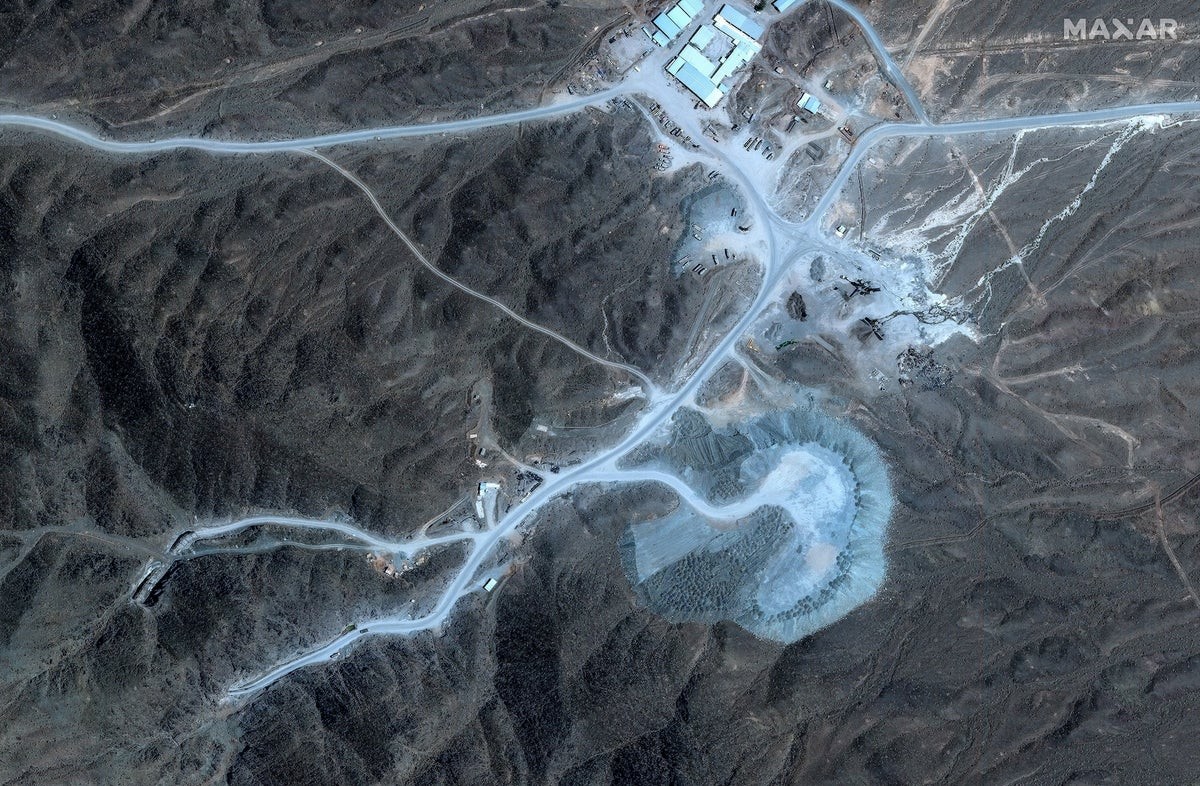
President Donald Trump threatens to bomb Pickaxe Mountain. The target is clear. Subterranean tunnels house Iran’s nuclear centrifuges nearby. But the earth itself fights back.
Geology offers a shield here. Just as the Strait of Hormuz acts as a choke point for trade due to its narrow shape, the rock structure of this mountain provides massive protection for sensitive equipment. Both features stem from the same ancient collision of continents.
How Plate Tectonics Built Iran’s Natural Fortress
Pickaxe Mountain sits in central Iran. Roughly 77 miles north of Isfahan. It lies inland from the Zagros Fold-Thrust belt. That range runs along the Persian Gulf coast in long, wrinkled lines. The belt and the mountain formed because the Arabian Plate smashed into the Eurasian Plate.
This collision didn’t just build mountains. It shaped the Strait of Hormuz too. Making it vulnerable to Iranian control. The story of Pickaxe Mountain, known locally as Kuh-e Kolang Gaz La, starts even earlier in that process.
An ocean called the Neo-Tethys used to separate the two plates. It subducted under the Eurasian Plate. Like a conveyor belt. It pulled the Arabian Plate into its current spot. That motion created the Urumieh-Dokhtar Magomatic Arc. Pickaxe Mountain is part of that arc.
“It’s basically a volcanic arc above a subdration zone,” says Richard Walker. He is a tectonics professor at Oxford. He has studied this area extensively.
When oceanic crust dives under a continent, water-rich rock triggers melting. Magma forms. It rises. It becomes volcanoes. You see this in Alaska. The Pacific Plate slides under North America there. It created the most active volcanoes in the U.S.. Mount St. Helens is another example. So are the Andes in South America.
Pickaxe Mountain isn’t active anymore. Subduction stopped there 30 million years ago. The Neo-Tethys Ocean closed. The plates butted heads. But farther south in Iran and Pakistan, volcanoes still erupt. Subduction continues in the Arabian Sea there.
Why Andesite Rock Defeats Bunker Busters
The rock here matters. Pickaxe Mountain is made of andesite. This tough volcanic rock gets banded with limestone. That limestone was laid down at the edges of the lost Neo-Tethys ocean. Andesite shares its name with the Andes mountains. Same rock. Same reason it exists.
On the Mohs hardness scale, andesite scores a 7. Quartz is also a 7. A steel nail is softer. This rock resists impact.
Iran started digging tunnels under Pickaxe Mountain in 2020. The goal was to replace the centrifuge facility damaged at Natanz. That site was hit in July 2020. An explosion caused serious damage. Likely a covert Israeli attack. The facility was hit again in 2021.
The new tunnels sit more than 300 feet underground. The Institute for Science and International Security confirmed the work. The andesite creates a shield over 5,000 feet thick. That is hard to penetrate.
Consider the U.S. GBU-57 Massive Ordnance Penterator. The “bunker buster.” It can punch through hundreds of feet of soft earth. Clay or loose dirt. But hard rock stops it. In andesite, it might only dig a few dozen feet deep.
Which Vulnerabilities Remain for Nuclear Facilities
So is the site invincible? No. Weak points remain. Human-made ones. Ventilation shafts. Tunnel entrances. These are the targets.
The Institute suggests attackers must aim for these spots. To damage hidden equipment. This strategy worked in June 2025. Bombings at Natanz and the Fordow nuclear site damaged centrifuges there.
Iran’s highly enriched uranium likely stays sealed now. Buried under rubble from the bombing runs. The tunnels are deep. The rock is hard. But the air still has to move in.
Will the next strike find the vents? Maybe. Or maybe the mountain will keep holding its secrets.