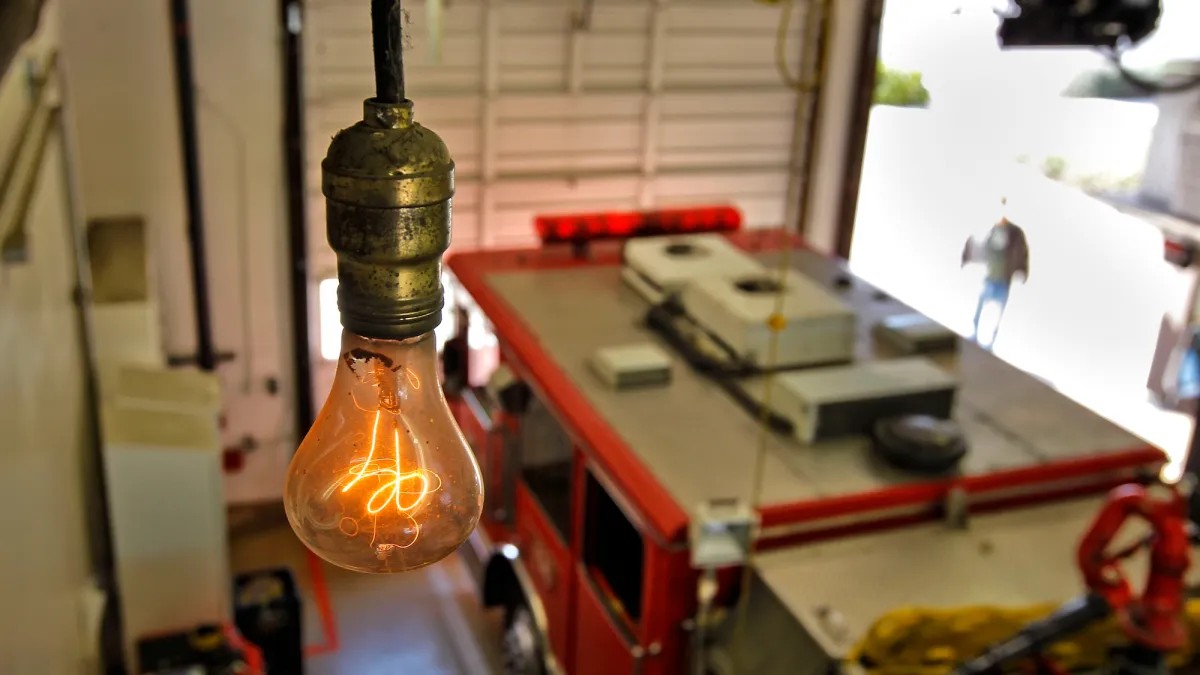
It was summer in Livermore, California. Inside fire station #6, people gathered. They sang “Happy Birthday.” The recipient was a light bulb.
This isn’t a prank. It’s the Centennial Light. It has burned for 125 years.
Conspiracy theories love this bulb. They want it to prove a point about corporate villainy. They want to blame the Phoebus Cartel for ruining everything. But physics doesn’t care about your plot twist. The truth is simpler, and weirder.
The Myth of the Conspiracy
Let’s clear the air first. The Phoebus Cartel did exist. Formed in 1925, it included giants like General Electric and Philips. They fixed prices. They standardized lifespans. They capped bulbs at 1,000 hours.
Critics say the Centennial Light proves this was sabotage. A bulb lasting 1.5 million hours? That’s not a product. That’s a loophole. They argue that if GE didn’t artificially limit life, we’d all be living in eternal, cheap brightness.
But that ignores how incandescence actually works. It ignores the heat.
Heat Is the Enemy
Early bulbs were handmade luxuries. Artisans at Shelby Electric Company in Ohio tried to make them last. They used tungsten wires in airtight glass. Basic stuff, right?
Here’s the problem. To get white light, you need heat. Real heat. About 5,700°C. That’s hotter than the sun’s surface. Tungsten melts at roughly 3,422°C. You can’t just crank up the dial. If the filament gets too hot, it evaporates. The wire breaks. The light goes out.
There’s a trade-off. More brightness means faster death. Dimmer light means longer life. Manufacturers had to balance the two. You couldn’t have both peak efficiency and peak longevity in the same package. Not back then.
A Happy Accident
So, what is the Centennial Light?
It’s a 60-watt bulb that draws four watts.
Four watts. It’s dimmer than a standard four-watt LED. Why?
Experts believe it’s an accident. Someone at Shelby Electric likely crafted a filament with absurdly high electrical resistance. High resistance means low current. Low current means less heat. Less heat means the filament doesn’t evaporate fast. It stays intact.
It was sold as a night light. A pilot light. Something you don’t expect to stare at directly.
The Centennial Light didn’t survive because it was engineered to last a century. It survived because it was never meant to be bright in the first place.
The Real Lesson in Planned Obsolescence
The Phoebus Cartel standardized 1,000 hours not to hide super-bulbs. They did it because ultra-durable bulbs were dim.
Imagine a bulb that lasts 10,000 hours but provides the light of a candle. People won’t buy it for their living rooms. They want illumination. They want value. A 1,000-hour bulb that provides bright, consistent light was the sweet spot for electricity costs and user satisfaction.
The Centennial Light isn’t an exception. It’s the extreme end of a spectrum nobody wanted for their main lighting. It’s a ghost bulb. A low-energy footnote in the history of electric light.
Moving On
We stopped relying on incandescent bulbs. Fluorescent came first. Then LEDs. They use less power. They last longer. They don’t get dangerously hot.
Did big corps play dirty? Sure. Price-fixing is dirty. Standardization isn’t inherently evil, though.
The Centennial Light remains a curiosity. It sits in a fire station, glowing softly. Not because it defeated corporate greed. But because it was built wrong in all the right ways.
It’s still on. Is anyone else still waiting for a better bulb? Maybe. But for now, the dimmest light wins the race.