Trigonometric identities are equations that connect different trigonometric functions. They hold true for every possible value of the angle. The only variable needed is the angle itself.
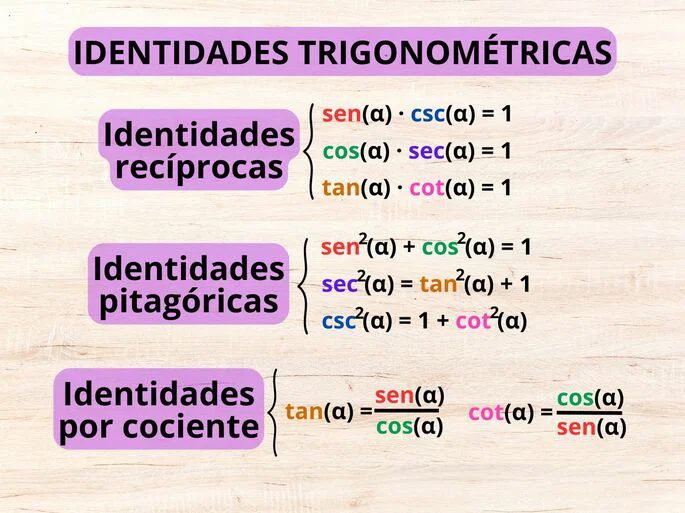
Take the relationship between sine and cosecant for an angle α.
sin(α) = 1 / csc(α)
This equation shows that sine is the inverse of cosecant, and vice versa. It works for any value of α. That universal validity is what defines it as an identity.
The Three Fundamental Categories
Most basic trig identities fall into three groups:
- Reciprocal identities : Show the inverse relationship between functions (like sin and csc, cos and sec, tan and cot).
- Pythagorean identities : Derived from the unit circle and Pythagorean theorem (e.g., sin²θ + cos²θ = 1).
- Quotient identities : Express tangent and cotangent as ratios (tan θ = sin θ / cos θ, cot θ = cos θ / sin θ).
Beyond these three core types, you can derive others depending on the specific functions and angles involved.
Why “Identity” Means It Works Everywhere
A common question is why do trigonometric identities apply to all angles? Because they are based on geometric and algebraic truths, not specific cases. The relationship sin(α) * csc(α) = 1 isn’t just true at 30 degrees or 90 degrees. It is structurally true for every real number α where the functions are defined. This makes them powerful tools for simplifying expressions and solving equations without plugging in numbers.
The key takeaway: if an equation between trig functions holds for every valid angle, it’s an identity. If it only works for certain angles, it’s just an equation.
How cofunction and parity identities simplify trig calculations
Once you have the basic reciprocals and Pythagorean links down, the next layer gets trickier. You need to know how angles relate to their complements and how functions behave when the sign flips.
Cofunction identities connect a trig function of an angle to the function of its complement. They work because sine and cosine, for instance, trace similar but shifted paths on the unit circle. If you know $\sin(30^\circ)$, you can find $\cos(60^\circ)$ without calculating anything new. The pairs are:
- $\sin(\theta) = \cos(90^\circ – \theta)$
- $\cos(\theta) = \sin(90^\circ – \theta)$
- $\tan(\theta) = \cot(90^\circ – \theta)$
- $\cot(\theta) = \tan(90^\circ – \theta)$
- $\sec(\theta) = \csc(90^\circ – \theta)$
- $\csc(\theta) = \sec(90^\circ – \theta)$
Then there is parity. This sounds fancy, but it just asks: is the function symmetric?
Even identities have symmetry across the y-axis. Flip the angle sign, and the value stays the same.
– $\cos(-\theta) = \cos(\theta)$
– $\sec(-\theta) = \sec(\theta)$
Odd identities lack that symmetry. Flip the sign, and the value flips too.
– $\sin(-\theta) = -\sin(\theta)$
– $\tan(-\theta) = -\tan(\theta)$
– $\csc(-\theta) = -\csc(\theta)$
– $\cot(-\theta) = -\cot(\theta)$
Why does this matter? Because it lets you handle negative angles instantly. No lookup table required.
Which sum and difference formulas solve for unknown angles?
Stuck on an angle like $150^\circ$? Don’t guess. Break it down.
Sum and difference identities let you split an unfamiliar angle into two you already know. If you know the values for $240^\circ$ and $90^\circ$, you can reframe $150^\circ$ as $240^\circ – 90^\circ$ and calculate from there. It’s not magic. It’s algebra with trigonometric functions.
The sum of angles formulas look like this:
– $\sin(A + B) = \sin(A)\cos(B) + \cos(A)\sin(B)$
– $\cos(A + B) = \cos(A)\cos(B) – \sin(A)\sin(B)$
– $\tan(A + B) = \frac{\tan(A) + \tan(B)}{1 – \tan(A)\tan(B)}$
The difference of angles formulas are nearly identical, just with a minus sign in the right spots:
– $\sin(A – B) = \sin(A)\cos(B) – \cos(A)\sin(B)$
– $\cos(A – B) = \cos(A)\cos(B) + \sin(A)\sin(B)$
– $\tan(A – B) = \frac{\tan(A) – \tan(B)}{1 + \tan(A)\tan(B)}$
These are workhorses. Use them when direct evaluation fails.
How do double-angle identities extend the sum formulas?
Double-angle identities are just a special case of the sum formulas where both angles are the same. Set $A = B$, and everything collapses.
If you’re stuck on $120^\circ$ but know $60^\circ$ cold, this is your exit.
– $\sin(2\theta) = 2\sin(\theta)\cos(\theta)$
– $\cos(2\theta) = \cos^2(\theta) – \sin^2(\theta)$
– $\tan(2\theta) = \frac{2\tan(\theta)}{1 – \tan^2(\theta)}$
You can extend these to the reciprocal functions too:
– $\csc(2\theta) = \frac{1}{2\sin(\theta)\cos(\theta)}$
– $\sec(2\theta) = \frac{1}{\cos^2(\theta) – \sin^2(\theta)}$
– $\cot(2\theta) = \frac{1 – \tan^2(\theta)}{2\tan(\theta)}$
They save time. They prevent errors. And they make the messy parts of trigonometry feel manageable, even if the notation looks intimidating at first.