Eric Lu didn’t just design a font. He built a trap.
It works on optical illusions, specifically ones that catch human brains but leave generative AI stumbling. Ghost Font isn’t a silver bullet for the copyright wars, sure. It doesn’t solve everything. But it’s an ingenious proof of concept. It reminds us that while algorithms are powerful, they are still fundamentally stupid in very specific, very human ways.
We’re currently in a weird limbo. Lawmakers are talking. The public is pushing back. Tech giants? They’re just plugging away, scraping the internet without asking for permission. Until actual legislation kicks in, we’re basically on our own to guard our words. Lu’s experiment shows what we can do on our own.
How it hides
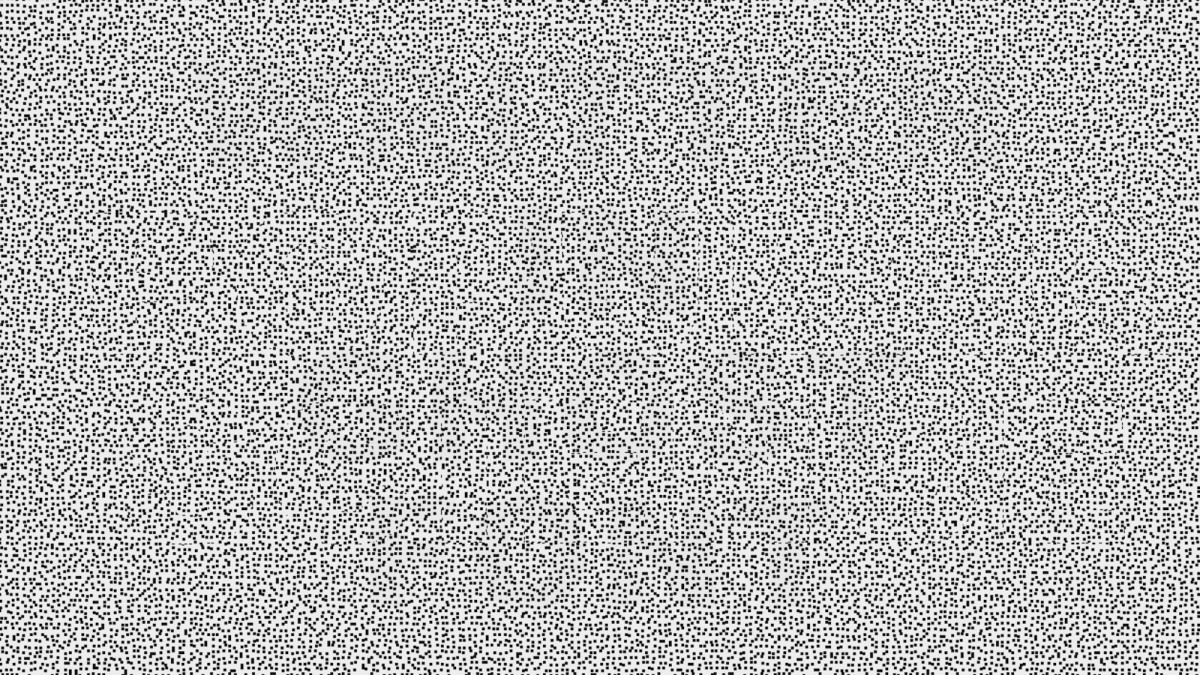
The mechanics are deceptively simple. You type a message. The software overlays that text into hundreds of moving dots in a quick video animation. Here’s the trick. The dots forming your letters move up the screen. The background noise of dots moves down. This creates a visual opposition your mind naturally detects.
Pause the video. What happens?
The words disappear. They get swallowed by the static clutter. To a still image—and therefore to the AI that usually scans frames one by one—the message is gone. AI processes videos like flipbooks. It looks at each individual page. It doesn’t feel the cumulative animation like you do. Humans see motion. Machines see data points.
“Humans will see the cumulative animation… but AI is still forced to lookat the image on each individual page.”
To double down, Ghost Font also injects a decoy text: “written in Ghost Font.” This sits in the static frame. The AI grabs that. It thinks, “Ah, got the text.” It misses the real message hidden in the motion completely.
Lu tested it against Anthropic’s Claude and OpenAI’s models. Both failed. They missed the boat entirely.
The limits of cleverness
Is it perfect? No. Lu admits it.
The font is useless for long essays. It handles short messages. If AI gets smart enough to analyze video as optical flow rather than distinct frames, the whole thing breaks. Then again, if AI can do that, it’ll probably just write your essays for you anyway. Who cares if it reads this font?
It’s also tough on the eyes. Staring at the dizzying animation for ten seconds causes headaches. It’s probably terrible for people with certain visual disabilities. But isn’t there a certain joy in watching a multi-billion dollar intelligence system get hoodwinked by some dots moving up instead of down?
Maybe. Or maybe it’s just a fleeting victory.
A small note before you go: Popular Science is owned by Ziff Davis. They filed a lawsuit against Open AI back in April 2025 over copyright infringement. So this article is coming from a place that isn’t just philosophical about the problem.