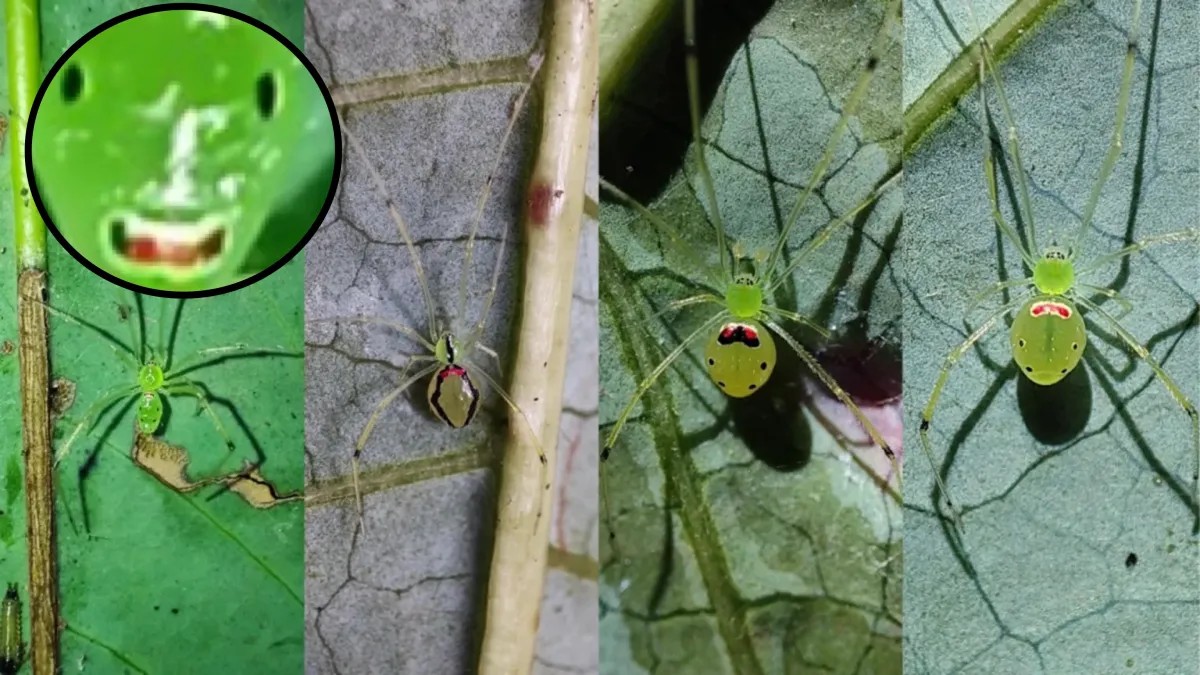
They look identical. That is the trick.
The Theridion grallator, better known as the happy-face spider, has been the star of Hawaiian ecology since 1900. Tiny, neon green, and grinning up from the leaves, it was assumed to be a lonely island resident. A unique biogeographic island. Until last year.
Now we know there is a clone. Not a clone, strictly speaking, but a mirror image found thousands of miles away on the steep, cold slopes of the Uttarakhand Himalayas.
Scientists gave it a fitting name: Theridion himalayans. Or, to the non-technical crowd, the Himalayan happy-face spider.
The discovery started with a distraction.
In 2023, researchers from India’s Forest Research Institute were up in the Himalayas. Their job was boring, or so they thought—cataloging ants. Ants are small. They get lost in the undergrowth. But every now and then, something with eight legs would interrupt the count.
Devi Priyadarshini, a biologist at the Regional Museum of Natural history, remembers the moment the work stopped and the shock set in. Her colleague, Ashirwad Tripathi, sent her a photo. A spider clinging to a Daphniphyllum leaf. High altitude. Remote.
Priyadarshini froze.
She had studied the Hawaiian specimen during her master’s. The patterns were unmistakable. The smiley dots. The stripes. She knew immediately they had stumbled onto a jackpot.
Over the next few months, Tripadi collected thirty-two more samples. All distinct individuals, yet all sharing that bizarre, cheerful coloration. Morphs vary, obviously, but the brand is the same.
Lab work confirmed what the eyes saw: these are not the Hawaiian spiders that somehow traveled. Genetic sequencing showed an 8.5% difference. That is significant. Enough to say they evolved completely independently. One lineage on an isolated volcanic chain, another in the heavy air of the mountains. Same design, different blueprints.
Tripathi chose the species name himalayans as a tribute. A nod to the range that guards the north and hides its secrets well.
So why the face?
Nobody knows for sure. The green bodies blend in with leaves. The faces? Maybe. Probably. Priyadarshini calls it a “deeper genetic mystery.”
There is a weirder link though. A coincidence that defies simple logic.
Both spider species love ginger. Not just any ginger, but the same type. Except ginger doesn’t belong in Hawaii. It is invasive there. How did an ancient arachnid line pick up a taste for a plant that wasn’t even in their home range originally?
Priyadarshini thinks the Himalayan spider might be an elder cousin. Older. The original source. The Hawaiian version the descendant that lost the map but kept the look.
It sounds like a stretch.
She calls it a tall claim. But they are going back. The hunt continues. There are missing links to find. Connections to map.
How does evolution keep repeating its favorite joke across an ocean?
For now, we just have the photos. Smiles in the grass. Smiles on the rocks.
Who is looking at whom?