We used to think we knew how supernovae worked. Massive stars explode. They leave behind neutron stars or black holes. Usually, the biggest stars are in pairs—binary systems bound by gravity.
So why had we never seen two supernovae born from a single binary system?
It wasn’t that they didn’t happen. They were just hiding. Specifically, they were hiding in plain sight inside the Jellyfish Nebula.
Finding the invisible second supernova in IC 443
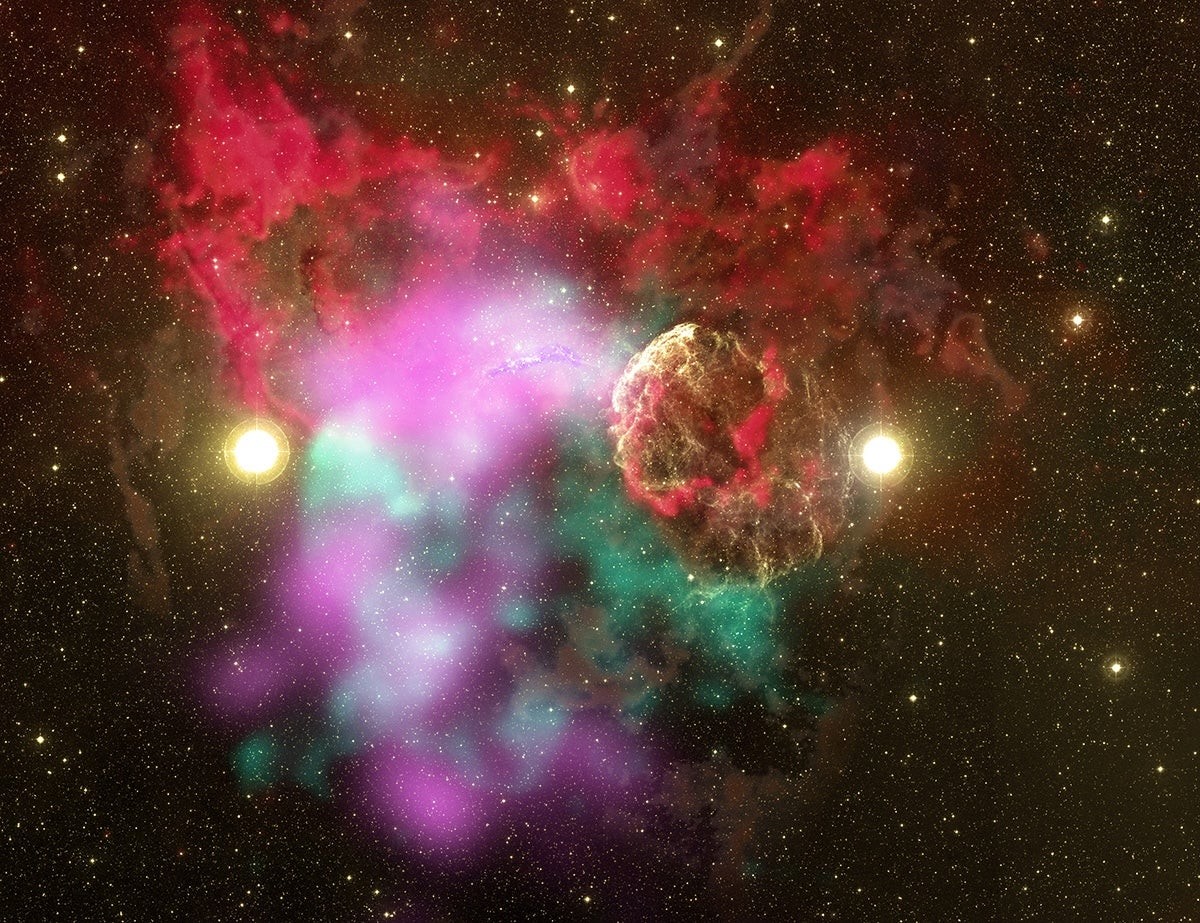
The Jellyfish Nebula’s real name is IC 443. It is one of the most famous supernova remnants in our galaxy. It shines brightly in X-rays. For decades, that brightness was a problem. It masked everything else around it.
There was another remnant nearby. It was faint. We called it G189.6+3. It lingered in the data but refused to confirm itself.
Astronomers look for supernova remnants by finding shock waves. These are the ripples left when a star’s core implodes and blows the rest of itself to pieces. Usually, you see this in radio signals or X-ray shells.
In 2023, a team used the eROSITA telescope. It is an X-ray telescope launched in 2018 (operating since 2019). They found a plasma shell heated to over eight million degrees Celsius.
That sounded like a second supernova. But the radio signal was missing. Or rather, it didn’t match the whole shell. It was ambiguous. Not a smoking gun. Just a shadow.
How gamma rays revealed the double explosion
The breakthrough came from looking higher up the energy scale.
Miltiadis Michailidis, an astronomer at Stanford, led a team using data from NASA’s Fermi Gamma-ray Space telescope. They dug into 16 years of archives. They weren’t looking for radio waves. They were looking for gamma rays.
They found a glow. It traced the X-ray shell perfectly.
This proved G189.6 was not just a weird gas cloud. It was a supernova remnant.
But there was a twist.
The northern part of this new remnant looked different. It emitted a different type of gamma ray signal. Most of G189.6 sat in empty space. Its glow came from electrons accelerated by the shock wave.
The northern part hit a wall. Specifically, the S249 H II region, a dense cloud of ionized hydrogen. Here, protons were accelerated, not just electrons. This specific interaction creates a distinct gamma-ray signature.
Here is the kicker: The S249 cloud was already known to be interacting with the Jellyfish Nebica (IC 443).
This meant G189.6 and IC 443 weren’t just visually close in the sky. They were physical neighbors. They occupied the same volume of space.
Why this binary supernova discovery matters
Why do we care about two dead stars next to each other?
It solves a long-standing theoretical puzzle.
Stars in binary systems evolve together. When the first, heavier star explodes as a supernova, the blast wave hits its partner. It kicks it out of orbit. The partner star flies off.
Later, that partner star also explodes.
If the time between the two explosions is short enough, you get two remnants that look like they are interacting.
Computer simulations confirmed this sequence. The two stars started as a pair. The first exploded. The second was sent flying. It traveled far enough to keep its remains separate from the first, but close enough that we can see the connection.
The explosions happened within a few thousand or tens of thousands of years of each another. That is a blink of an eye in astronomical time.
This allows us to measure something we couldn’t before: energy propagation.
We can now calculate exactly how the energy from the first supernova traveled through space. We can see how it pushed matter around. We can track stellar shrapnel moving through the dark.
What this means for understanding the early universe
This isn’t just about one weird pair of stars.
It validates our models of binary star evolution. As Michailidis puts it, we had theories. Now we have physical evidence to check against them.
More importantly, these systems might tell us about the early universe.
In the beginning, the cosmos was smaller. It was packed with massive, short-lived stars that interacted constantly. Binaries were common. They exploded frequently.
Studying IC 443 and G189.6 is like looking at a relic from that violent era.
We are starting to understand how stars and galaxies form by watching how they die.
The team is already planning to search for more. If they find others, we can refine our predictions. We can map how these systems evolve in the Milky Way and beyond.
Until then, the Jellyfish Nebula has a twin. And it has been waiting in the data all along.
Do we have enough gamma-ray data to find them all? Maybe not yet. But the next one is out there.