You have to add fractions. You are looking at the denominator. they are different. This is very annoying.
The solution lies in a concept that most students dread, but actually rely on all the time. This is the least common multiple, often abbreviated LCM or mcm in Spanish.
Let’s put the academic jargon aside. The Least Common Multiple is the smallest number that is divisible by two or more whole numbers. No remainders. Just clean division.
What is the least common multiple?
Don’t panic if you see mcm(a, b) = x. It simply means:
- a and b are starting numbers (natural numbers).
- x is the smallest result that is divisible by both a and b.
Let’s take the numbers 2 and 3 for example.
List the multiples of number 2: 2, 4, 6, 8, 10…
List the multiples of number 3: 3, 6, 9, 12, 15…
See where your lists overlap. The first number appearing in both lists is 6.
Therefore mcm(2, 3) = 6.
You can expand this as much as you need. Two or three numbers are standard, but the logic also applies to four, five or more numbers. The goal is the same, to find the smallest shared multiple.
Why do we need this?
This is more than just a mathematical exercise. Least Common Multiple has one important real-world application: adding and subtracting fractions.
1/2 and 1/3 cannot be added directly. The denominator is different. To solve this problem, we need to find a common denominator. The smartest choice? The least common multiple of these denominators. Keep the numbers small and the calculations more efficient.
Three ways to calculate the least common multiple
There is no one “right” way. Just what works for the brain. Here are the three most effective methods.
1. Listing Multiples
This is the most intuitive method for beginners.
- Write the multiple of the first number.
- Write the multiple of the second number.
- Find the first number in both lists.
4 and 6 :
* Multiples of 4: 4, 8, 12, 16…
* Multiples of 6: 6, 12, 18…
The first match is 12. Therefore mcm(4, 6) = 12.
This works well for small numbers. If the number is large, it will fail.
2. Prime Factorization
This is an effective approach. Can be expanded.
- Break down each number into its prime factors.
- Get all the unique primes in the list.
- Use the highest power found for each prime factor.
- Multiply them together.
**mcm(12,
Finding the least common multiple doesn’t have to be like solving complex equations. Identifying number patterns is important for students and parents to understand this concept. You can choose the method that suits the numbers you are dealing with.
List multiples of small numbers
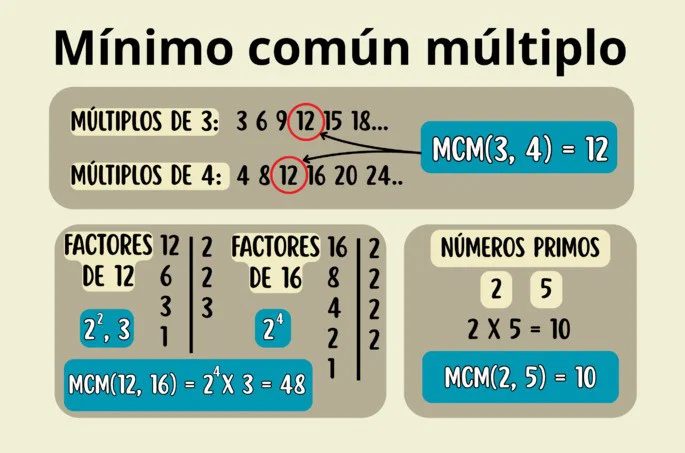
The listing method are best for working with small, manageable integers. Take two numbers, say 3 and 4, and write their multiples in order.
Multiples of 3: 3, 6, 9, 12, 15, 18…
Multiples of 4: 4, 8, 12, 16, 20…
Look for duplicates. Both lists have 12. We need the least common multiple, so we’ll stop there.
mcm(3, 4) = 12
It’s very simple. But what happens when the number increases?
Prime factorization for larger numbers
As the numbers grow, it becomes tedious to list several. Another method uses prime factorization. Break the numbers into their prime building blocks.
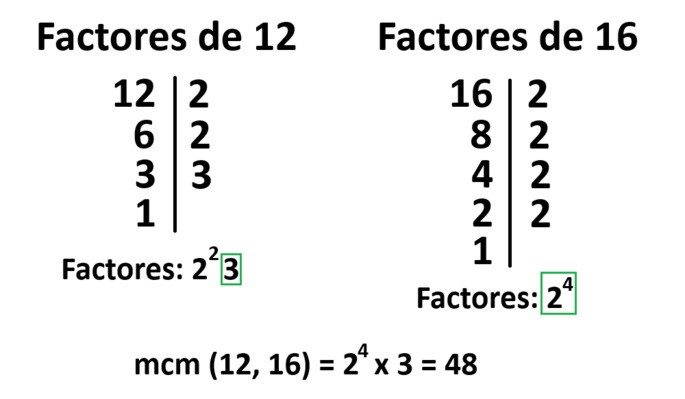
Start with 12 and 16. Divide these by the smallest prime number, 2. Continue dividing by 2 until the result is a whole number.
- 12 ÷ 2 = 6
- 6 ÷ 2 = 3
You cannot divide 3 by 2 evenly. Move to the next prime number, which is 3.
- 16 ÷ 2 = 8
- 8 ÷ 2 = 4
- 4 ÷ 2 = 2
- 2 ÷ 2 = 1
This process continues until it reaches 1. By comparing the prime factors, you can determine the least common multiple without having to enumerate an endless series of numbers.
Find the lowest common multiple of 15 and 25
When dealing with larger numbers, listing multiples becomes tedious. This is why prime factorization is so powerful here. Let’s break down 15 and 25 and see what’s underneath.
Start with number 15. This splits neatly into 3 and 5 . Both are prime.
Now look at 25. It is 5** multiplied by itself, or $5^2$.
The goal is to select the highest power of each element in the list.
With the initial number 3, it occurs only in the first number (15). That’s why we introduce 3.
For prime 5, 15 has $5^1$ and 25 has $5^2$. The highest exponent is 2. Therefore, we take $5^2$ (or 25).
Multiply these together:
$3 \times 25 = 75$
Therefore lcm(15, 25) = 75.
This method works because each original number divides the result equally. It’s faster than writing out long lists of multiples, especially if the number has more than 3 digits.
For prime numbers
What if you were asked to find the least common multiple of two prime numbers? Like 2 and 5?
It’s easy. Just multiply them. Why? This is because a prime number has no divisors other than 1 and itself. It cannot be divided further. There is no shared “common ground” to worry about, so combine them.
$2 \times 5 = 10$
Therefore lcm(2, 5) = 10.
This shortcut will save you time. If you find two prime numbers in the problem, don’t think too much about it. Multiply. You get the LCM immediately.
Practical application: Schedules and cycles
Why is this important outside of homework? Think cycles.
Imagine two buses. Bus A runs every 15 minutes. Bus B arrives every 25 minutes. They both just left the station together. When will they meet again?
You just calculated that. The answer is 75 minutes.
This logic applies to gear ratios, planetary orbits, and even the rhythm of music. Understanding how the numbers interact can help you predict when different systems will sync up.
If you’re a student, practice the prime factorization method until you feel like it changes automatically. It’s the most powerful tool you have. It works for small numbers and huge numbers alike. The list method is great for beginners, but it’s not scalable.
Keep practicing. These patterns may seem familiar. Don’t panic the next time you encounter a complex LCM problem. You will just break it down.
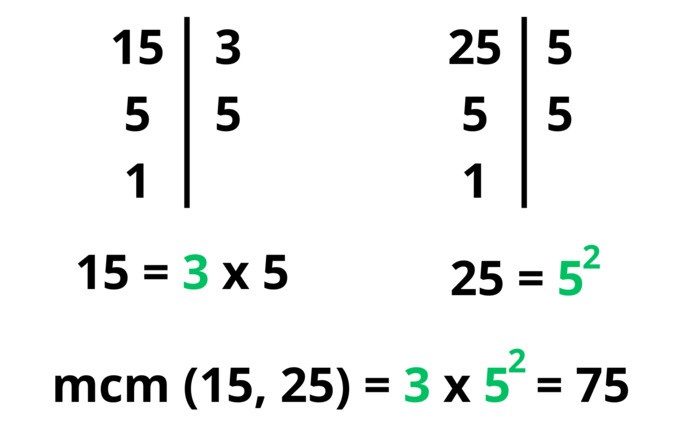
We concluded the previous section by taking the largest exponent factors (3 and 5²) and multiplying them. This gives us the Least Common Multiple (LCM) of 15 and 25 : 75. Next, we move on to the actual application.
For prime numbers
Let’s look at exercise 3. We need the least common multiple of 7 and 11. The answer is 77.
But why is this method so easy?
First, look at the numbers. 7 and 11 are both prime numbers. This means that they are only divisible by themselves and 1. Since there are no common factors other than 1, there is no need to do complex factorization.
To find the least common multiple of two prime numbers, multiply them.
mcm(7, 11) = 7 x 11 = 77
It’s very simple. No prime factorization trees needed. Direct multiplication of two different prime numbers.
Using the Listing Method for Small Sets
Exercise 4 asks you to find the least common multiple of 4, 6, and 8. The result is 24.
Since these numbers are small, the list method is faster than calculating prime factors. Just write the multiples of each number until you find the first common number.
The list should look like this:
- Multiples of 4: 4, 8, 12, 16, 20, 24, 28, 32, 36, 40…
- Multiples of 6: 6, 12, 18, 24, 30, 36, 42, 48, 54, 60…
- Multiples of 8: 8, 16, 24, 32, 40, 48, 56, 64, 72, 80…
You will notice that they overlap. 12 shows up in the 4 and 6 lists. 48 appears in all three. However, you want the smallest common multiple. Scan the list to find the first number that appears in each column.
That number is 24.
mcm(4,6,8) = 24
This approach works well for small integers, but becomes tedious for large numbers. That’s when you switch back to prime factorization.
Prime Factorization for Larger Numbers
Exercise 5 increases the level of difficulty. We need the LCM of 30, 45, and 54. The answer is 270.
If the numbers are large, listing multiples is inefficient. Instead, factorize each number separately. Next, determine the largest exponent of each prime factor of any number.
Let’s break down each number.
- 30 factors into 2 x 3 x 5
- 45 factors into 3² x 5
- 54 factors into 2 x 3³
Let’s see
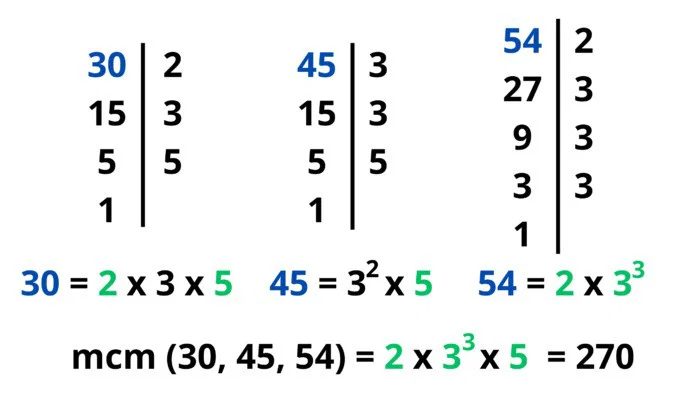
El proceso se simplifica al identificar los factores primos que comparten los números. Como 30 y 54 solo se pueden dividir una vez por 2, ese valor se toma para el cálculo del mínimo común múltiplo (mcm). No se repite ni se eleva más allá de lo necesario.
De igual manera, 30 y 45 tienen un factor común: 5. No existe otro número en el conjunto que posea este factor con un exponente mayor. Por eso, también se incluye en el cálculo.
El caso del factor 3
Finalmente, los tres números comparten el factor 3. Aquí es donde mucha gente se confunde. 54 tiene este factor con el exponente más alto (3³, o 27). Por lo tanto, se usa ese valor específico para calcular el mcm, en lugar de 3 o 3².
La regla es clara: siempre toma la potencia más alta de cada factor primo.
El cálculo final
Con todos los elementos en su lugar, la operación queda así:
mcm(30, 45, 54) = 2 × 3³ × 5 = 270
El resultado es 270. Si sigues esta lógica de elegir el máximo exponente, puedes aplicarlo a cualquier conjunto de números. ¿Qué otros números te gustaría practicar con este método?