Geometry can feel abstract until you see it in action. Thales’s theorem, often called the basic proportionality theorem, is one of those concepts that sounds dry but is incredibly practical. It’s a rule about ratios. Specifically, it deals with how lines interact when you start them from a single point and slice them with parallel lines.
Here is the core idea in plain language: if you take two straight lines (transversals) that begin at the exact same vertex, and you cut across them with parallel lines, the segments created on those two original lines will be proportional.
The Rule: Parallel intercepts create proportional segments on transversal lines originating from the same point.
How It Works Visually
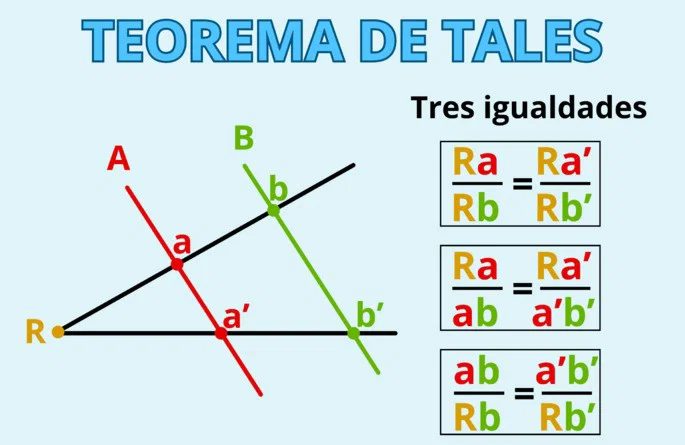
Let’s break this down without the jargon. Imagine a point labeled R. From this point R, two lines shoot out. These are your transversal lines. They don’t have to be parallel to each other. They just need to start at R.
Now, imagine drawing straight lines that cross both of these transversals. If these crossing lines are parallel to each other, something interesting happens. They slice the two original lines into segments.
Let’s say the first parallel line cuts the transversals at points A and B. The second parallel line cuts them at points C and D. The theorem states that the ratio of the segment on the first line is equal to the ratio of the segment on the second line.
Mathematically, if we look at the segments between the parallel lines, the relationship holds:
* The length of the segment on the first transversal divided by the next segment on that same line equals the length of the corresponding segment on the second transversal divided by its next segment.
This isn’t just about any random lines. The key constraint is that the cutting lines must be parallel. If they aren’t parallel, the segments won’t be proportional. The parallelism is what forces the ratios to stay locked.
Why This Matters for Students
You might wonder why you need to know this. It’s not just for passing a geometry test. This principle underpins scaling, similar triangles, and even some aspects of perspective in art and design.
When you see two triangles that share a vertex and have parallel bases, you are looking at Thales’s theorem in disguise. The triangles are similar. The sides of the larger triangle are scaled versions of the smaller triangle’s sides. The ratio of scale is constant.
This makes calculating unknown lengths surprisingly easy. If you know the length of one side and the ratio of the segments created by the parallel line, you can find the other side without complex trigonometry.
A Concrete Example
Imagine you have two lines meeting at point R.
1. Line 1 goes through points A and B.
2. Line 2 goes through points C and D.
3. The line segment AB is parallel to the line segment CD.
If the distance from R to A is 3 units, and the distance from A to B is 6 units, the total length from R to B is 9 units.
Because the lines are parallel, the ratio of
Verifying Proportionality with Known Values
Let’s test the theorem with actual numbers. This moves the concept from abstract theory to something you can calculate.
Imagine a setup with four specific segments:
- Segment Ra measures 2 meters.
- Segment ab measures 4 meters.
- Segment Ra’ measures 3 meters.
- Segment a’b’ measures 6 meters.
Using the second equality shown in the previous visual reference, we check the ratios. The result? The proportion holds. The quotient for every segment pair is exactly 0.5.
This confirms the Teorema de Tales (Thales’ Theorem): when multiple parallel lines intercept two lines originating from the same point, all resulting segments remain proportional. The lines must stay equidistant from each other throughout their length. If they aren’t parallel, the ratios break.
Historical Context
This principle isn’t just geometry; it’s history. It was formulated by Thales of Miletus, a Greek philosopher who also influenced mathematics, physics, and legislation. He didn’t just draw shapes—he tried to quantify the world.
Applying Thales’ Theorem to Similar Triangles
The theorem has practical applications when calculating the sides of similar triangles. Two triangles are similar if they share the same shape, have identical inscribed angles, and possess sides that are proportional in length.
But how do you actually create a similar triangle from an existing one?
Draw a line inside a triangle that is parallel to one of its sides. The resulting smaller triangle at the top (or bottom, depending on perspective) will be similar to the original.
The key is parallelism. Without parallel lines cutting through the triangle, you lose the proportional relationship that makes the math work.
Consider the visual aid often used to demonstrate this. A triangle is split by a line parallel to the base. The small triangle on top mirrors the large original. Their angles match. Their sides scale perfectly. This is the core utility of the theorem in real-world calculations, from construction to map-making.
Why does this matter for students or DIYers? Because you can measure what you can see and calculate what you can’t. If you know the height of a tree is too great to measure directly, but you can measure its shadow and the shadow of a nearby stick, Thales gives you the ratio. You don’t need a ladder. You need proportion.
The image typically referenced here shows this split. The parallel line creates the condition. The angles prove the similarity. The sides confirm the ratio. It’s a closed loop of logic.
Is it always this clean? In a textbook, yes. In the real world, measuring errors creep in. But the principle remains the anchor.
If you’re looking at that diagram now, notice how the parallel line acts as a scaler. It doesn’t change the angles. It only changes the scale. That’s the power of similarity. You preserve the identity of the shape while changing its size.
This sets the stage for using the theorem to solve for unknown lengths. You don’t need to guess. You just need the knowns.
Scaling Shapes with Thales’ Theorem
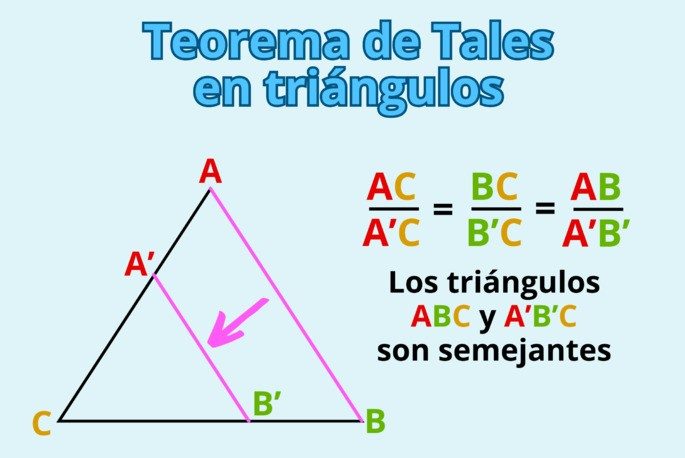
Draw a line parallel to side AB, and you’ve just created a new side, A’B’. Now you have two similar triangles: the original ABC and the smaller (or larger) A’B’C.
Thales’ Theorem isn’t just a geometric curiosity. It guarantees that the sides of these two triangles are proportional. This means the relationship between corresponding sides remains constant. Specifically:
- Side AC in the original triangle relates to side A’C in the similar triangle.
- Side BC in the original triangle relates to side B’C in the similar triangle.
- Side AB in the original triangle relates to side A’B’ in the similar triangle.
The ratio of proportionality is identical across all pairs. The proportion between AB and A’B’ matches the proportion between AC and A’C, which also matches the proportion between BC and B’C.
Let’s verify this with a concrete example:
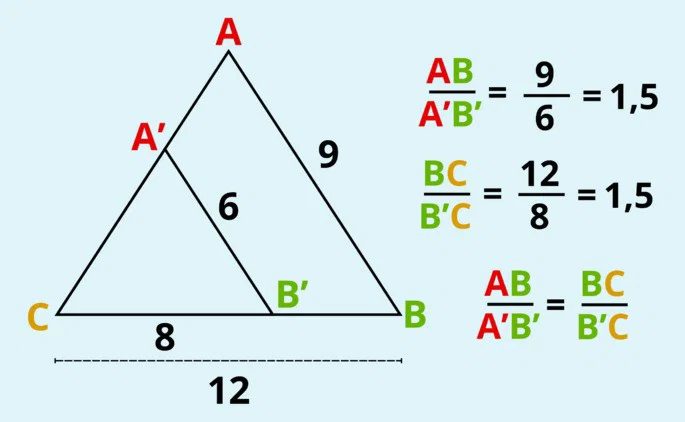
Probar la semejanza con razones y Teorema de Tales
Why do two triangles look alike but have different sizes? The answer lies in the ratios of their corresponding sides. When you compare the measurements, you are essentially testing for similarity using the principles underlying Thales’ theorem (often referred to as the intercept theorem or proportional segments).
Take the example of the triangles shown in the previous section. Side AB measures 9, while its corresponding side A’B’ is 6. If you divide the larger side by the smaller one ($9 \div 6$), you get a ratio of 1.5.
Now look at the next pair. Side BC is 12, and side B’C is 8. Divide them ($12 \div 8$), and you get the same result: 1.5.
This consistency is not a coincidence. When the ratios of corresponding sides are equal, the figures are similar. This confirms that the triangles in the image are similar because they satisfy the conditions derived from Thales’ theorem. While we often associate Thales with parallel lines cutting transversals, the core concept here is proportionality. If the sides scale by the same factor, the angles remain unchanged, and the shapes are geometrically identical, just resized.
For a broader context on geometric proofs, you might also want to review the Pythagorean theorem and other fundamental theorems that govern shape properties.
Practice exercises on Thales’ Theorem
Theory means little without application. To truly grasp how Thales’ theorem works in different scenarios, you need to solve problems that require you to identify proportional segments. Below are exercises designed to test your understanding.
Exercise 1
Consider the following figure:
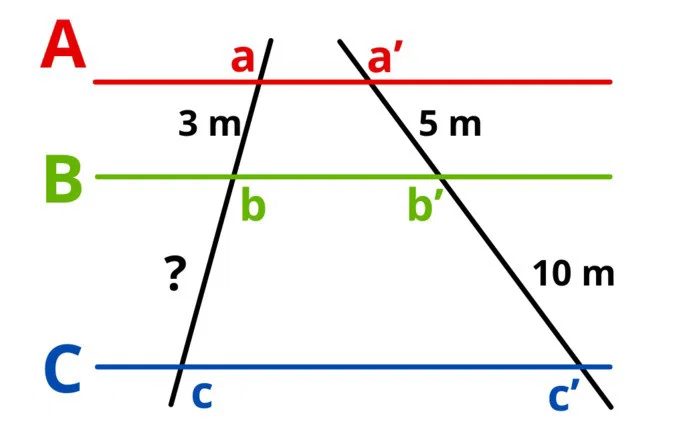
Aplicando el Teorema de Tales para hallar la longitud del segmento BC
Ya sabemos que el segmento bc mide 6 metros. Pero, ¿cómo llegamos a esa cifra exacta? La figura que analizamos muestra dos líneas transversales interceptadas por tres rectas paralelas. Los datos que teníamos en la mano eran concretos:
- El segmento ab mide 3 metros.
- El segmento a’b’ mide 5 metros.
- El segmento b’c’ mide 10 metros.
Para encontrar el valor desconocido, existen dos caminos claros. Ambos dependen de la proporcionalidad que establece el Teorema de Tales.
Método 1: Usando la razón entre segmentos correspondientes
La lógica es sencilla. Si las rectas son paralelas, la relación entre los segmentos de una transversal es idéntica a la de la otra. Es decir, la razón entre a’b’ y b’c’ es la misma que entre ab y bc.
Planteamos la equivalencia:
La razón entre a’b’ y b’c’ es igual a la razón entre ab y bc.
Si sustituimos los valores conocidos:
$$ \frac{5}{10} = \frac{3}{bc} $$
Simplificamos la fracción de la izquierda. Cinco sobre diez es exactamente la mitad, o sea, 0.5. Ahora la ecuación se ve así:
$$ 0.5 = \frac{3}{bc} $$
Para despejar bc, multiplicamos cruzado o simplemente invertimos la operación. Si 3 dividido entre algo da 0.5, entonces ese algo debe ser el doble de 3.
$$ bc = \frac{3}{0.5} $$
$$ bc = 6 $$
El resultado es claro: bc = 6 metros.
Método 2: Igualdades directas del Teorema de Tales
No necesitas pasar por el paso intermedio de calcular una razón decimal. El teorema permite igualar productos de segmentos opuestos directamente. Una de las formas más rápidas de escribir esta igualdad es:
$$ ab \cdot b’c’ = bc \cdot a’b’ $$
Sustituimos los números que ya conocíamos:
$$ 3 \cdot 10 = bc \cdot 5 $$
Multiplicamos los términos del lado izquierdo:
$$ 30 = 5 \cdot bc $$
Ahora, dividimos ambos lados por 5 para aislar bc :
$$ bc = \frac{30}{5} $$
$$ bc = 6 $$
El mismo resultado. Dos métodos diferentes. Una única respuesta.
Ejercicio 2
Observa la siguiente figura, cuyos lados se miden en centímetros:
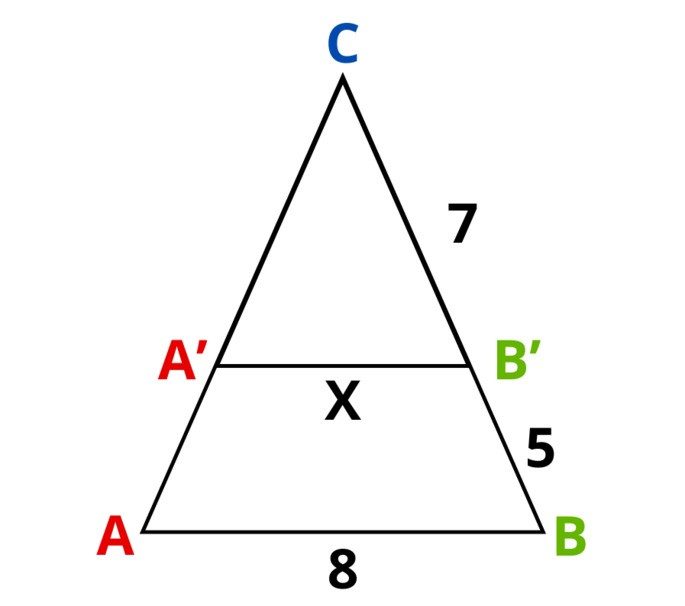
Calculando la incógnita X con el teorema de Tales
El valor final de X es 4,67 centímetros. Para llegar aquí, partimos de tres datos geométricos claros: el segmento CB’ mide 7 centímetros, B’B es de 5 centímetros y AB tiene una longitud de 8 centímetros. La incógnita X representa exactamente el segmento A’B’.
La estrategia para hallar esta medida se basa directamente en la aplicación del teorema de Tales. Lo primero que necesitamos es determinar la longitud total del segmento CB. Esto se logra sumando las dos partes conocidas: CB’ y B’B.
Una vez que tenemos la longitud completa de CB, el siguiente paso es establecer la razón o ratio de proporcionalidad entre las figuras. Este número es la clave que conecta las dimensiones conocidas con las incógnitas.
Al operar con ese ratio, aislamos X. Dado que X corresponde al segmento A’B’, la división final arroja el resultado concreto: 4,67 cm.
“El teorema de Tales permite relacionar segmentos paralelos cortados por dos secantes, haciendo posible encontrar longitudes desconocidas mediante proporciones.”
Ejercicio 3
Ahora toca resolver un caso un poco más complejo. En la siguiente figura, debes hallar los valores de las tres incógnitas: X, Y y Z.
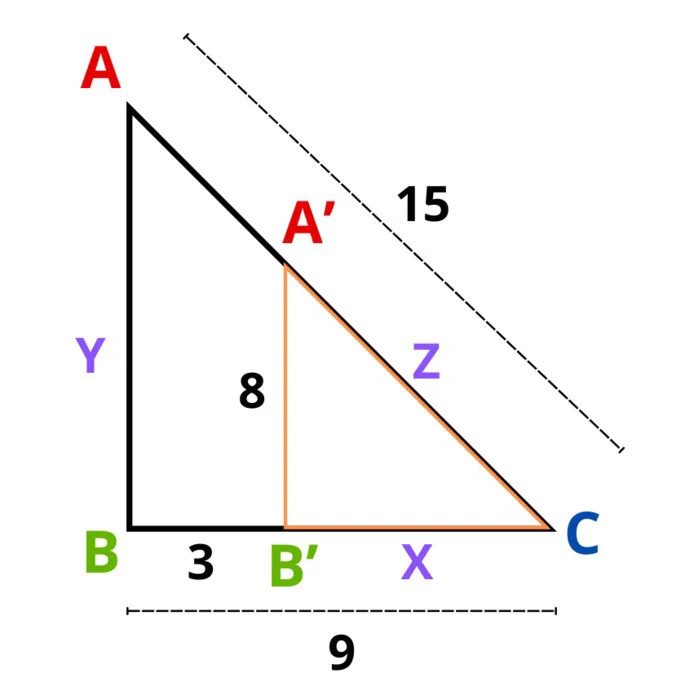
Ya tienes las respuestas finales: X = 6, Y = 12 y Z = 10. Pero el verdadero valor está en entender cómo llegaste a ellos. No se trata solo de memorizar números, sino de dominar la lógica detrás de la proporcionalidad de segmentos.
Cómo calcular longitudes desconocidas paso a paso
Empecemos por X. En este ejercicio, ya tenías dos datos clave: la longitud del segmento BC es 9 y la de BB’ es 3. La operación es directa. Solo necesitas restar.
9 menos 3 es igual a 6.
Por lo tanto, X = 6.
Ahora, toca el turno de Y, que representa el segmento AB. Aquí la cosa se pone un poco más interesante. No puedes restar; necesitas encontrar el ratio de proporcionalidad entre los triángulos semejantes.
Para obtener esa razón, usas los segmentos BC y B’C. Una vez que tienes ese factor de escala, aplicas el teorema de Tales a los segmentos AB y A’B’. Multiplicas la longitud conocida por la razón y listo.
Y = 12.
El proceso para Z es idéntico al anterior. Identificas los segmentos correspondientes, aplicas la misma lógica de proporcionalidad y resuelves la ecuación básica.
El resultado final es Z = 10.
Verifica tu comprensión con afirmaciones clave
¿Estás seguro de que entiendes las reglas del juego? A menudo, los estudiantes confunden las condiciones de la semejanza. Analicemos estas afirmaciones para separar el mito de la realidad.
La verdad sobre el teorema de Tales
Una afirmación común es que las líneas transversales no necesitan ser cortadas por rectas paralelas. Esto es falso.
Para que el teorema de Tales se aplique, las líneas transversales deben ser interceptadas por rectas paralelas. Sin paralelismo, no hay proporcionalidad garantizada.
Tampoco es cierto que el teorema solo funcione con exactamente dos rectas paralelas y dos transversales. Puede haber tantas líneas paralelas como quieras cortando tantas transversales como necesites. La proporcionalidad se mantiene siempre que las líneas sean paralelas.
Definición precisa de triángulos semejantes
Aquí es donde más errores se cometen. ¿Es suficiente con que dos triángulos tengan la misma forma?
No. La semejanza exige dos condiciones estrictas:
1. Los ángulos inscritos deben ser iguales.
2. Los lados correspondientes deben ser proporcionales.
Decir que los lados “no tienen por qué ser proporcionales” es un error fundamental. Si los ángulos son iguales pero los lados no siguen un ratio constante, no son triángulos semejantes en el sentido matemático estricto que permite usar el teorema de Tales para calcular longitudes.
Las únicas afirmaciones correctas en este contexto son aquellas que establecen que los segmentos formados por la intersección de líneas transversales y rectas paralelas son siempre proporcionales entre sí, y que la semejanza requiere ángulos iguales, forma idént