For decades, studying sperm whales (Physeter macrocephalus ) has been a logistical nightmare for marine biologists. These creatures are masters of evasion, capable of diving 1,300 to 4,000 feet deep and migrating up to 15,000 miles annually. Traditional research methods, which rely on attaching physical tags to whales, are limited by short battery lives—typically lasting only one to three days. This brief window provides only a fragmented glimpse into their lives, leaving vast gaps in our understanding of their social structures and communication.
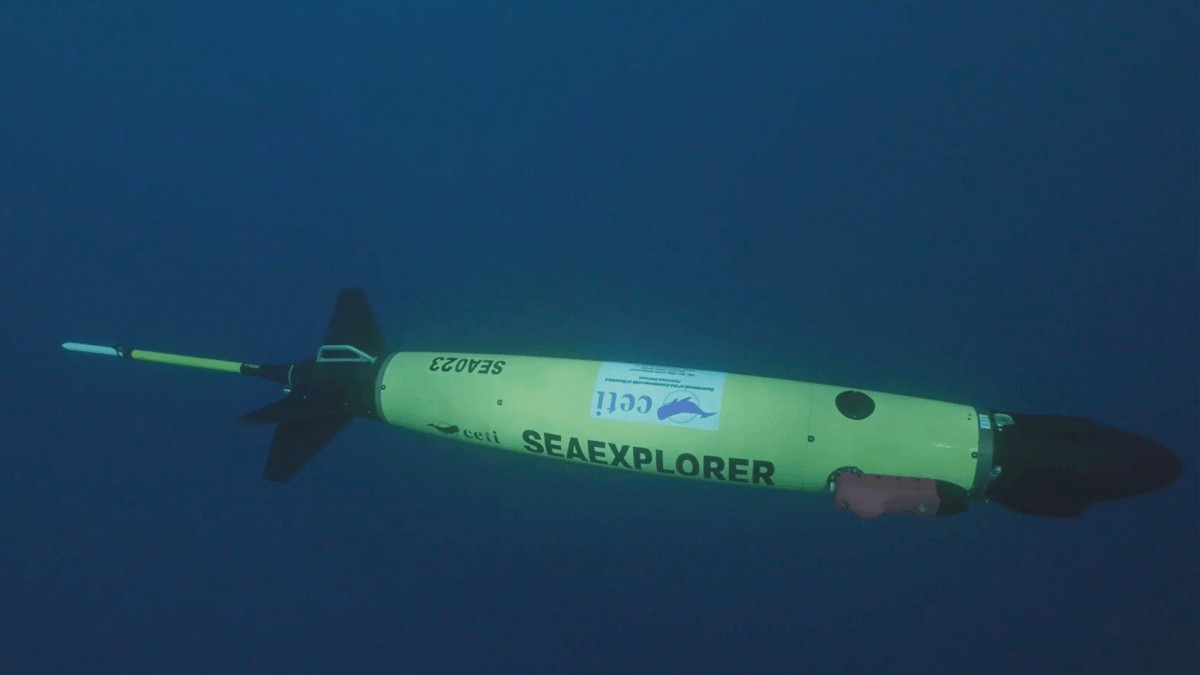
A breakthrough technology aims to close these gaps. Project CETI (Cetacean Translation Initiative) has developed an autonomous underwater glider equipped with embedded AI, designed to track sperm whale vocalizations in real-time without disrupting their natural behavior. Detailed in a study published in Scientific Reports, this system represents a significant leap forward in minimally invasive marine biology.
The ‘Waymo of the Sea’
The core innovation lies in the glider’s ability to think and react independently underwater. While all underwater gliders possess a standard navigation computer to control movement, CETI’s system features a custom secondary computer acting as a “backseat driver.” Developed in collaboration with French ocean robotics company Alseamar, this onboard processor runs detection algorithms that identify sperm whale clicks and codas (distinctive sound patterns) instantly.
“With the new glider, we significantly extend ‘backseat driver’ capabilities by enabling complete mission changes (such as different dive plans),” explains Roee Diamant, Project CETI’s Underwater Acoustics Lead. “This allows fully autonomous control by the glider for tracking whales—a first for underwater gliders, like the Waymo of the underwater world.”
This autonomy is critical. The glider uses four custom hydrophones to triangulate the source of underwater calls. Once a whale is located, the AI adjusts the vehicle’s path to maintain proximity. When the glider surfaces every few hours, it transmits data via satellite, recalibrates sensors, and receives updated mission parameters before diving again. This cycle allows for continuous, long-term monitoring that was previously impossible.
Why This Matters: Unlocking Whale Language
The ability to listen to individual whales for extended periods opens new avenues for research. David Gruber, Founder and President of Project CETI, notes that this technology allows scientists to observe complex social dynamics, such as how calf whales learn clan-specific dialects.
Currently, Project CETI conducts fieldwork in a 12-by-12-mile area off the coast of Dominica in the Caribbean. Here, researchers have already witnessed births and begun decoding sperm whale “alphabets.” However, sperm whales are not confined to small zones. By expanding monitoring capabilities beyond this single region, scientists can track how dialects vary across different ocean basins and how social networks form over vast distances.
A Quiet Observer
A major challenge in marine biology is balancing data collection with animal welfare. Traditional research vessels can disturb whales with noise and physical presence. CETI’s approach prioritizes minimal interference. The glider operates quietly and is programmed to ascend and reposition itself subtly once vocalizations are detected, rather than chasing the animals aggressively.
“Here, we extend this minimally-invasive approach by using a self-guided underwater glider that operates quietly and with less disturbance,” says Diamant.
This method aligns with broader ethical shifts in marine science, moving away from intrusive tagging toward passive, remote observation. By respecting the whales’ space, researchers can gather more naturalistic data on behavior and communication.
Conclusion
The integration of AI-driven autonomy into underwater gliders marks a pivotal moment for cetacean research. By enabling long-term, non-invasive tracking of sperm whales, this technology not only improves data quality but also respects the animals’ natural behaviors. As these systems become more sophisticated, they promise to deepen our understanding of whale societies and the intricate languages they use to navigate the deep ocean.