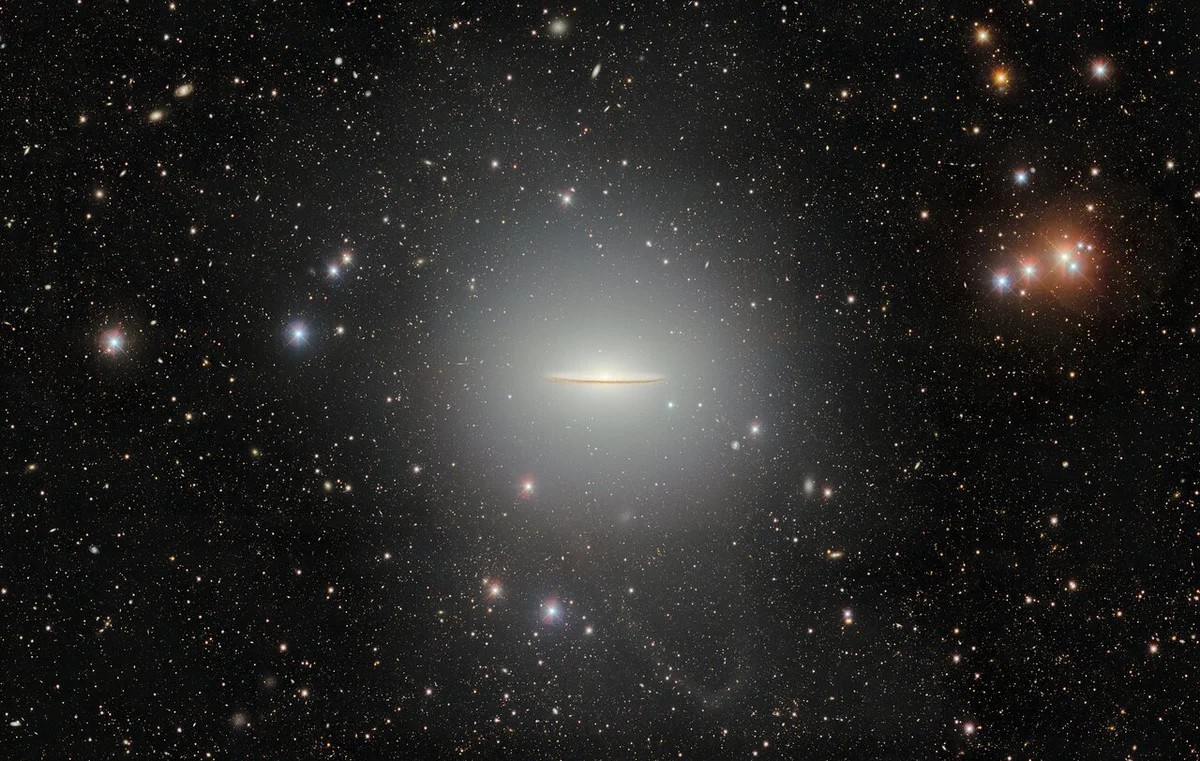
Astronomers have unveiled breathtaking new images of the Sombrero Galaxy (Messier 104), capturing the celestial landmark with unprecedented clarity. Utilizing the 570-megapixel Dark Energy Camera mounted on the Victor M. Blanco 4-Meter Telescope in Chile, the new data provides a much deeper look into the structure of this iconic spiral galaxy than ever before.
A Cosmic Landmark: From Earth to the Virgo Constellation
Located approximately 30 million light-years away in the Virgo constellation, the Sombrero Galaxy is a favorite among both professional astronomers and amateur stargazers. While it can be spotted with basic binoculars or small telescopes, its unique appearance is striking: a brilliant, massive central bulge surrounded by a thin, flat disk, giving it the distinct look of a wide-brimmed hat.
Unveiling the Galaxy’s Inner Workings
The high-resolution imagery allows scientists to peer into the complex layers that define the galaxy’s anatomy:
- The Core and Star Clusters: The bright central nucleus is surrounded by roughly 2,000 globular star clusters. These are dense, spherical groups of stars held together by intense gravitational forces.
- The Dust Lane: The rim of the galaxy appears strikingly dark in these images. This is caused by a thick “dust lane” composed of space dust and hydrogen. This ring is not merely a visual feature; it is a stellar nursery, serving as the primary site where new stars are born.
- A Supermassive Heart: At the very center of Messier 104 lies a supermassive black hole with a mass roughly equivalent to one billion suns.
The Giant Halo: A New Perspective
Perhaps the most significant revelation in these new images is the scale of the galaxy’s halo. While the main disk of the galaxy spans about 50,000 light-years, the surrounding halo extends much further, appearing roughly three times wider than the disk itself.
According to the National Optical-Infrared Astronomy Research Laboratory (NOIRLab), this may represent the first time such a halo has been captured with this specific combination of scale and intricate detail.
Why This Matters
Understanding the relationship between a galaxy’s central bulge, its star-forming dust lanes, and its massive outer halo is crucial for mapping how galaxies evolve over billions of years. By capturing the halo in such detail, astronomers can better study how galaxies interact with their environment and how much “invisible” matter influences their structure.
The ability to visualize the vastness of the halo alongside the dense star clusters in the core provides a complete picture of the galaxy’s massive gravitational footprint.
In summary, these new images transform our understanding of the Sombrero Galaxy from a flat, disk-like object into a massive, multi-layered system dominated by a gargantuan halo and a billion-sun black hole.