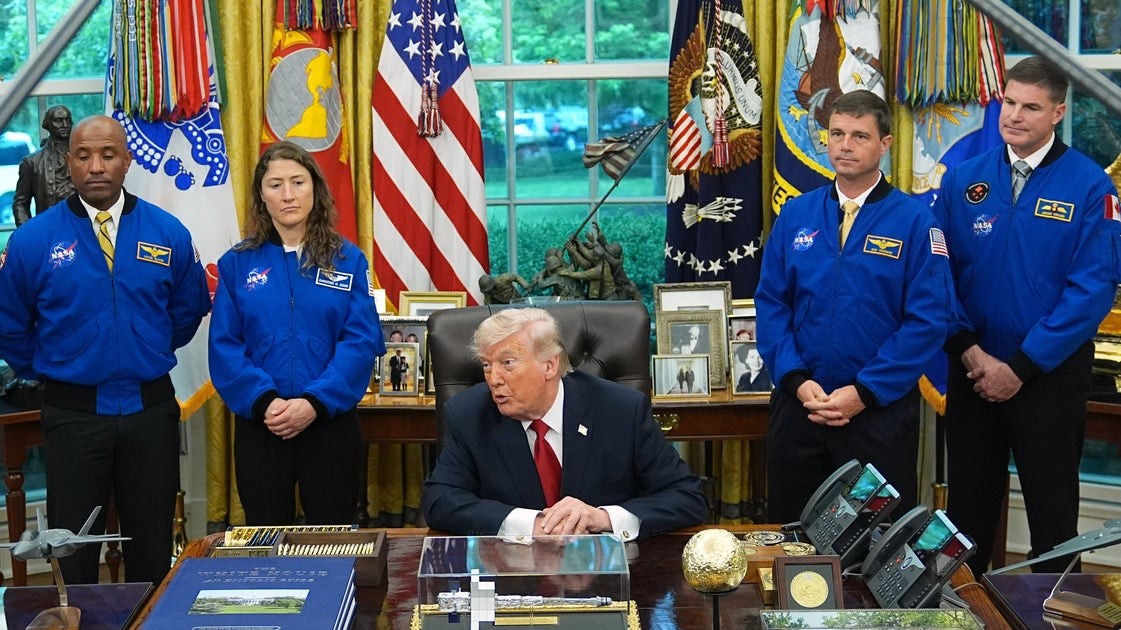
During a recent Oval Office meeting with the Artemis II crew, President Donald Trump made an unexpected claim that has sparked widespread debate: he believes he is physically and intellectually capable of becoming an astronaut.
The comment came as the president stood alongside astronauts Reid Wiseman, Victor Glover, Christina Koch, and Jeremy Hansen. “To get in there, you have to be very smart. You have to do a lot of things physically good,” Trump stated. “So I would’ve had no trouble making it. I’m physically very, very good.”
He then turned to Jared Isaacman, the private-sector entrepreneur who recently served as NASA Administrator before returning to the private sector, and asked, “Is the president allowed to go up in one of these missions?”
Isaacman responded diplomatically: “We can get working on that, sir.”
The Physical Demands of Spaceflight
The president’s assertion raises important questions about the rigorous standards required for human spaceflight. Astronauts undergo years of intense physical and psychological training, including:
- Cardiovascular endurance : Spaceflight places extreme stress on the heart and lungs.
- Musculoskeletal strength : Microgravity causes rapid muscle atrophy and bone density loss; astronauts must maintain peak fitness to counteract these effects.
- Cognitive resilience : Mission control requires split-second decision-making under high-stress conditions.
- Medical clearance : Candidates must pass exhaustive health screenings, including vision, hearing, cardiovascular function, and neurological assessments.
These requirements are not arbitrary—they are essential for survival in one of the most hostile environments known to humanity.
Historical Context: Trump’s Military Service Record
Trump’s claim that he would have “no trouble” making it as an astronaut contrasts with his own military service history. During the Vietnam War era, he received multiple draft deferments:
- Educational deferments : He was granted several postponements to complete his college education at Fordham University and the Wharton School of the University of Pennsylvania.
- Medical deferment : In 1968, after graduating, he was classified as 4-F (unfit for military service) due to bone spurs in his feet—a condition that typically disqualifies individuals from combat or physically demanding roles.
While bone spurs themselves are not necessarily disqualifying for all types of service, the combination of educational and medical deferments suggests that Trump did not meet the physical or logistical requirements for active duty at the time.
Public Reaction and Political Implications
The president’s remarks quickly drew criticism on social media, where users mocked the idea of sending him into space