


它们是代数最著名的展开式背后隐藏的数字。 二项式系数 是安静地位于二项式定理内部的正整数。 该定理采用一个简单的和,如 ($a + b$) 并将其计算到任意幂 $n$。 结果呢? 一长串术语。
您可能还记得高中代数中的这一点。 该工具可以扩展 $(x + 2)^5$ 等表达式,而无需您手动将其相乘。 该公式使用这些系数来准确告诉您每一项对最终答案的贡献有多大。
The Math Behind the Expansion
When you raise the sum of two numbers $a$ and $b$ to the power $n$, you get two or more terms. $n + 1$ products available. Everyone follows a certain pattern.
The general form is:
$$ (a + b)^n = \sum_{k=0}^{n} \binom{n}{k} a^{n-k} b^k $$
where $\binom{n}{k}$ is the binomial coefficient. You can see the numerical weight of each term. Variable $k$ moves from value 0 to value $n$. This change changes the power of $a$ and $b$. Any combination is sure to give the desired effect.
为什么这些数字很重要
您需要它们,因为没有捷径就很难计算组合。 想象一下,从 10 人的小组中挑选 3 个人。您可以列出所有可能的三人组。 或者你可以使用系数。 它节省时间。 它减少了错误。
这些数字随处可见。 在概率上,它们帮助计算在 $n$ 硬币翻转中恰好获得 $k$ 正面的几率。 在物理学中,它们有助于扩展波函数。 在计算机科学中,它们帮助分析算法。
Calculation method
You don’t need a calculator for small numbers. The formula is simple:
$$ \binom{n}{k} = \frac{n!}{k!(n-k)!} $$
The exclamation mark means factorial. Multiplies all integers between 1 and this number. For example, $5! = 5 × 4 × 3 × 2 × 1 = $120.
Suppose we want to expand $(a + b)^3$. Here $n = 3$. We need the coefficients $k = 0, 1, 2, 3$.
- If $k = 0$: $\binom{3}{0} = 1$
- If $k = 1$: $\binom{3}{1} = 3$
- If $k = 2$: $\binom{3}{2} = 3$
- If $k = 3 $: $\binom{3}{3} = 1$
So the expansion is:
$$ (a + b)^3 = 1a^3 + 3a^2b + 3ab^2 + 1b^3 $$
Pretty simple, right? But what happens as $n$ grows?
帕斯卡三角连接
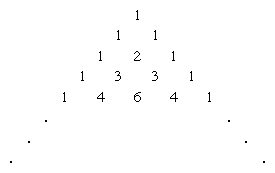
有一种直观的方法可以找到这些数字。 看看帕斯卡三角形 。 每行以 1 开始和结束。每


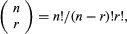

If we consider the terms in the binomial expansion, the index r does not remain static. It moves. It takes consecutive values starting with 0, then 1, then 2, all the way to n. This sequence is the backbone of the formula you need to calculate the binomial coefficients for each part of the expansion.
The actual calculation is based on a certain formula involving factorials. There you will see n! which means factorial of n. You get this number by multiplying the first n natural numbers together. So if n is 4, do 1 x 2 x 3 x 4. There is one exception to remember: 0! is defined as equal to 1. This sounds contradictory, but it ensures that the math remains consistent.
If you don’t want to do the multiplication every time, you can use an alternative method. The multipliers appear in a famous arrangement known as Pascal’s triangle. This geometric arrangement of numbers allows you to find binomial coefficients using simple addition instead of complex factorials.
Why Factorials Matter in Expansion
The factorial notation isn’t just shorthand. It’s a strict rule. If n is a positive integer, n! is the product of all integers 1 to n.
- 1! = 1
- 2! = 1 x 2 = 2
- 3! = 1 x 2 x 3 = 6
But what happens when r reaches 0? The formula still needs to work. That’s why 0! is explicitly defined as 1. Without this definition, the first term of any binomial expansion (where r is always 0) would break the pattern. It ensures that the leading coefficient is always 1, which is exactly what you see in the first row of Pascal’s triangle.
Building the Triangle Instead of Calculating
Not everyone likes crunching large factorials. Pascal’s triangle provides a visual shortcut. Each number in the triangle is the sum of the two numbers above it. The edges are always 1.
- Row 0: 1
- Row 1: 1 1
- Row 2: 1 2 1
- Row 3: 1 3 3 1
If you need the coefficients for the expansion where n = 5, just look at the 5th row (start counting from 0). The numbers there give you the multipliers for each term. For small n it’s faster. For larger n, the factorial formula scales better, but the triangle helps to visualize the symmetry.
The connection between the two methods is direct. The entry in Pascal’s triangle in row n and position r corresponds exactly to the binomial coefficient calculated by the factorial formula. You can choose the tool that seems less cumbersome for the problem at hand. Or you can use both to check your work.

如何查找特定的二项式系数
您可以通过查看第 n 行和第 r 列的交点来查明帕斯卡三角形中的任何特定数字。 只要记住两者都从零开始计数即可。 规则很简单:每个内部数字都是其正上方两个数字的总和。
这个结构不仅仅是一个数学难题。 它生成 (a + b) 幂展开的系数。
- n = 0: 1
- n = 1: a + b
- n = 2: a ² + 2ab + b ²
- n = 3: a³ + 3 a² b + 3 ab² + b*³
- n = 4: a ⁴ + 4a 3b + 6a ²b 2 + 4ab 3 + b ⁴
这种模式会无限期地持续下去。
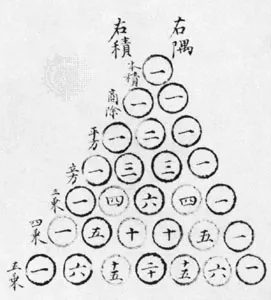
值得注意的是,虽然布莱斯·帕斯卡在西方教科书中获得了赞誉,但他并不是第一个发现这一点的人。 几个世纪前,伊斯兰和中国数学家就开始研究这些数组。 Al-Karajī在公元 1000 年左右计算出了帕斯卡三角形。 Jia Xian更进一步,在 11世纪中叶将其计算到 n = 6。
Practical applications of probability calculation and combinatorics
Binomial coefficients are not limited to algebra. They are the backbone of combinatorics and probability theory. More specifically, they tell you how many different ways a subset of k items can be selected from a larger set of n items.
The order does not matter here. You’re just looking for the number of unique combinations.
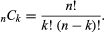
In mathematical notation, this is written as nCk. You hear: “n choice k.” Calculations convert these triangular entries into usable probabilistic information based on certain combinatorial formulas.

Mathematics behind the choice
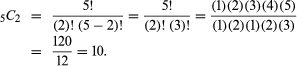
Consider a binomial expansion like $(a+b)^n$. There are as many ways to choose $k$ terms from $n$ as there are ways to find the coefficient of the $k$th term in its expansion. This is a pure shortcut. Take five objects and choose two. How many unique combinations can you make?
$$\binom{5}{2} = \frac{5 \times 4}{2 \times 1} = 10$$
10 different pairs. Although simple arithmetic, it reveals how combinatorial science underpins probability and statistics. Once you understand which formula applies to selection without replacement, stop guessing and start counting.

Mastering the Art of Deep Focus
You don’t need a meditation retreat. You don’t need a silent monastery. You just need to understand how your attention works—and how to protect it. The biggest mistake students and lifelong learners make is treating focus like a switch you flip on and off. It’s not. It’s a muscle. And like any muscle, it fatigues, adapts, and requires specific training.
The goal isn’t to clear your mind completely. That’s impossible. The goal is to create a structure where distraction has nowhere to go.
The Psychology of Interruption
Why does checking one email take twenty minutes? Because of the “attention residue” effect. When you switch tasks, part of your brain stays stuck on the previous activity. You’re not fully present in the new one. You’re half-here, half-there. This fragmenting is why you can study for hours and remember nothing.
To fix this, you need to batch your interruptions. Don’t let your phone dictate your schedule. Set specific windows for communication. Check Slack, email, and social media only at predetermined times. The rest of the day? It’s for deep work.
“Context switching is the enemy of mastery. Protect your focus like it’s money in the bank.”
Building a Distraction-Proof Environment
Your environment shapes your behavior more than your willpower ever will. If your phone is within arm’s reach, you will check it. Not because you’re weak, but because you’re human. Friction matters.
Make distractions hard to access. Put your phone in another room. Use website blockers during study sessions. Clear your desk. Visual clutter competes for your cognitive resources. A clean space signals to your brain that it’s time to concentrate.
This isn’t about austerity. It’s about design. Design your space for the work you want to do, not the work you’re avoiding.
The Power of the Pomodoro Technique
If you struggle with starting, try the Pomodoro Technique. Work for 25 minutes. Break for 5. Repeat. This method works because it lowers the barrier to entry. Twenty-five minutes feels manageable. It’s not a daunting block of hours. It’s a sprint.
During the 25 minutes, you do nothing else. No checking messages. No adjusting your posture for the tenth time. Just the task. During the break, you move. Stand up. Stretch. Get water. Your brain needs this downtime to consolidate information.
Why does this work? Because it respects the limits of your attention span. It acknowledges that sustained focus is expensive. By breaking work into intervals, you make it sustainable.
Active Recall: The Learning Hack No One Talks About
Reading is passive. It feels like learning, but it isn’t. Highlighting text gives you a false sense of competence. You recognize the information, so you think you know it. You don’t.
Real learning happens when you struggle to retrieve information from memory. This is called active recall. Close the book. Ask yourself: “What did I just read?” Explain it out loud. Write it down from memory. The struggle is the point. That effort strengthens neural pathways.
Test yourself. Frequently. Early. Often. Don’t wait until the exam. Start testing yourself on day one. It feels harder. It feels frustrating. That’s how you