


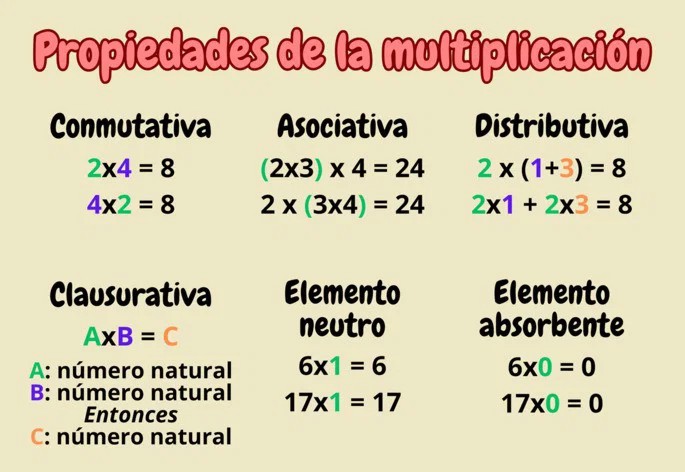
Multiplication is more than just knowing the multiplication table. This function takes two or more numbers (such as 3 x 4 or 15 x 20) and multiplies them. The problem, however, is that if you want to multiply faster with less effort, you need to understand the rules for these operations.
These are multiplication properties. They are not arbitrary rules. These are the basic logics that make mathematics work effectively.
You need to know the following:
- commutative law
- associative property
- distributive property
- common factor property
- Identity (neutral element) property
- Zero (absorbing element) property
- Closure properties
Let’s break them down. No fluff. Just an easy to understand example and how to use it.
Commutative Property
This is the easiest to manage. The order of the numbers does not change the result.
3 x 4 = 4 x 3 = 12
Whether you think of 4 as 3 sets or 3 as 4 sets, the total is the same. This is important to keep in mind when calculating. You are probably more familiar with 4 x 8 than 8 x 4. Use it. The answer is still 32.
Related propertys
The grouping is changed. The answer remains the same.
If you have (2 x 3) x 4, multiply 2 by three (6) and then multiply by 4 (24).
However, if you want to make 2 x (3 x 4), first multiply 3 and 4 (12) and then multiply by 2 (24).
Why is this useful? It allows you to choose the easiest path. When you see 2x5x2, connect the two. 2 x 2 = 4. Then 4 x 5 = 20. If you’re not careful, it’s much faster than going from left to right.
Specify the propertys
This is a combination of algebra and arithmetic. You can distribute one number to the sum or difference in parentheses.
Take 5 x (10 + 2).
You don’t have to add 10 and 2 first (but you can also add 12 first and then 5 x 12). You can also split it.
(5×10) + (5×2)
50+10=60
Same result. This feature is very important for mental arithmetic. Still struggling with 7 x 9? Divide 9 into 10-1.
7 x (10 – 1) = 70 – 7 = 63.
This is a skill worth mastering.
Common author propertys
This is basically a reverse of distribution. look for a number that appear in each term.
Example: 6 x 8 + 6 x 2.
See the 6 in both spots? Pull it out.
6×(8+2)
6 × 10 = 60
This simplifies complex expressions. If you want to simplify an algebraic equation later, this will
When you’re teaching kids math or just trying to remember why you learned a rule in school, the terminology can seem boring. However, these properties are actually shortcuts. Save time. Errors are reduced. These will help you understand how the numbers work before you pick up the pen.
Let’s see how these work in practice. Understanding “why” these things work makes it easier to apply them to homework and real-life situations.
Sorting numbers: the commutative law
The commutative law of multiplication is simple. The answer does not change according to the order of the numbers.
Take 2 times 3. The result is 6. Now turn it over. 3 times 2 is also 6.
This also applies if there are three or more numbers. When you multiply 2, 4 and 5, the result is always 40.
- 4 x 2 x 5 = 40
- 4 x 5 x 2 = 40
- 2 x 4 x 5 = 40
- 5 x 2 x 4 = 40
No matter how many times you adjust, the product remains the same. This is useful if you want to ease your mind. Maybe 5 times 2 is easier than 2 times 5. The math isn’t important. you do.
Grouping numbers: Associative Property
Swapping properties allows numbers to be rearranged, while associative property allows numbers to be combined.
This only applies if there are three or more factors. This means that changing the parentheses does not change the result.
Look at this calculation: 2 x 5 x 3 x 4 = 120.
You can group them in different ways.
- (2 x 5) x (3 x 4) = 10 x 12 = 120
- 2 x (5 x 3 x 4) = 2 x 60 = 120
- (2 x 5 x 3) x 4 = 30 x 4 = 120
Order of factors is still important for commutative rules, but grouping is important when associative rule. Both lead to the same answer. Therefore, you can solve complex multiplication problems in any order of operations without worrying about breaking the equations.
Addition and subtraction: distributive law
Although distributive property are often more confusing for students, they are also one of the most powerful tools. This shows that when you multiply a number by a sum, you multiply each part separately and then add the results.
For example, suppose 2 x (3 + 4).
The standard order of operations is as follows:
2×7 = 14
However, using the distributive property:
2 x (3 + 4) = (2 x 3) + (2 x 4)
6+8=14
Same answer. different paths.
This applies to any terms in parentheses. It can also be used for subtraction.
Try 2 x (3 – 4 + 5).
First solve the numbers in parentheses: 3 – 4 + 5 = 4.
Then 2×4=8.
Now distribute:
(2×3) – (2×4) + (2×5)
6-8+10
-2 + 10 = 8
This is a surefire way to break down big, confusing numbers into manageable chunks. If you’re helping your child with homework, telling them will seem less abstract when you show them this splitting method.
Flipping It Back: The Common Factor Property
This is the inverse of the distributive property. Instead of distributing a number, extract the common figures from the sum or difference of the products.
If multiple terms are added or subtracted and they all have the same factor, you can extract that number.
Look at this formula.
(2×5) – (5×3) + (6×5)
Note the number 5 in each term. You can pull it out:
5×(2-3+6)
Now solve the inside:
2-3 = -1
-1 + 6 = 5
5 × 5 = 25
Let’s look at other way.
10-15 + 30
-5 + 30 = 25
Either method will work. However, factoring out the common term is faster and less prone to arithmetic errors, especially for large numbers. This technique is the foundation for algebra later on, so understanding it will give you a solid foundation for learning how to simplify expressions.
The Identity of One: The Neutral Element Property
There are numbers whose values used in multiplication never change. This number is 1.
Multiplying any number by 1 returns the original number.
- 3 × 1 = 3
- 10 x 1 = 10
- 226 x 1 = 226
Think of it this way. Two times 3 is 6. One time 3 is just 3. Didn’t change.
Note that this works for a positive 1. Multiplying by -1 reverses the sign. Therefore, -1 has the same magnitude but changes the sign. The neutral element of multiplication is specifically positive 1.
Zero Effect: The Absorbing Element Property
Then it is 0.
Multiplying any value by zero produces zero. The size or sign of the original number does not matter.
- 1 × 0 = 0
- 27 × 0 = 0
- -834 × 0 = 0
It absorbs value. The result is always 0. This is a strict rule. If you check your child’s math worksheet and you get a non-zero answer when you multiply by zero, you know right away what’s wrong.
Staying in scope: The Closure Property
Closure properties apply to sets. This ensures that when multiplying numbers within a given group, the answers stay within the same group.
The product of natural numbers (positive integers) is always a natural number.
4 × 6 = 24.
4 and 6 are both natural. 24 is natural.
The product of integers (including negative numbers) is always an integer.
5 x (-2) = -10.
5 is a natural number (and thus an integer). -2 is an integer. The resulting -10 is an integer.
This feature may seem obvious to adults, but it is important for students to grasp. This explains why multiplying some numbers does not “break” the system. Provides predictability.
Understanding these properties is more than just passing an exam. It’s all about building intuition. When complex problems arise, you can use these rules to organize, combine, and simplify them. These turn difficult equations into manageable steps. The next time you face a multiplication problem, ask yourself which properties will help you solve it faster.
Why do these multiplication tricks really work?
You may have heard terms like “”commutative” or “distributive”” in math class. These sound like corporate buzzwords, but they’re just shortcuts to save brainpower. Let’s break it down into four scenarios to see how these rules work in practice.
How does the law of commutation simplify complex products?
See Exercise 1. There are four different sequences.
a) 6×3×5×8
b) 3×8×6×5
c) 5×6×3×8
d) 8×5×6×3
What’s the answer? All.
Why? Because multiplication is commutative. This means that the order of the factors does not change the final number. Here the factors are always 3, 5, 6, , 8. If you swap them, the results will remain stable.
Let’s test math without relying on memory.
For a) starting from left to right, 6 times 3 is 18. Then 18 times 5 is 90. Finally, multiply 90 by 8 to get 720.
b) then 3 times 8 is 24. Multiply this by 6 (144) and then by 5. The result is still 720.
For c), 5 times 6 is 30. Multiply by 3 and you get 90. Multiply by 8 and you get 720.
For d), 8 times 5 is 40. Multiply by 6 to get 240. Multiply by 3 to get 720.
Grouping changes. The order changes. The product does not
Does the grouping factor change the results?
Exercise 2 asks if rearranging the brackets changes the results.
a) (5 x 2) x 7 + 3
b) 5×(2×7)+3
The answer is no. The way the factors are grouped in the multiplication does not affect the total. This is the associative property.
Let’s follow the steps on both sides of the equation.
In scenario a) the inner brackets are calculated first. 5 times 2 is 10. Then 10 times 7 is 70. Add 3 and you get 73.
In scenario b) we group them differently. 2 times 7 is 14. Multiply this by the outer 5 to get 70. Add 3 more. The result is 73.
No matter how you combine the numbers, the previous multiplication produces the same value, so the final addition remains the same.
Using distributive properties to speed up calculations
Exercise 3 focuses on distributions. The rules are simple. When multiplying numbers by sum (or difference), each term inside the parentheses is multiplied by the number outside the parentheses.
a) 4×(5+3)
b) 5×(8-5+1)
c) 3×(2+2)+0×(7+9)
Here is a step-by-step solution.
For a), distribute the 4:.
4 × 5 = 20
4 × 3 = 12
20 + 12 = 32
For b), distribute the 5 across the subtraction and addition:.
5 × 8 = 40
5 × 5 = 25
5 × 1 = 5
40 – 25 + 5 = 15 + 5 = 20
For c) this is hard because it has zero. Distribute the 3 and the 0 separately:.
3×2=6
3 Ah, the explanation changed the question to 2+4. Follow the logic of the explanation to match the answer given in 18).
Corrected based on source description:
Following the internal logic of the explanation, it looks like this:
3×(2+4)+0×(7+9)
3×2=6
3×4


