


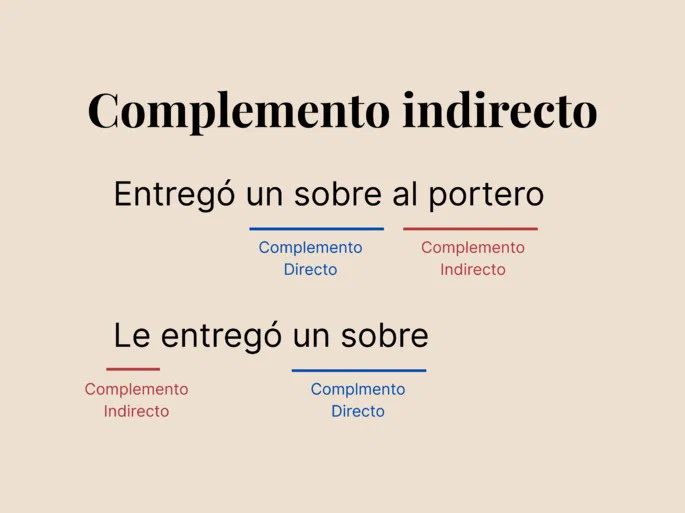
You hand a gift to your mom. She receives it. But grammatically, she isn’t the main recipient of the action in the same way the gift is. The gift is the direct object. She is the indirect object.
This distinction trips up learners constantly. It feels abstract until you see the mechanics. The indirect object (complemento indirecto) is the entity that receives the action indirectly. Usually, that entity is a person. Sometimes it’s an animal. Rarely is it a thing.
Consider this sentence: Le dio un regalo a su madre.
Who got the gift? The mother. But the verb dio (gave) acts on the gift directly. The mother is just the target. The action flows to her.
Who Qualifies as an Indirect Object?
Most of the time, you will see indirect objects referring to people. It makes sense. We give things to people. We tell stories to people. We send emails to people.
Objects? Less common. You might say Dio un golpe a la mesa. Here, the table receives the blow. But it’s awkward. We prefer direct constructions for inanimate objects. Stick to people for clarity.
The Two Ways to Build It
There are only two structural paths to creating an indirect object in Spanish. Pick your lane.
1. The Prepositional Phrase
This is the explicit route. You use the preposition a (or al for a el ). It spells out the recipient clearly.
Entregó un sobre al portero **.
Look at the structure. Al portero. The preposition a signals the shift from the direct object (the envelope) to the indirect receiver (the doorman). Without a, the meaning collapses or changes entirely.
2. The Atonic Pronoun
This is the shorthand route. You swap the phrase for a tiny, unstressed word. These are the clitic pronouns: me, te, se, nos, os, le, les.
Le entregó un sobre.
Here, le replaces al portero. The meaning stays the same. The structure shrinks. This is where confusion sets in.
Why the “Le” Gets Complicated
Native speakers love le. They use it even when it’s redundant. Le di el libro a él. It sounds natural. It emphasizes the recipient. But for learners, it’s a minefield.
Why do you use le instead of lo? Because lo is for direct objects. Le is for indirect. The gift is lo. The person is le.
Mix them up, and your sentence breaks.
Le lo di. Incorrect.
Se lo di. Correct.
Spanish grammar demands se when both le (indirect) and lo (direct) meet. It’s a phonetic fix. Le lo is hard to say. Se lo flows.
Practical Steps for Identification
How do you know which is which in a real sentence?
- Find the verb.
- Ask “What?” or “Whom?” directly
The Indirect Object: What It Is and Why It Matters
Think of the indirect object as the recipient. If the direct object is the thing being moved, the indirect object is who it’s moving toward. Syntactically, it’s a phrase that can be swapped out for specific pronouns.
Take this sentence: Entregó un sobre al portero.
You can replace the recipient with le.
Le entregó un sobre.
But you don’t have to replace it. You can keep both. This is called duplication.
Le entregó un sobre al portero.
Some grammars call this the objeto indirecto. The structure stays the same regardless of the name.
It’s easy to mix this up with the direct object when that object is a person. This confusion leads directly to leísmo, a topic we will tackle later. But before we get into the errors, let’s look at how to spot the right target.
How to Identify the Indirect Object in a Sentence
Identifying the indirect object requires a few specific tests. Don’t guess. Follow the steps.
1. It Starts with “A” or “Al”
The indirect object almost always begins with the preposition a or al. It does not start with para.
Here is the difference.
Dio una camisa a su hermano.
The brother receives the shirt. A su hermano is the indirect object. You can say:
Le dio una camisa a su hermano.
Now look at this:
Dio una camisa para su hermano.
Someone receives a shirt, but it is for the brother. Para su hermano is a circumstantial complement, not an indirect object. The pronoun le in the first sentence refers to the person getting the shirt. In the second, it refers to someone else entirely.
Note: Direct objects that refer to people also start with a. So this test alone isn’t foolproof. You need more than just the preposition.
2. The Pronoun Swap Test
You can replace the indirect object phrase with specific pronouns based on person and number: me, te, se, nos, os, le, and les.
Try these:
- Entrega a María estas flores → Entrégale estas flores.
- Presta la bicicleta (a mí ) → Préstame la bicicleta.
- Da tiempo a tus alumnos → Dales tiempo.
If you can swap the phrase for one of these pronouns and the sentence still makes sense grammatically, you are likely looking at an indirect object.
3. The Duplication Rule
This is a hard rule. The indirect object can be duplicated. The direct object cannot.
If you can put the pronoun and the phrase in the same sentence, it’s an indirect object.
Compró un libro a su pareja.
You can say:
Le compró un libro a su pareja.
Valid. Indirect object.
Now try a direct object:
Vio a su prima por la calle.
Can you duplicate it?
La vio a su prima por la calle.
No. That sounds wrong. You don’t duplicate direct objects. If duplication fails, it’s a direct object.
4. Gender Doesn’t Change the Pronoun
This is the killer test for third-person singular.
The indirect object uses le or les. These do not change based on gender. The direct object uses lo (masculine) or la (feminine).
Look at the results:
- Dio un regalo a Juan → Le dio un regalo.
- Dio un regalo a Juana → Le dio un regalo.
The pronoun le covers both. It is gender-neutral.
Now look at the direct object:
- Vio a Juan → Lo vio.
- Vio a Juana → La vio.
The pronoun changes because the direct object cares about gender. The indirect object does not. If the pronoun stays le regardless of whether the recipient is male or female, you have an indirect object.
5. Don’t Ask “Who?” or “For Whom?” at the Verb
Asking ¿A quién? or ¿Para quién? is unreliable. It leads to traps.
Consider this sentence:
Vi a Rosa en el congreso.
Ask: ¿A quién vi?
Answer: A Rosa.
Is this an indirect object? No. It’s a direct object. You would say La vi.
Consider another:
Le compró una pulsera para su hijo.
Ask: ¿Para quién se la compró?
Answer: Para su hijo.
Is this the indirect object? No. Para su hijo is a circumstantial complement. The actual indirect object is Le (referring to the seller or the friend who bought it).
Questions at the verb often mislead. Stick to the structural tests.
Real-World Examples of Indirect Objects
Here is how this looks in practice. Notice the duplication, the pronouns, and the placement.
- A Mario le duele muchísimo la espalda. (Duplication: A Mario + le )
- ¿Ves ese archivador? Dáme lo, por favor. (Pronoun: me )
- El entrenador dijo unas duras palabras a sus jugadores. (Phrase only: a sus jugadores )
- Les compramos bombones por su aniversario. (Pronoun: les )
- ¿Puedes enviarnos una copia del informe? (Pronoun: nos )
- A ella no le gustan las películas de ese género. (Duplication: A ella + le )
- Ponte los guantes para jugar en la nieve. (Reflexive indirect: te )
- El mensajero le dio malas noticias al emperador. (Duplication: le + al emperador )
- ¡Una araña en el pelo! ¡Quítame la! (Pronoun: me )
- ¿Le entregaste el paquete al cliente? (Duplication: Le + al cliente )
- No le puse nada de azúcar al postre. (Duplication: le + al postre — note: here al postre acts as the indirect target of the action)
- Bien, envíase lo por email. (Impersonal/Reflexive indirect: se )
- Creo que a Julia le encanta ese restaurante. (Duplication: a Julia + le )
- Os daremos un detalle si rellenáis el cuestionario. (Pronoun: os )
- Quítale esa placa gráfica y ponle otra más potente. (Pronouns: le )
- ¿No les molesta el ruido de las obras? (Pronoun: les )
- El dentista me puso un empaste en la muela. (Pronoun: me )
- Entregaron el premio al deportista. (Phrase only: al deportista )
- Sobre el aumento… pídese lo al jefe y te lo dará. (Duplication/Sequence: se/te + al jefe )
- Póngale a su hijo esta pomada en la picadura. (Duplication: le + a su hijo )
What Is Leísmo?
Leísmo happens when you use le or les as a direct object instead of lo or la.
Le vi por la calle.
Instead of:
Lo/La vi por la calle.
This is widespread across the Spanish-speaking world. In some regions, it’s so common it feels natural. In others, it’s flagged as an error.
So, is it wrong?
Normatively, it is acceptable in two specific cases.
First, when referring to a male person in the singular.
Lo conocí ayer.
Can also be:
Le conocí ayer.
Both are correct. For plural males, les