Prepositions are the glue in Spanish grammar. They are invariable words. Their job is simple but powerful: to introduce a term and link it to other parts of the sentence. Without them, connections feel broken. Take the phrase Fueron a bailar. Here, the word a acts as the bridge. It introduces the verb bailar. Together, they form a prepositional phrase. The structure holds because of that tiny, silent connector.
There are twenty-three prepositions in standard Spanish. Most people know the common ones. De, en, por, and para show up everywhere. But the full list is longer. It includes ante, bajo, con, and contra. You will also find desde, durante, entre, and hacia. Then there are hasta, mediante, según, sin, sobre, and tras. The list ends with versus and vía.
Not all of these carry equal weight in daily conversation. Some are relics. Cabe once meant “next to” but now sounds archaic. So is rarely heard outside of literary texts. Versus appears mostly in sports or legal contexts. The rest remain active. They define space, time, purpose, and origin. Mastering them changes how you construct thought. It turns disjointed words into coherent meaning. Why does this matter? Because prepositions dictate logic. They tell you where something is. When it happens. Who it involves. Ignore them, and your Spanish falters. Use them well, and you sound native.
Prepositions in Spanish are the glue of the sentence, but they don’t carry heavy semantic weight on their own. They are relational tools. Take the preposition de. It doesn’t mean “of” in a vacuum. It signals origin when you say de Francia. It indicates material when you discuss something de madera. It shows possession with de María. The meaning shifts entirely based on context.
Understanding how prepositions function is less about memorizing definitions and more about recognizing their role as connectors. They bridge gaps between nouns, verbs, and ideas without standing alone as the main subject or action.
Core Characteristics of Spanish Prepositions
These words are rigid. They don’t bend to fit the sentence structure.
- Closed Class: You won’t find new prepositions entering the language. The list is finite.
- Invariable: No gender, no number. Con is con, whether it’s one person or a million.
- Unstressed: They are átonas. They lack stress in speech, with según being a notable exception.
- Positional Constraints: You cannot end a sentence with a preposition. It feels incomplete, and grammatically, it’s wrong.
- Grammatical Category: They sit among the nine parts of speech in Spanish grammar, distinct from verbs or adjectives.
Classifying Prepositions by Meaning
A single preposition can wear many hats. A, for instance, can mark time (a las ocho ) or purpose (a comprar ). Context is king.
Location and Direction
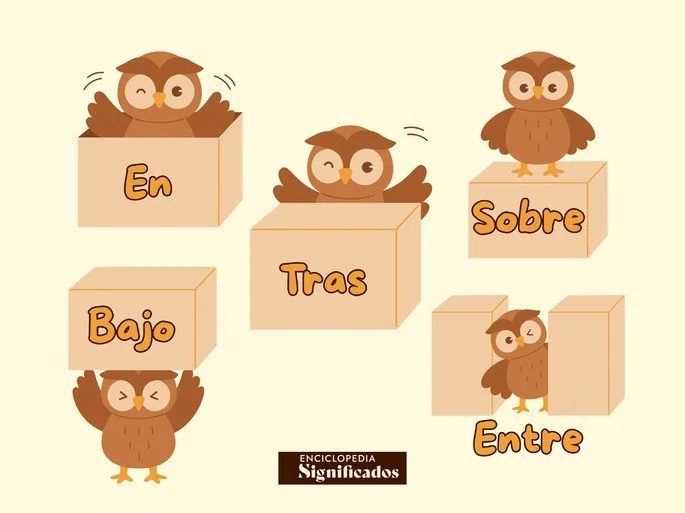
Where are things? Where are they going? Prepositions like en, sobre, bajo, entre, and tras pin objects down. Entre places something between two other things. Sobre puts it on top. Bajo tucks it underneath.
For movement, a and hacia guide the path. Hacia suggests direction without a fixed endpoint. A often implies arrival. Fue hacia el despacho suggests the journey. Llegó a Córdoba marks the destination.
Time and Simultaneity
Temporal prepositions anchor events. En can mean “in” a week. Sobre and tras mark approximations or sequences. Durante stretches over a duration. A fixes a specific hour.
Manner and Instrument
How is something done? Con is the workhorse here. Se expresó con cariño. Hizo pasta a la carbonara uses a in a specific culinary construction. Mediante and vía introduce the medium. Lo envió vía email. Se lo dijo mediante un intermediario.
Abstract Relations
Beyond physical space, prepositions handle logic. De marks material or possession. Sin indicates privation. Contra and versus set up opposition. Para and a signal purpose. Según introduces dependence on conditions.
Prepositional Locutions
Sometimes a single word isn’t enough. Locuciones prepositivas are fixed phrases that act as a single prepositional unit. They usually combine a preposition, a noun, and another preposition.
- A costa de: At the cost of. Se alió con el rival a costa de perder sus amistades.
- A favor de: In favor of. Se mostraron a favor de introducir cambios.
- A falta de: Lacking. A falta de pan, buenas son tortas.
- Con arreglo a: According to. Adaptaron el presupuesto con arreglo a la situación.
- De cara a: With an eye to. Construyeron un almacén de cara al futuro.
- En lugar de: Instead of. Estudió mucho, pero suspendió en lugar de aprobar.
- Por culpa de: Due to the fault of. Llegó tarde por culpa del tráfico.
These phrases pack nuance that a single preposition might miss. They are essential for sounding natural.
Contractions: Al and Del
Two prepositions merge with the masculine singular definite article el. This isn’t optional. It’s mandatory.
- A + el = al: Fueron al cine. Voy al supermercado.
- De + el = del: Te espero a la puerta del teatro. ¿Vienes del dentista?
Never write a el or de el. It breaks the flow and violates grammar rules. The contraction smooths the transition between words.
Prepositions in Context
Theory is dry. Examples breathe life into the rules.
- Desde tu ventana se ve la playa. (From your window…)
- Vamos a descansar un poco. (To rest a bit…)
- La mampara del baño es de vidrio templado. (Of the bathroom / of glass…)
- Se dio un golpe contra la puerta. (Against the door…)
- Si vas hacia el río, ten cuidado por el camino. (Toward the river / along the path…)
- Siempre va al trabajo en metro. (To the work / by metro…)
- Vamos sin prisa. (Without rush…)
- La reunión de ventas es sobre las cinco y media. (Of sales / around five thirty…)
- Si vienes con alguien. (With someone…)
- Los juncos crecieron bajo el puente. (Under the bridge…)
- Llegamos hasta el pueblo. (As far as the village…)
- Está ante tus ojos. (Before your eyes…)
- ¿Te vienes a dar un paseo por la playa? (To take a walk / through the beach…)
- No sé si puedo ir, según qué día sea. (Depending on which day…)
- Ya casi nada se hace vía fax. (Via fax…)
- Se fue para el dentista. (For the dentist…)
- Tras el bosque hay un lago. (Behind the forest…)
- No trabaja durante las dos últimas semanas. (During the last two weeks…)
- Supo las novedades mediante su primo. (Through his cousin…)
- Van a hacer un parque entre los dos bloques de edificios. (To build / between / of buildings…)
These sentences show the variability. The same preposition can shift meaning based on the verb or noun it attaches to. De signals possession in one sentence and material in another. A marks direction in one, purpose in another.
Why This Matters for Learners
Mastering these small words is often harder than learning complex verb conjugations. Why? Because they don’t follow strict logical patterns. They are idiomatic. You have to feel them.
You can memorize the list of nine prepositions. You can understand the contractions. But fluency comes from seeing how con changes the texture of a sentence. How por and *