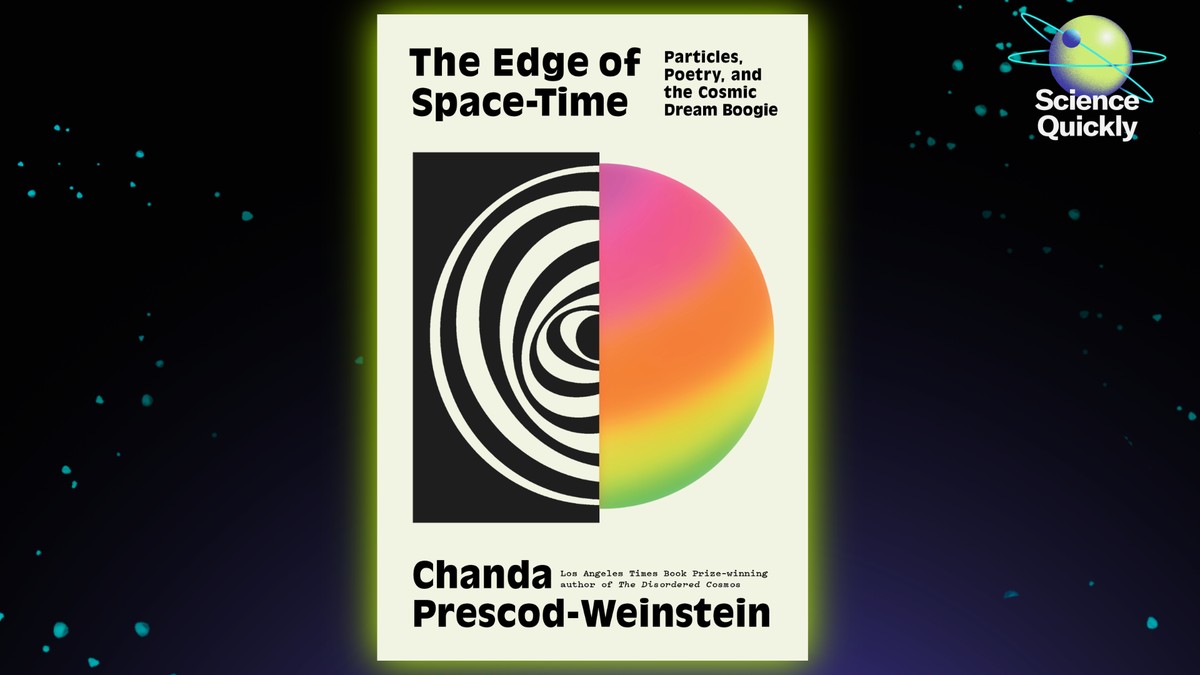
Theoretical physics is often perceived as a cold, intimidating landscape of abstract equations and impenetrable jargon. However, for physicist Chanda Prescod-Weinstein, the study of the universe is far from sterile. In her new book, The Edge of Space-Time: Particles, Poetry, and the Cosmic Dream Boogie, she argues that the boundaries of our universe are deeply intertwined with the humanities—spanning from ancient philosophy and queer theory to pop culture icons like Star Trek and Missy Elliott.
In a recent discussion with Scientific American editor Bri Kane, Prescod-Weinstein explored how the rhythms of physics mirror the structures of poetry, the importance of diverse scientific histories, and the lingering mysteries of the dark universe.
The Poetry of Patterns
For Prescod-Weinstein, the connection between physics and poetry is not merely metaphorical; it is structural.
“There’s a poetry to [the universe]… There’s a rhythm and patterns,” she explains. “What we do in physics is look for patterns and try to establish them. Poetry is often very pattern-based, whether you’re talking about meter or the structure of the poem on the page.”
This perspective reframes physics from a dry collection of rules into a search for the underlying elegance of existence.
Uncovering Forgotten Histories
One of the most striking aspects of Prescod-Weinstein’s work is her effort to bridge the gap between science and the humanities by uncovering lost intellectual lineages. She notes that our modern understanding of physics often overlooks non-Western contributions that were documented centuries ago.
A key example is Mozi, a philosopher from China’s Zhou kingdom. While researching Newton’s laws, Prescod-Weinstein discovered that Mozi had articulated principles similar to Newtonian physics a millennium before Newton was born. This discovery highlights a critical truth: science relies heavily on the humanities. Without the work of historians and translators, much of the foundational human inquiry into space and time would remain lost to history.
Science Fiction as a Moral Compass
While many view science fiction as a genre focused on “gadgetry” or impossible technology, Prescod-Weinstein finds its true value in its social implications. Using Star Trek as a primary example, she argues that the franchise’s greatest achievement isn’t faster-than-light travel, but its vision of human cooperation.
To her, Star Trek represents a “guiding light” for how scientists should behave in society:
* A Vision of Utopia: A society where basic needs are met, allowing humans to focus on curiosity and exploration.
* Ethical Engagement: A framework for interacting with the unknown—and with each other—with respect and shared values.
* Social Responsibility: The idea that science should be conducted by a species that has transformed itself into peaceful, inquisitive beings.
The Great Unknowns: Dark Matter and Cosmic Acceleration
The conversation shifted toward the “frontier” problems that define modern cosmology—mysteries that even the most brilliant minds are still struggling to solve.
1. The Dark Matter Problem
Prescod-Weinstein recounts a formative encounter with the late Vera Rubin, the astronomer who proved that most of the matter in the universe is invisible. Rubin’s work opened a door for a new generation of scientists to tackle the “dark matter” puzzle.
Currently, researchers are hunting for particles like the axion to explain this invisible mass. The hunt is gaining momentum thanks to a new wave of technology, including the Vera C. Rubin Observatory, the Nancy Grace Roman Space Telescope, and the Euclid telescope, all of which aim to map galaxy structures with unprecedented detail.
2. Cosmic Acceleration and the “Coincidence Problem”
Perhaps even more unsettling is the discovery that the expansion of the universe is not slowing down, but accelerating. This phenomenon is often attributed to dark energy (or a “cosmological constant”).
However, Prescod-Weinstein finds the standard explanation—that this energy is simply a fundamental property of a vacuum—to be deeply unsatisfying. It leads to the “coincidence problem” : if the universe’s expansion is driven by this specific energy, why does it happen at a time and in a way that allows for our existence? This raises profound metaphysical questions: are we merely incidental observers in a cosmic fluke, or is there a deeper logic we have yet to grasp?
Conclusion
Chanda Prescod-Weinstein’s work suggests that physics is not just about calculating the movement of particles, but about understanding our place in a vast, rhythmic, and deeply interconnected cosmos. By blending hard science with art and history, she invites us to see the universe not as a math problem to be solved, but as a story to be told.