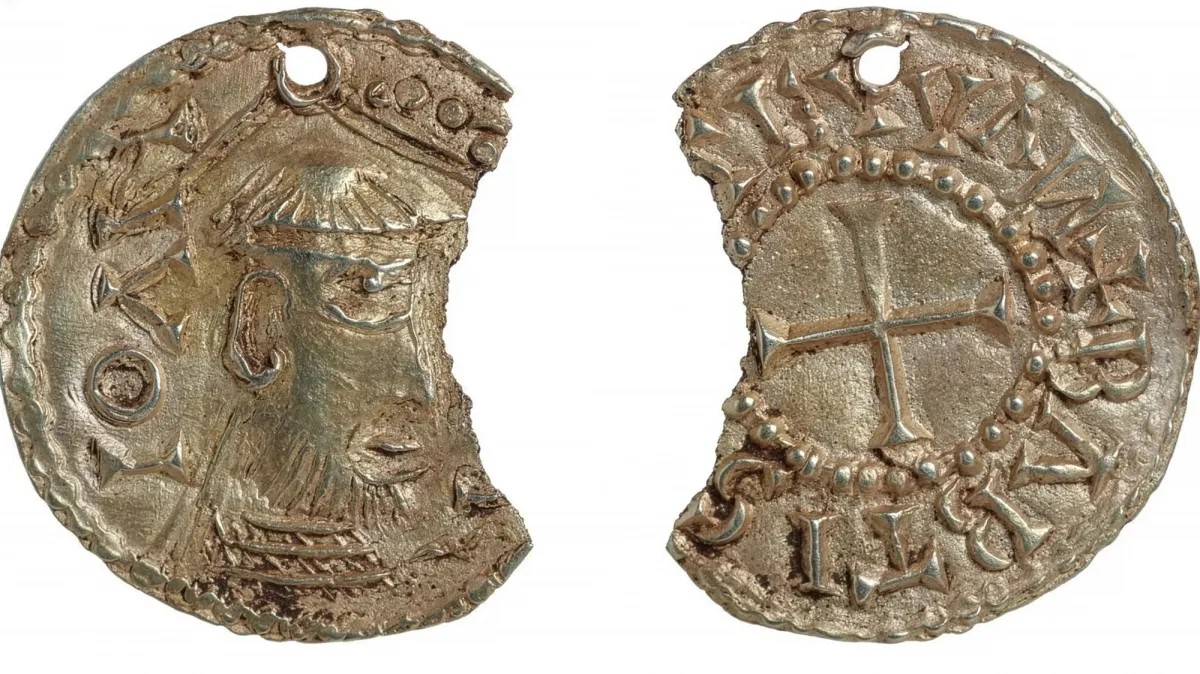
A recent discovery in the English countryside has left archaeologists and historians questioning the established narrative of the Viking Age. A metal detectorist, operating less than 30 minutes from the University of Cambridge, has unearthed a ninth-century gold coin pendant that defies conventional historical logic.
The Mystery of the Bearded Saint
While the discovery of ancient coins in England is relatively common—ranging from Iron Age gold in East Yorkshire to Viking silver caches in North Yorkshire—this specific find is unique due to its iconography.
The pendant features a detailed, bearded profile of Saint John the Baptist, a fact confirmed by a Latin inscription on the piece. This creates a profound historical contradiction: the coin was found in an area once controlled by Vikings who had conquered the English kingdom of East Anglia.
The central tension lies in the religious divide of the era:
– The Vikings: Historically documented as pagans during this period.
– The Coin: Explicitly depicts a Christian saint.
Why This Discovery Matters
In the study of history, artifacts act as the primary evidence for how different cultures interacted. This coin is what numismatists (coin experts) call an “outlier”—it does not fit the established pattern of the time.
Simon Coupland, a numismatics expert, described the anomaly by comparing it to “a child trying to fit a hexagonal object into a square hole.” When an object refuses to fit the “square hole” of known history, it suggests that our understanding of the “square” itself—the historical context—may be flawed.
The presence of a Christian saint on a Viking-era artifact raises several compelling possibilities regarding cultural integration:
- Cultural Assimilation: Did pagan Vikings adopt Christian symbols as a way to blend into the largely Christian population of East Anglia?
- Individual Agency: Was the pendant simply owned by a Christian resident of East Anglia, rather than a Viking?
- Early Conversion: Does this suggest that some Vikings were adopting Christianity much earlier than historians previously believed?
Redefining the Ninth Century
The ninth century was a period of intense conflict and movement across the British Isles. For a long time, the distinction between the “pagan invader” and the “Christian local” has been treated as a sharp, clear line.
However, this gold pendant suggests a much more fluid and complex cultural landscape. It hints at a world where religious boundaries were being crossed through trade, marriage, or social necessity, long before the official Christianization of the Viking populations.
This single small artifact serves as a reminder that history is rarely a series of neat, isolated chapters, but rather a messy process of overlapping cultures.
Conclusion
This discovery challenges the traditional view of the Viking Age as a strictly binary conflict between paganism and Christianity. It suggests that the cultural and religious integration of England was far more nuanced and rapid than previously recorded.