Scientists did it again.
They proved Einstein right.
Once more.
His 1915 general theory of relativity says gravity is just objects falling along the curve of spacetime. Spacetime isn’t static. It bends. It twists.
Frame-dragging is the proof.
Imagine a spinning spoon in honey.
The honey moves. Anything caught in it moves with the spoon.
The Earth does the same to spacetime.
A massive, rotating planet drags the fabric of the universe along with its spin. Black holes do it too, just faster and more violently.
A new study in Nature measures this effect better than ever before.
Ignazio Ciufolini leads the work. He’s at Sapienza University in Rome.
“We improved the measurement by more than tenfold,” Ciufolini says.
In physics?
That is a big deal.
It helps kill off weird alternative theories of gravity.
The Disco Balls
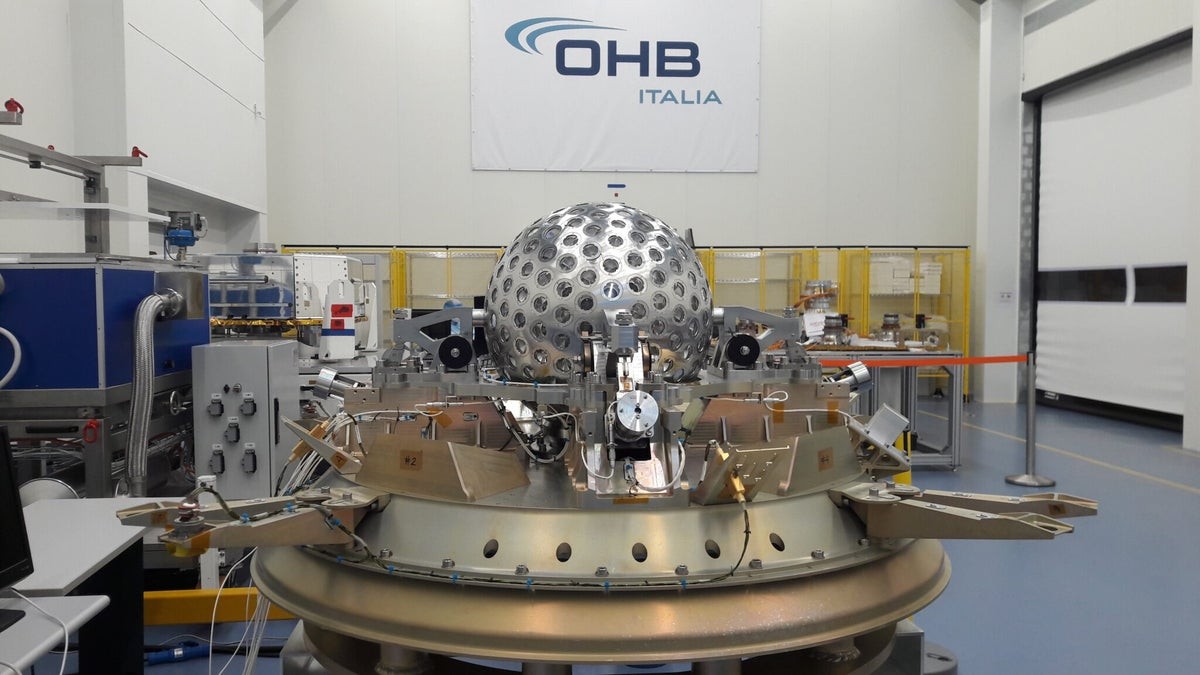
The data comes from LARES-2.
Launched in 2022 by the Italian Space Agency.
It is a follow-up to NASA’s older LAGEOS satellites.
All three are mirror-covered spheres.
Look like galactic disco balls.
Scientists bounce lasers off them to track their position in space with extreme precision.
They orbit thousands of kilometers up.
Way above the atmosphere.
No air to mess up their path.
If Earth were a perfect sphere, those satellites would only shift because of frame-dragging.
Earth is not a sphere.
The moon and sun pull on it.
Tides make the planet lopsided.
That messes up the orbit calculations.
Ciufolini and his team had to cancel out the moon and sun noise.
They combined LARES-2 data with the old LAGEOS numbers.
They pinned frame-dragging down to one part in a thousand uncertainty.
Daniel Holz calls it an impressive feat.
He teaches astrophysics at Chicago.
He wasn’t on the project.
NASA tried this before.
Gravity Probe B launched in 2004.
Cost $750 million.
Used gyros.
This new method?
Way cheaper.
Way better.
“They treat the whole orbit as a gyroscope,” Holz says.
It’s elegant.
One hundred times better precision for a fraction of the price.
The Tidal Problem
Tracking lunar and solar tides was the hard part.
Most tidal effects canceled out when mixing the satellite data.
One didn’t.
K1 tide.
It added uncertainty.
The team had to watch how K1 pulled on the satellites for three whole years.
They finally understood its grip.
Placed new limits on K1’s strength.
Helps seismologists and oceanographers.
Good bonus.
The main goal?
Testing Einstein against other ideas.
Paul Lasky sees the catch.
He’s at Monash University.
“We are in the solar system,” Lasky points out.
Gravity here is weak.
Alternate theories might look exactly like relativity in weak fields.
They would only show up where gravity gets insane.
Near black holes.
In strong regimes.
“This is a pristine measurement,” Lasky admits.
“But it doesn’t probe the strong gravity zones.”
Does it matter?
For now.
Holz says it just adds another feather to Einstein’s cap.
Relativity stays intact.
Some creative new theories?
Dead on arrival.
Ruled out.
Progress happens that way.
The theorists who wanted to break Einstein’s rules have to move on.
Next theory.
Next test.
Einstein still waits in the wings.