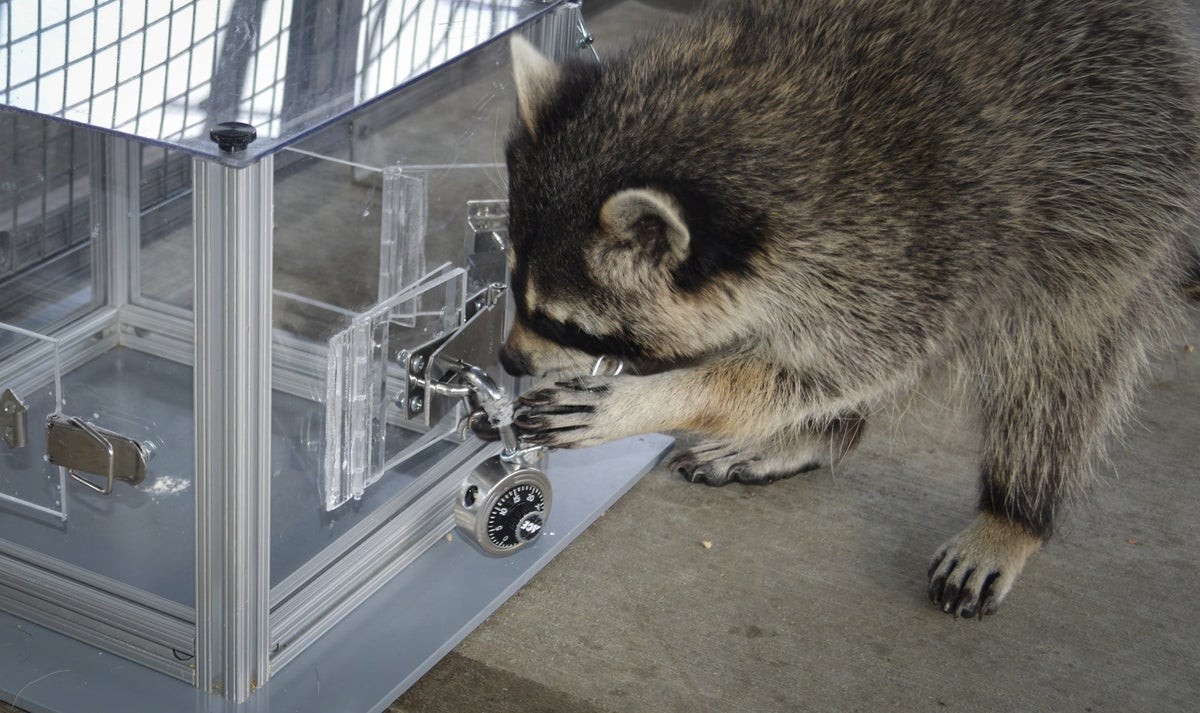
Raccoons are surprisingly intelligent creatures, and new research suggests their problem-solving isn’t solely driven by hunger. Like humans enjoying a challenging puzzle, these adaptable animals will persistently investigate solutions even when no reward is guaranteed. This behavior highlights a cognitive flexibility that helps them thrive in human environments – and makes securing your trash bins a constant battle.
The Science of Curiosity
Researchers at the University of California, Berkeley, and the University of British Columbia have discovered that raccoons engage in what they call “information foraging.” This means they explore alternative ways to solve puzzles, like a multi-access box with locks and latches, even after already obtaining a treat. The study tested captive raccoons using puzzle boxes filled with marshmallows, sardines, or sardine-dipped dates (marshmallows were the clear favorite). Scientists expected the raccoons to stop once they got their reward, but instead, the animals continued opening alternative solutions.
Beyond Immediate Rewards
The team found that raccoons don’t just seek food; they actively seek knowledge about how things work. This suggests an intrinsic motivation for problem-solving beyond basic survival. Hannah Griebling, a Ph.D. candidate in cognitive ecology, explains: “They’ll open one solution, get the marshmallow, and then immediately try another one… not waiting for a refill.” The behavior diminishes with puzzle complexity but never stops completely.
Implications for Human-Wildlife Interaction
This research has clear implications for managing raccoon behavior in urban settings. Rather than simply making containers harder to open, which could encourage further investigation, the best approach is complete prevention. As Griebling notes, “Really ensuring that they can’t get into something is probably important.” The study also raises broader questions about animal cognition. While we can’t know what raccoons are thinking, their behavior suggests that curiosity and problem-solving can be rewarding in themselves.
The findings also underscore the need for further research with wild populations. Captive raccoons may behave differently from those in their natural habitat, where the risks of wasting time on an unsolvable lock are higher. Ultimately, this research reinforces that raccoons aren’t just clever scavengers; they’re intrinsically motivated problem-solvers whose behavior is far more complex than simple hunger.