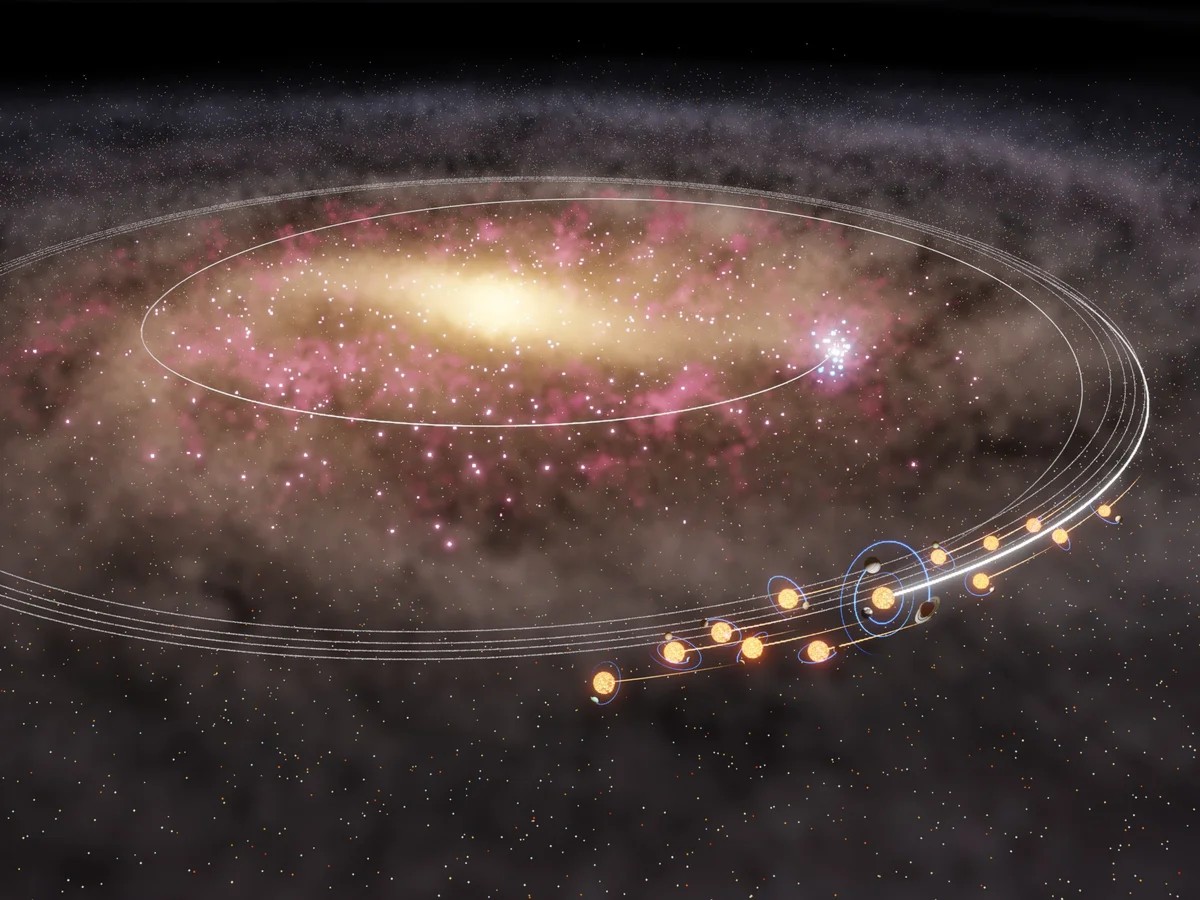
For billions of years, our sun has resided in a relatively quiet region of the Milky Way galaxy. But new research confirms it wasn’t always this way: the sun, along with thousands of similar stars, embarked on a remarkable journey from the galaxy’s bustling core to its calmer outskirts. This discovery challenges previous assumptions about stellar movement and raises questions about how galactic structures influence star populations.
The Sun’s Galactic Origins
Astronomers have long suspected that the sun formed closer to the galactic center, where star formation was faster and heavy metals were more abundant. A star with the sun’s age and chemical composition would not have been able to form in its current location. The key evidence lies in the sun’s chemical makeup, which indicates its birthplace was far more metal-rich than the peaceful galactic suburbs it occupies today.
This migration wasn’t a solo journey. Researchers analyzed data from the European Space Agency’s Gaia satellite, cataloging 6,594 “solar twins”—stars with similar mass and metallic composition to our sun—within 1,000 light-years of Earth. The age distribution revealed two distinct peaks: a younger group of stars formed locally, and a massive older population between six and four billion years old that originated elsewhere.
Breaking the Galactic Barrier
The Milky Way’s structure presented a significant obstacle to this migration. An enormous rotating bar of gas, dust, and stars slices through the galactic center, creating a “corotation barrier” that typically prevents inner galaxy stars from moving outward. Simulations suggest only about 1% of stars born near the core could breach this barrier within 4.6 billion years. Yet, the data shows thousands of solar twins did make the journey.
How? The researchers propose that the corotation barrier wasn’t fully formed when the migration occurred. Instead, the growing galactic bar may have actually propelled the stars outward, aided by the Milky Way’s spiral arms and gravitational interactions with the Sagittarius dwarf galaxy. This suggests that galactic dynamics are more fluid and less restrictive than previously believed.
Debate and Further Research
Some astronomers caution that the observed peak in older solar twins might be a statistical illusion, caused by the way the sample was selected. Distance limitations could favor stars with oblong orbits, which tend to be older. However, the research team claims to have accounted for this bias, finding no strong correlation between age and orbital shape in the solar twins.
The field of galaxy dynamics is ever-evolving, and exact timescales remain uncertain. But the evidence strongly suggests that the sun and its stellar companions were not static residents of the galaxy. Instead, they were active migrants, reshaped by the forces of galactic evolution.
This migration matters because it redefines our understanding of how stars populate galaxies. If thousands of stars can breach seemingly insurmountable barriers, it implies that galactic structures are more porous than once thought, and stellar movement is far more widespread than previously imagined.