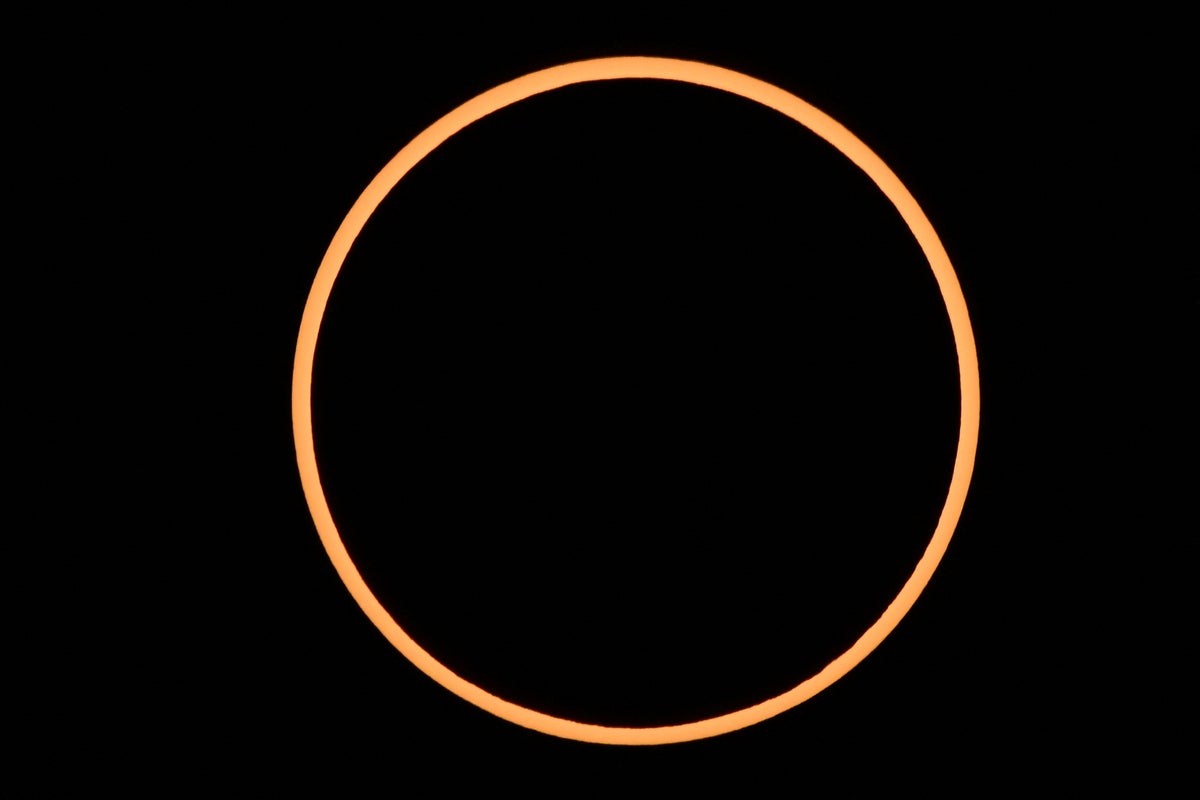
A striking annular solar eclipse – often called a “ring of fire” due to the fiery halo of sunlight visible around the moon – graced parts of the Southern Hemisphere on Tuesday. The event, the first of its kind in 2026, occurred when the moon passed between the Earth and the sun at its farthest orbital point, creating a spectacular but brief celestial display.
What Makes This Eclipse Unique?
Unlike total solar eclipses where the moon completely blocks the sun, an annular eclipse happens when the moon is too far away to cover the sun’s disk entirely. This leaves a brilliant ring of sunlight visible around the moon’s silhouette. This is why it’s called “annular,” from the Latin word for ‘ring-shaped’.
Where Was It Visible?
The eclipse reached its peak at 7:12 A.M. EST, with the most dramatic view reserved for observers in Antarctica. While portions of Africa and South America also experienced the event, only those at Concordia Station in Antarctica witnessed the full “ring of fire” for a little over two minutes during a two-hour duration.
Why Do These Eclipses Matter?
Solar eclipses, though visually stunning, are also valuable scientific opportunities. They allow researchers to study the sun’s corona (outer atmosphere) and test predictions about the moon’s orbit. They also remind us of the precise movements of celestial bodies that govern our planet’s environment. The fact that this event was visible in Antarctica highlights how even remote regions can be connected to global astronomical phenomena.
Another annular eclipse is expected to occur soon, meaning those who missed this one will have another chance to witness the rare spectacle.
This eclipse serves as a reminder of the dynamic relationship between the Earth, the moon, and the sun, offering both scientific value and a breathtaking natural display.