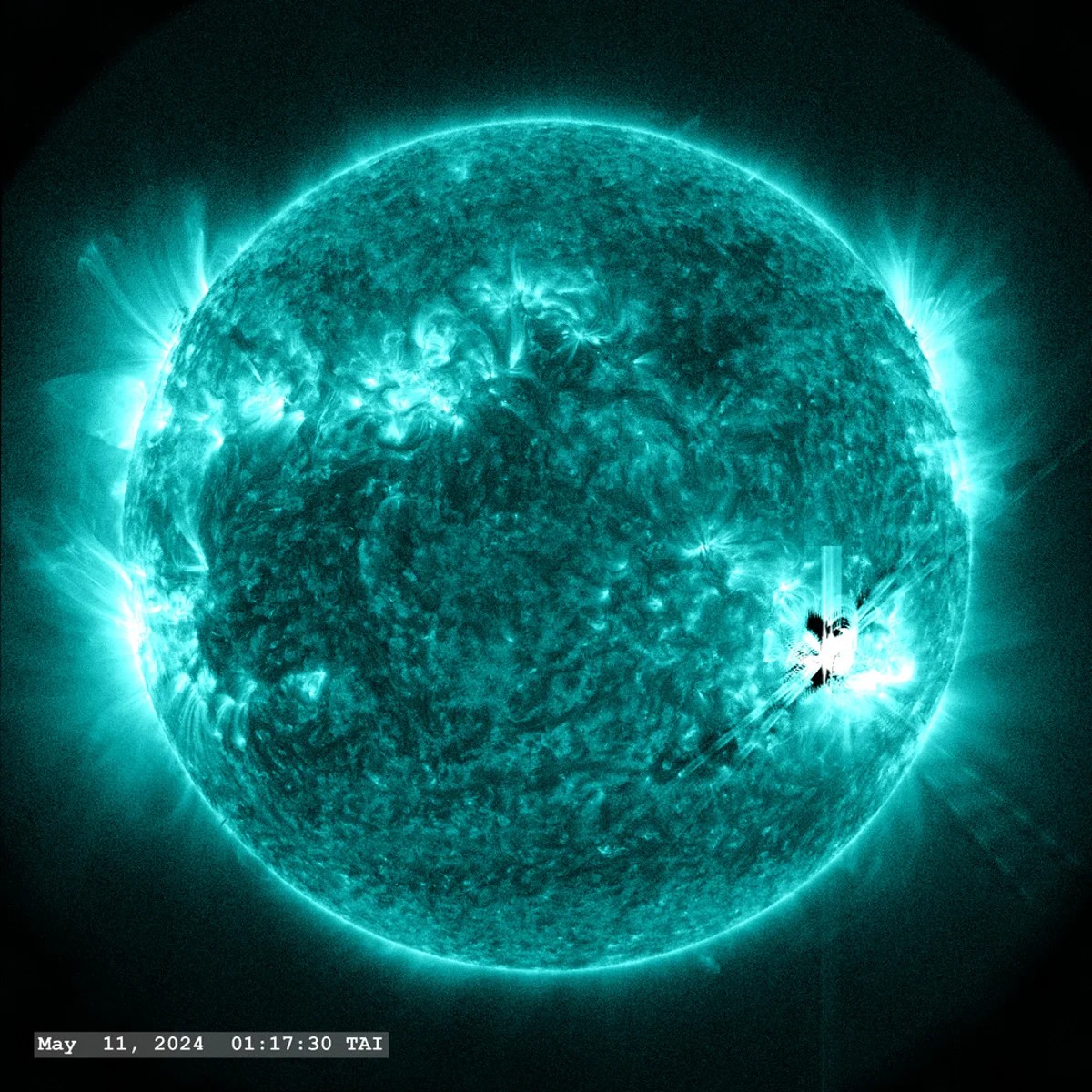
The most extensive continuous observation of a solar active region to date—spanning 94 days—has provided scientists with unprecedented data about the origins of powerful space weather events. This research, centered on active region NOAA 13664, comes after a May 2024 period marked by some of the strongest geomagnetic storms in over two decades. These storms disrupted critical infrastructure, including satellites, power grids, and GPS systems, while also creating spectacular auroral displays as far south as Florida.
The Challenge of Observing Solar Activity
The Sun’s rotation makes prolonged observation of any single active region difficult. Regions appear, unleash flares, and then rotate out of Earth’s view within weeks, limiting the time scientists have to study their evolution. Previously, capturing detailed, long-term data on these regions was nearly impossible.
Solar Orbiter’s Breakthrough
The European Space Agency’s Solar Orbiter mission has changed this. Launched in 2020, the Orbiter allowed researchers to track NOAA 13664 from its emergence on the far side of the Sun on April 16, 2024, through its eventual disappearance behind the solar limb on July 18, 2024. This uninterrupted view is a landmark achievement in solar physics. According to Ioannis Kontogiannis, a physicist at ETH Zurich, it represents “the longest continuous series of images ever created for a single active region.”
What We Learned and Why It Matters
NOAA 13664 proved to be exceptionally potent, triggering severe geomagnetic storms that impacted Earth. The research underscores the unpredictable nature of solar eruptions; scientists can observe them, but precisely forecasting their intensity remains a key challenge. As Louise Harra, lead author of the study, explains, disruptions can even extend to critical systems like railway signaling, with potentially dangerous consequences.
“Even signals on railway lines can be affected and switch from red to green or vice versa… That’s really scary.”
Looking Ahead
The data collected from NOAA 13664 will be crucial for refining space weather models and improving our ability to predict and mitigate the effects of future solar storms. The Sun’s influence on Earth is undeniable, and continued observation is vital for safeguarding our increasingly technology-dependent society.
The ability to track solar activity in such detail provides a foundation for more accurate forecasts. This will help protect infrastructure and ensure the reliability of critical services during periods of heightened solar activity.