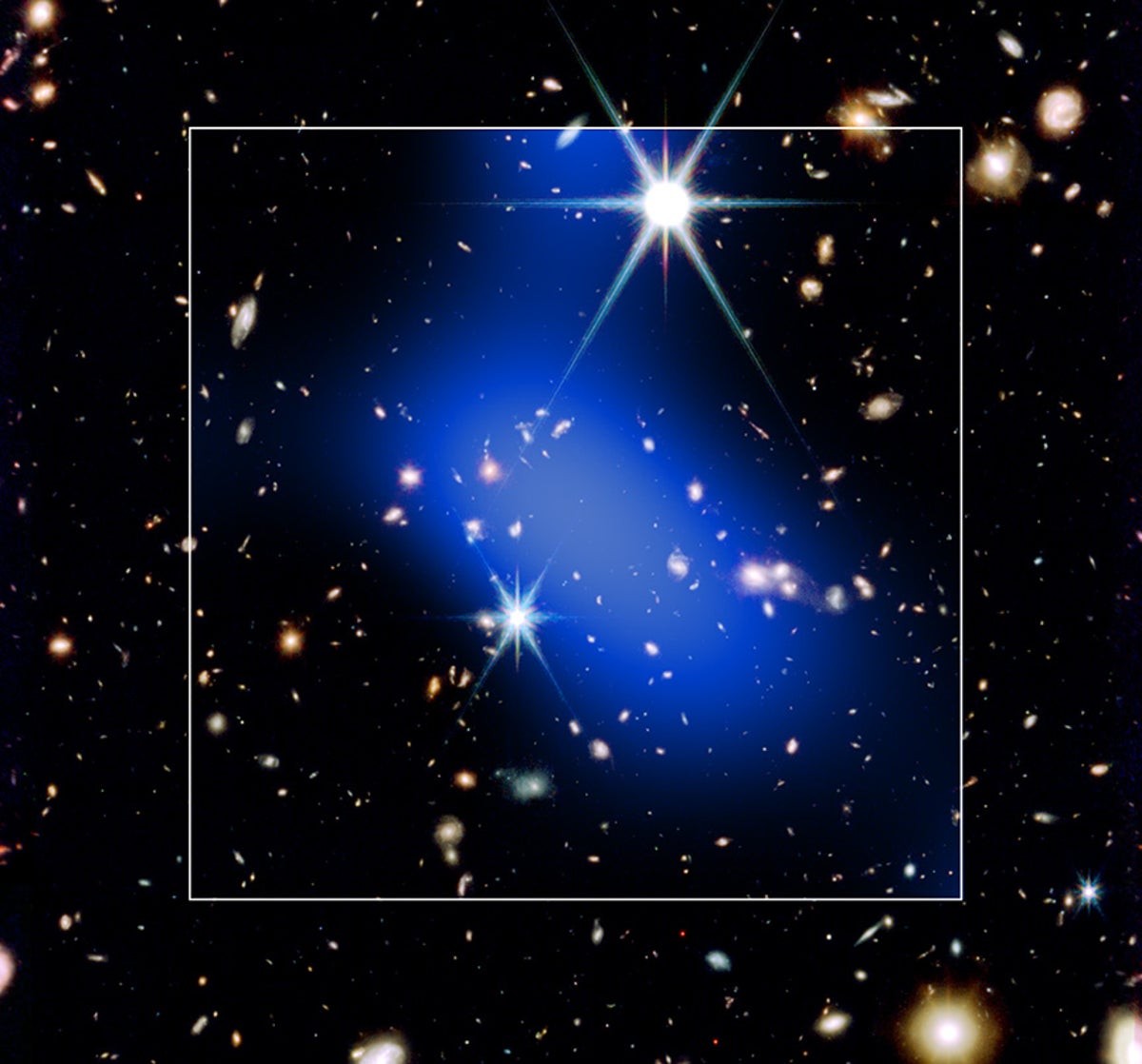
Astronomers have discovered an unexpectedly advanced “baby cluster” of galaxies, forming just a billion years after the Big Bang. This protocluster, designated JADES-ID1, challenges current cosmological models by appearing far more developed than predicted for its age. The discovery, made using data from NASA’s Chandra X-ray Observatory and the James Webb Space Telescope (JWST), marks the most distant confirmed protocluster with a detectable X-ray signature to date.
The Unexpected Maturity of JADES-ID1
Galaxy clusters are pivotal in astrophysics, serving as natural laboratories for studying galactic interactions and black hole growth. They also provide valuable insights into the cosmic web—the large-scale structure of the universe. JADES-ID1 contains at least 66 young galaxies and boasts a mass 20 trillion times that of our solar system, with most of its density coming from dark matter. Crucially, the protocluster is enveloped in a massive, X-ray emitting cloud of hot gas, typically seen in mature clusters.
This early presence of a hot gas atmosphere is what sets JADES-ID1 apart. Mature clusters develop this “intracluster medium” as gravity draws in gas, creating shock waves and heating the surrounding space. The fact that JADES-ID1 already displays this feature two billion years before the previous record-holding X-ray protocluster suggests unusually rapid growth.
What This Means for Cosmic Models
Current cosmological models struggle to explain how such a massive structure could assemble so early in the universe’s history. If JADES-ID1 continued growing at its current pace, it would eventually become an anomalously large galaxy cluster. Whether this requires a revision of existing cosmological frameworks remains uncertain, but the discovery raises fundamental questions about structure formation in the early universe.
Some researchers suggest that the protocluster’s rapid development might be an extreme but not impossible event within existing models. Simulations have shown that similar structures could form and exhibit detectable X-ray atmospheres within a half-billion years, though their growth tends to slow down as they mature. However, whether JADES-ID1 will follow this pattern is yet to be determined.
The Need for Further Research
Confirming the significance of this finding requires more data. Astronomers must identify additional protoclusters of similar age to determine if JADES-ID1 is an outlier or part of a broader, previously unrecognized phenomenon. Next-generation X-ray telescopes with improved sensitivity will also be crucial to refine our understanding of these extreme systems.
The discovery of JADES-ID1 underscores the dynamic and often unpredictable nature of cosmic evolution. Whether it represents a flaw in our current models or a rare but natural process, further investigation promises to reshape our understanding of the early universe.