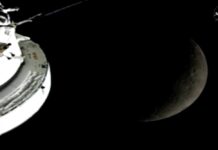
While most people on Earth only get a few fleeting minutes to witness a total solar eclipse, the crew of NASA’s Artemis II mission experienced something far more profound. Orbiting just a few thousand miles above the Moon, the four astronauts were treated to a celestial spectacle that redefined the traditional eclipse experience.
A Different Kind of Totality
On Earth, a total solar eclipse is a brief, dramatic event caused by a cosmic coincidence: the Sun is roughly 400 times larger than the Moon, but also 400 times farther away, making them appear nearly identical in our sky. On Earth, this alignment lasts only a few minutes.
However, from the vantage point of the Orion spacecraft, the scale and duration were entirely different:
- Extended Duration: Instead of a few minutes, the period of “totality”—when the Moon completely obscured the Sun—lasted an incredible 57 minutes.
- A Darker Canvas: As the Sun vanished, the crew observed the Moon as a “black orb,” illuminated only by Earthshine (the faint light reflected from our planet onto the lunar surface).
- Cosmic Clarity: With the Sun’s glare removed, the astronauts were able to observe planets including Venus, Mars, Saturn, and Mercury, along with various constellations, in much higher clarity.
Scientific Objectives Amidst the Spectacle
While the astronauts described the event as “indescribable” and “surreal,” the mission was not merely a sightseeing tour. The eclipse provided a rare window for several high-priority scientific observations:
1. Studying the Solar Corona
During the moments when the Sun’s disk was partially covered, the crew looked for features in the corona —the Sun’s outermost atmosphere. Observing solar streamers and plumes helps scientists better understand the Sun’s magnetic field and its impact on space weather.
2. Monitoring Lunar Dust
One of the most critical goals was observing lunar dust. Unlike Earth’s dust, lunar dust consists of sharp, glassy fragments created by constant meteoroid impacts. Because solar radiation can electrostatically charge these particles, they can “levitate” off the surface.
Understanding how this dust moves is vital for future lunar missions, as it is highly abrasive and poses a significant risk to both human lungs and sensitive space machinery.
3. Interplanetary Dust and Zodiacal Light
The crew also searched for zodiacal light, a faint glow caused by sunlight reflecting off interplanetary dust clouds. This helps researchers map the distribution of matter within our solar system.
The Human Element
Despite the intense scientific focus, the crew’s reactions were deeply personal. Astronaut Victor Glover noted that the human eye may not even be evolved to process such a sight, while Reid Wiseman remarked that the experience was so spectacular that he felt the need to “invent new adjectives” to describe it.
The mission also faced minor setbacks; while scientists hoped to observe Comet C/2026 A1 (MAPS) during the eclipse, the comet unfortunately disintegrated during its recent close approach to the Sun.
Conclusion
The Artemis II eclipse was more than a visual marvel; it was a unique laboratory in the sky. By observing the solar corona and lunar dust from a lunar perspective, NASA is gathering critical data that will help protect future astronauts as humanity moves toward long-term habitation of the Moon.