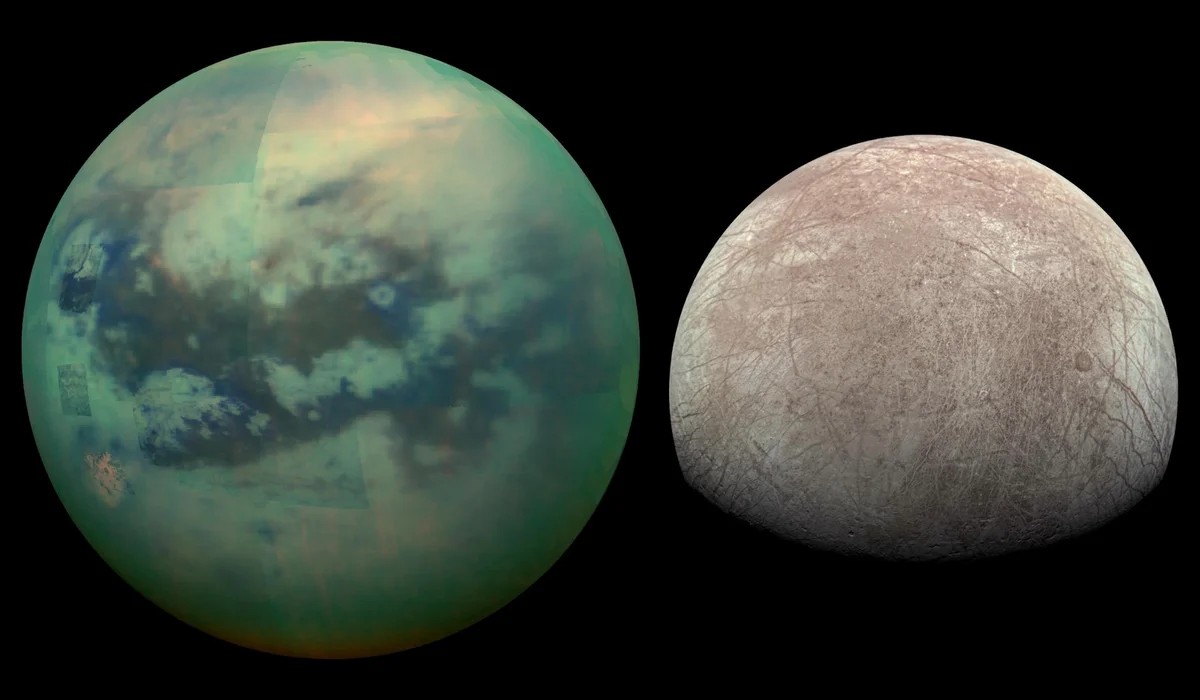
Recent research from NASA’s Cassini and Juno missions has cast doubt on the long-held assumption that Saturn’s moon Titan and Jupiter’s moon Europa harbor readily accessible subsurface oceans. While both moons remain scientifically intriguing, new data suggests that their potential for liquid water environments beneath their icy crusts is more complex — and potentially less promising — than previously thought.
Titan: A Slushy Interior, Not a Global Ocean
For years, scientists theorized that Titan, with its unique hydrocarbon-rich surface, also concealed a global ocean of water and ammonia beneath its icy shell. This idea was supported by observations of surface movement that seemed too fluid for a solid interior. However, a re-examination of Cassini mission data by researchers at NASA’s Jet Propulsion Laboratory now suggests otherwise.
Instead of a continuous ocean, Titan appears to have a slushy interior punctuated by pockets of liquid water. This revised understanding better aligns with all existing data, though it challenges the initial hope of a readily habitable environment. The upcoming Dragonfly mission, set to launch in 2028, will carry a seismometer to further probe Titan’s internal structure and provide more definitive answers.
“Sometimes it’s still shocking to think of Titan without an ocean,” admits Flavio Petricca, a planetary scientist at JPL.
Europa: A Thicker Ice Shell Limits Ocean-Surface Interaction
Europa, another prime candidate for harboring a subsurface ocean, may also be less accessible than initially believed. New data from the Juno mission indicates that Europa’s icy shell is likely thicker than previously estimated — potentially up to 20 miles deep. This thickness reduces the probability of significant interaction between the ocean and the surface, which is crucial for assessing habitability.
The Juno mission’s microwave radiometer was able to gather this data in just five minutes, demonstrating the efficiency of modern space exploration. While this is still an estimate, it represents the first direct physical measurement of Europa’s ice shell thickness.
Why This Matters
The search for life beyond Earth relies heavily on identifying environments where liquid water exists. Both Titan and Europa were considered frontrunners due to their suspected subsurface oceans. These new findings don’t rule out the possibility of life, but they raise the bar for what constitutes a habitable environment in our solar system.
The debate over the nature of these oceans highlights the importance of continuous data re-evaluation and the need for dedicated missions like Europa Clipper (NASA) and Jupiter Icy Moons Explorer (ESA) to gather more precise measurements. The coming years will be critical in refining our understanding of these enigmatic moons.
These revised assessments underscore a key principle in planetary science: assumptions must be constantly challenged, and data must be re-examined as technology advances. The ongoing exploration of Titan and Europa will continue to shape our understanding of ocean worlds, even if those worlds turn out to be more complex than anticipated.