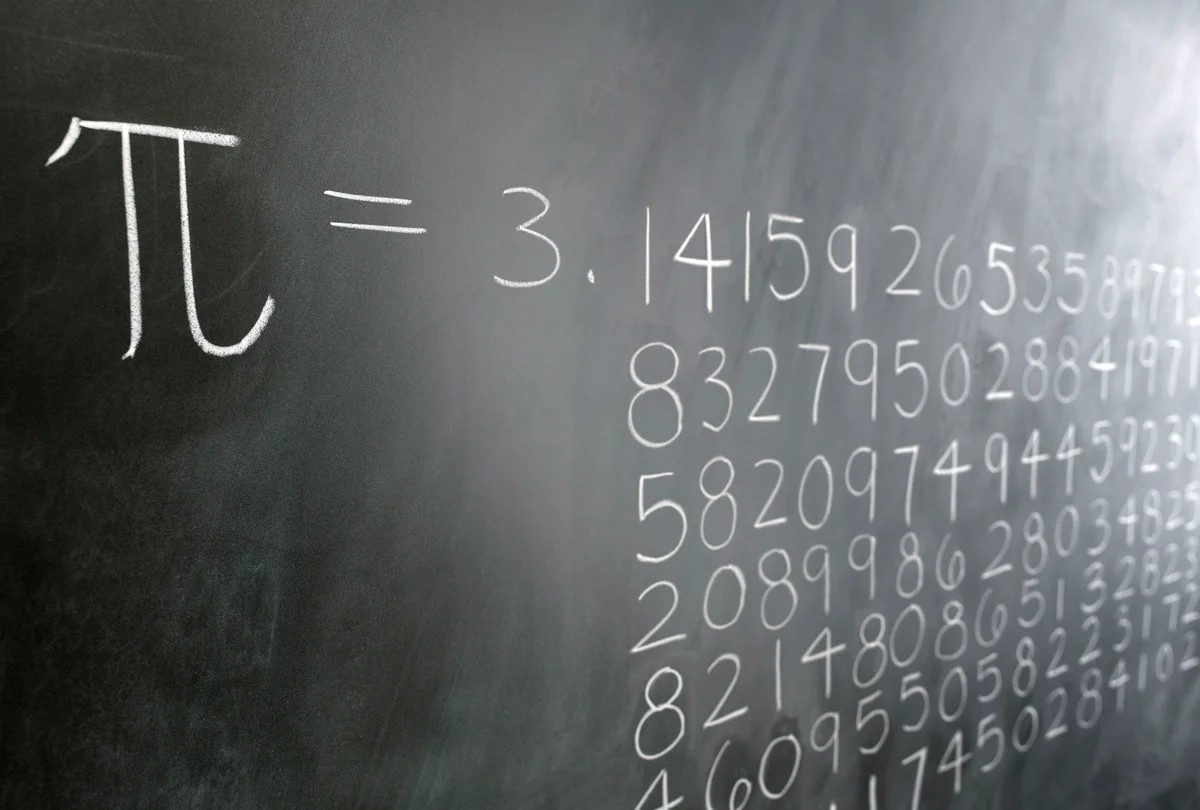
For over two millennia, mathematicians have relentlessly sought faster methods to calculate pi, resulting in thousands of distinct equations. Until now, each formula stood alone, a fragmented piece of an obscure puzzle. A new discovery reveals that these equations aren’t isolated incidents; they are expressions of a single, underlying mathematical structure. This breakthrough offers a cohesive framework for understanding pi’s calculations, rather than a collection of independent approaches.
The quest to calculate pi began with Archimedes, who estimated its value by inscribing and circumscribing polygons within a circle. His method, while rigorous for its time, relied on geometry and approximations. Over the centuries, mathematicians like Madhava of Sangamagrama and Leonhard Euler developed infinite series that converged on pi with increasing efficiency, but each remained a separate technique. Srinivasa Ramanujan later produced remarkably efficient formulas, yet no unifying principle connected them.
The Breakthrough: A Conservative Matrix Field (CMF)
In late 2025, a team of AI researchers at the Technion–Israel Institute of Technology identified a previously unknown structure—a Conservative Matrix Field (CMF)—underlying hundreds of pi formulas. This CMF acts as a common ancestor, demonstrating that seemingly unrelated equations are variations of the same fundamental object.
The team’s approach involved collecting and analyzing nearly half a million mathematical papers from arXiv.org. Using GPT-4o and specialized algorithms, they extracted 385 unique pi formulas, including those generated by the “Ramanujan Machine”—an AI bot designed to discover new mathematical conjectures. By recasting these formulas into a standardized infinite series format, the researchers could analyze their relationships within the CMF.
How the CMF Works
The CMF functions like a gravitational field on a grid. Each pi formula traces a unique path across this grid, but the destination (pi itself) remains constant. This means that equivalent formulas, though superficially different, converge on the same result within the CMF. The team’s algorithm confirmed that 43% of known pi formulas descend from a single CMF, with another 51% belonging to broader clusters. Only 6% remain unconnected, suggesting a potential for further integration.
The discovery suggests that the CMF could unify all pi formulas. The researchers are still exploring whether every equation generated from the CMF will produce valid pi calculations, but initial results indicate a strong correlation.
As David Bailey, a computer scientist formerly at Lawrence Berkeley National Laboratory, notes, this is akin to discovering the periodic table after centuries of isolating elements randomly. The CMF represents a fundamental shift in how we understand and approach pi calculations.
The new structure could also have broader implications for other mathematical constants and unsolved problems, like the Riemann hypothesis. The CMF provides a framework for unifying disparate mathematical concepts, potentially unlocking new insights across multiple disciplines.