Physicists at the Large Hadron Collider (LHC) have released a new measurement of the W boson, one of the universe’s fundamental building blocks. This latest finding brings a sense of stability to the current laws of physics, aligning closely with the established Standard Model, but it also reignites a debate over conflicting data from previous experiments.
The Role of the W Boson
The W boson is a heavy, fundamental particle—meaning it cannot be broken down into smaller components. It is roughly 80 times heavier than a proton and serves as a primary carrier of the weak nuclear force.
This force is essential to the mechanics of the universe; it governs processes such as:
– Radioactive decay: The transformation of elements, such as uranium turning into lead.
– Nuclear fusion: The process that allows hydrogen to fuse into helium, powering stars like our sun.
A Tug-of-War Between Experiments
For the past two years, the physics community has been divided by two conflicting sets of data regarding the W boson’s mass.
- The CDF Anomaly (2022): Researchers at Fermilab’s Tevatron collider reported a highly precise measurement that suggested the W boson was heavier than the Standard Model predicts. If true, this would have signaled a “crack” in our fundamental understanding of physics, suggesting the existence of unknown particles or forces.
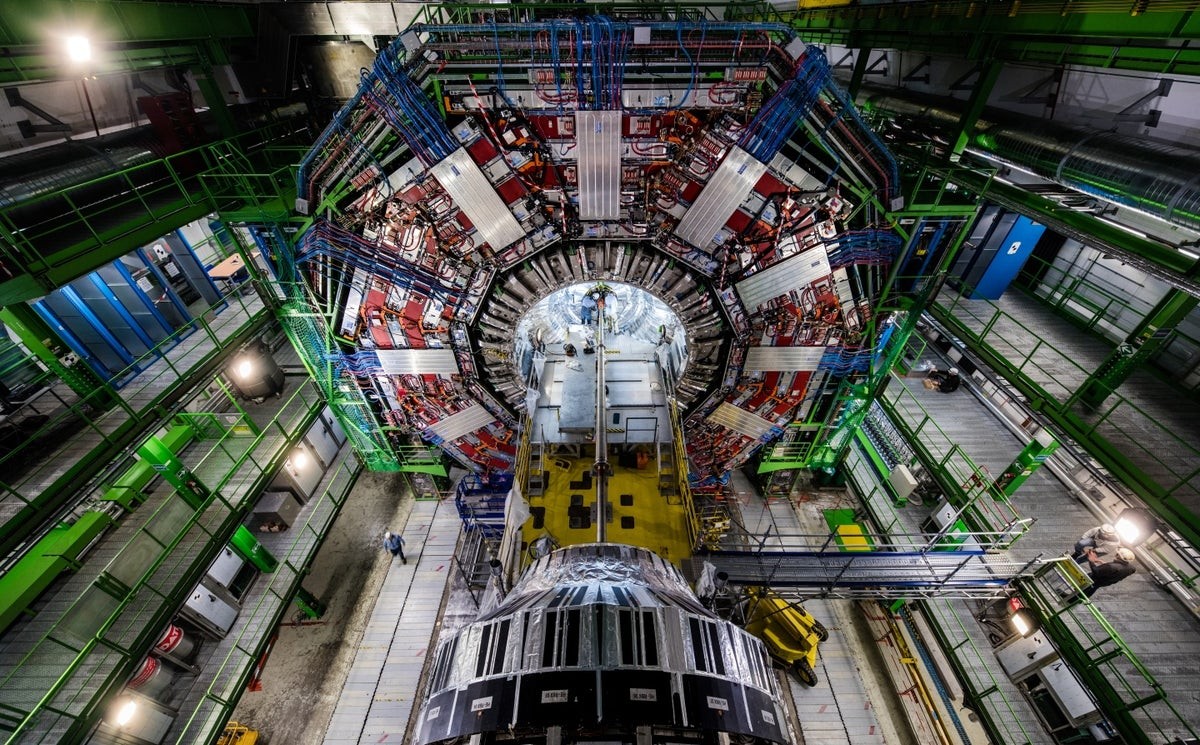
- The CMS Result (Current): The Compact Muon Solenoid (CMS) experiment at the LHC has now produced a measurement that aligns almost perfectly with the Standard Model. The W boson was measured at 80,360.2 ± 9.9 MeV, a figure that supports our existing theoretical framework.
“While it would have been thrilling to confirm the CDF result, what I really wanted was to publish a result that will stand the test of time,” says Kenneth Long, an MIT physicist and co-author of the study.
Why the Discrepancy Matters
The tension between these two results creates a scientific stalemate. Because both experiments claim high levels of precision, they cannot both be entirely correct.
Critics of the new CMS study, including Ashutosh Kotwal from Duke University, point out that the CMS measurement is only the first step. While the CDF team used six different methods to derive their mass, the current CMS publication relies on only one. This suggests that the “mystery” of the W boson is far from solved; it is simply a matter of determining which experimental method is more accurate.
The Search for “New Physics”
The Standard Model is the most successful theory in particle physics, yet scientists know it is incomplete. It fails to explain:
– Dark Matter: The invisible substance that makes up most of the universe’s mass.
– Dark Energy: The force driving the accelerated expansion of the cosmos.
Physicists are actively looking for “cracks” in the Standard Model—discrepancies between theory and reality—that could act as a gateway to these new frontiers. While the CMS measurement suggests that the recent W boson anomaly might just be an experimental error rather than a theoretical breakthrough, the hunt for a way to expand our understanding of the universe continues.
Conclusion
The latest measurement from the LHC reinforces the reliability of the Standard Model, potentially dismissing a major hint of new physics. However, the conflict with previous Fermilab data ensures that the quest to find flaws in our current understanding of the universe remains a top priority for physicists.