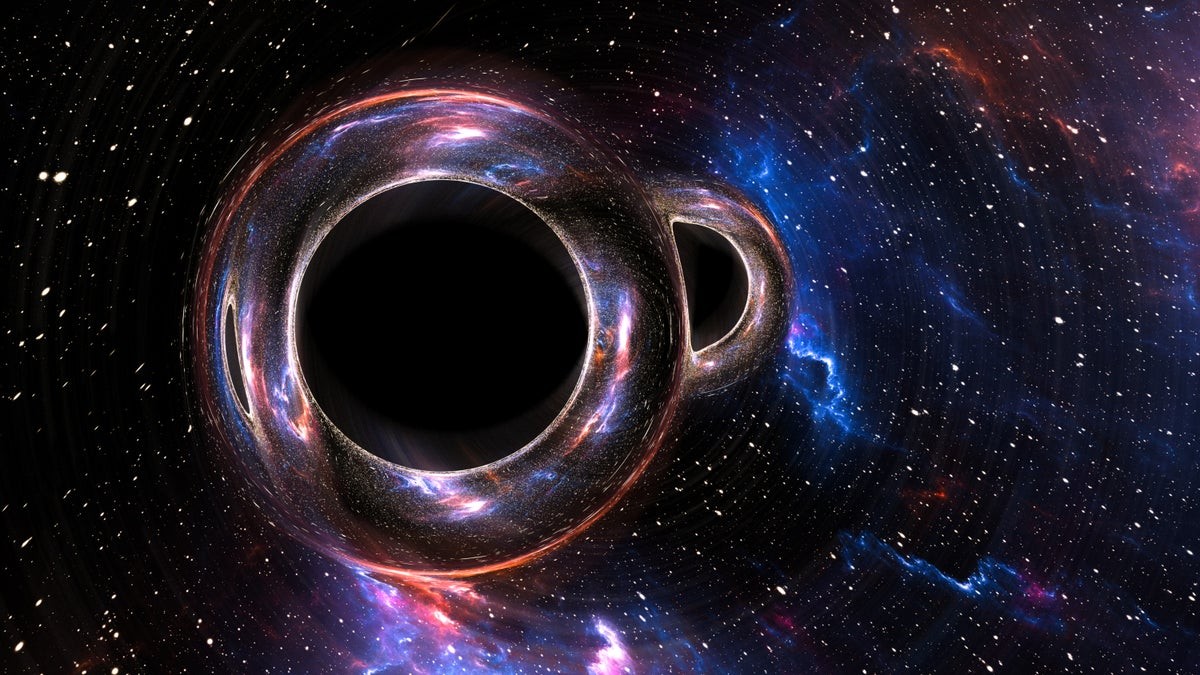
The universe’s most violent events aren’t always the brightest. While exploding stars and energetic pulsars grab headlines, the collisions of black holes release an almost incomprehensible amount of energy, a force so extreme it reshapes spacetime itself. This isn’t just theory; it’s a reality confirmed by decades of astronomical observation. But why does this matter? Because understanding these events is key to unraveling the universe’s deepest mysteries, from galaxy formation to the fundamental laws of physics.
The Inevitable Dance of Destruction
Black holes, by their nature, are gravitational vacuum cleaners. Once two find themselves in orbit, the eventual merger seems unavoidable. The process isn’t immediate. Two black holes, each with dozens of times the mass of our sun, could remain locked in a deadly waltz for longer than the universe has existed if they don’t encounter outside forces. If a nearby star perturbs their orbit, however, the stage is set for a catastrophic spiral.
Gravitational Waves: The Universe’s Hidden Scream
As the black holes draw closer, they begin emitting gravitational waves: ripples in the fabric of spacetime predicted by Einstein’s theory of relativity. These waves carry energy away from the system, causing the black holes to accelerate inward. This is a feedback loop: faster acceleration means stronger waves, which in turn accelerates the spiral further. In the final moments, the black holes orbit each other at near light speed, churning out increasingly powerful gravitational waves until they collide in a single, violent gulp. To date, astronomers have detected over 300 such mergers, each one a cosmic crescendo.
Energy Beyond Comprehension
The key to understanding the energy release lies in Einstein’s equation, E=mc², where mass converts into energy. During a black hole merger, roughly 5% of the combined mass is converted into gravitational waves. The implications are staggering. A collision between two five-solar-mass black holes releases as much energy in less than a second as our sun will emit over seven trillion years. To put that in perspective, it’s more energy than produced by a billion galaxies full of stars in the same timeframe.
The numbers scale dramatically with mass. Supermassive black holes—those behemoths at the centers of galaxies, weighing billions of times the mass of our sun—produce even more extreme results. Two 100-million-solar-mass black holes colliding release thousands of times the energy output of the entire visible universe in a single second. The scale is so immense that calculations can be disorienting; one scientist recalls first calculating the energy output, only to assume an error until double-checking the math. The result was a moment of existential dread at the raw power unleashed.
Invisible Power, Future Detection
These eruptions are invisible, however, because gravitational waves themselves are undetectable without specialized instruments. Moreover, supermassive mergers happen billions of light-years away, further weakening any signal by the time it reaches Earth. Despite this, evidence suggests these events occur. The European Space Agency’s Laser Interferometer Space Antenna (LISA) mission, set to launch in the next decade, may confirm them.
Even now, gravitational waves from these cosmic collisions pass through us constantly, weakened but still carrying the echo of unimaginable energy. The fact that such forces exist—and that we’re only beginning to understand them—underscores the universe’s brutal, awe-inspiring power.