The Winter Olympics are showcasing more than athletic skill; they are also a test of physics, strategy, and the limits of regulation. Recently, allegations surfaced – dubbed “Penisgate” – that some ski jumpers may have artificially altered their measurements to gain an edge. While shocking, the controversy highlights how even minor adjustments in equipment can drastically impact performance in a sport decided by centimeters.
The Physics of Surface Area
Ski jumping relies on exploiting aerodynamic principles to achieve maximum distance. The International Ski and Snowboard Federation (FIS) precisely measures jumpers’ suits, including “crotch height,” using laser technology. By temporarily increasing this measurement – whether through artificial means or strategic tailoring – athletes can obtain slightly larger suits.
This seemingly small change can be significant. Research from the 2000s and recent studies indicate that just one centimeter of extra material at the crotch could lengthen a jump by up to four meters. Similarly, increasing the suit’s overall circumference by one centimeter could add 3.2 meters to jump length. In a sport where victory margins are narrow, these gains matter enormously.
How Suits Manipulate Lift and Drag
The science is straightforward: extra fabric increases the surface area, providing more lift. This principle is analogous to the patagium of a flying squirrel, allowing for extended hang time. Ski jumpers aren’t just relying on gravity; they’re actively manipulating air resistance to their advantage.
Before the “Penisgate” scandal, officials from Norway’s ski jumping team were temporarily banned for illegally altering suits with extra crotch stitching during the Nordic World Ski Championships. This incident underscores how seriously athletes and coaches exploit these aerodynamic advantages. The FIS is now working to refine regulations to ensure fair measurement practices.
Beyond the Suit: The Role of Physics
While suit size is critical, ski jumping is fundamentally about physics. Jumpers accelerate down icy ramps to speeds of around 60 miles per hour, minimizing air resistance and friction. Their trajectory should follow a parabolic arc with an ideal launch angle of 45 degrees, but real-world conditions alter this.
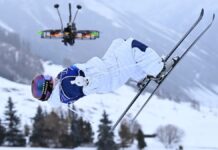
The sport’s modern “V” style jump, where skiers spread their skis in the air, is a prime example. By maximizing surface area, jumpers increase lift and reduce drag, extending their flight time. This technique revolutionized ski jumping in the 1990s, allowing athletes to jump farther—though also increasing crash rates.
Instinct Over Calculation
Despite the complex physics at play, elite ski jumpers don’t consciously calculate angles or drag coefficients mid-air. Muscle memory and years of training take over during competition. As Lasse Ottesen, a former Olympic ski jumper and current FIS race director, recalls, athletes become instinctively attuned to the forces acting on their bodies.
Ultimately, “Penisgate” exposes how even minor manipulations can exploit the physics of ski jumping. The scandal is a reminder that in competitive sports, where fractions of a second or centimeter determine victory, athletes will relentlessly push the boundaries of regulation and technique.