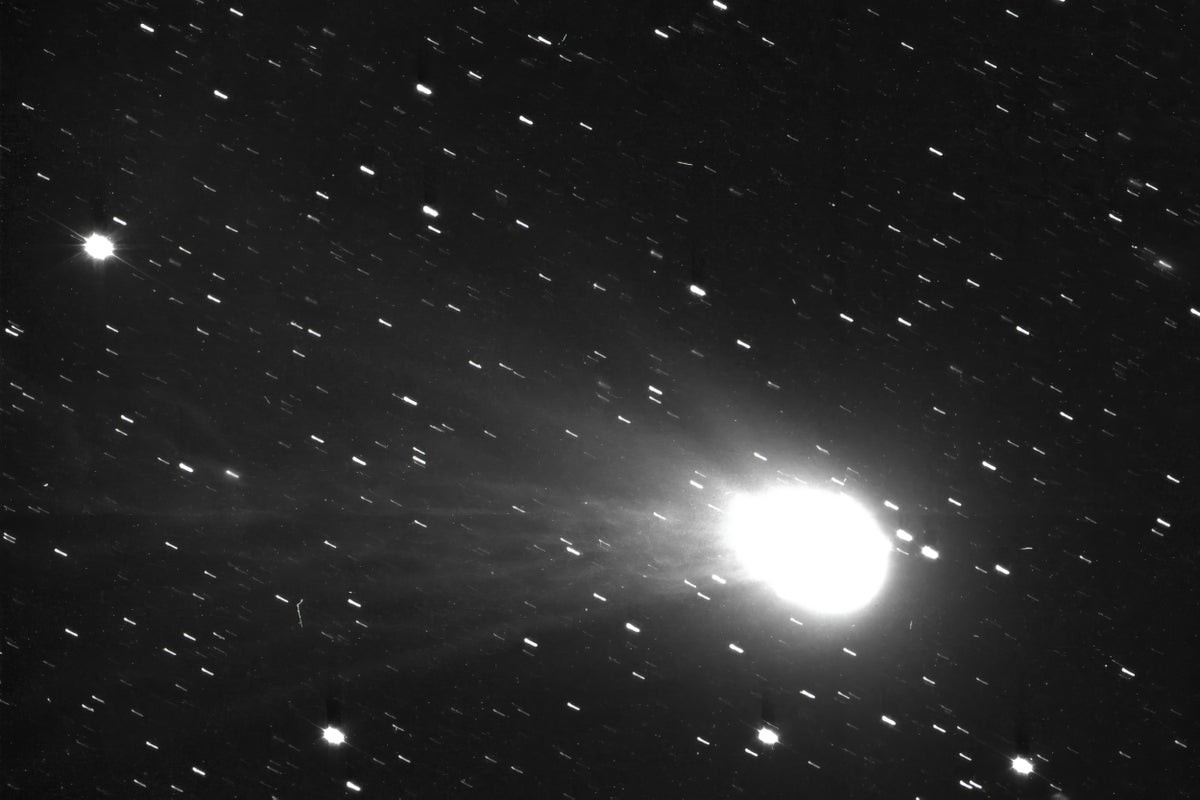
A recently observed interstellar comet, designated 3I/ATLAS, has captured the attention of astronomers worldwide as it speeds through our solar system. First spotted in July 2025, the comet reached speeds exceeding 150,000 miles per hour during its closest approach to the sun, making it one of the fastest interstellar objects ever recorded. The European Space Agency’s (ESA) Jupiter Icy Moons Explorer (JUICE) spacecraft captured a new image of the comet in November, revealing its unique egg-like shape and gas-veiled nucleus.
A Glimpse Beyond Our Solar System
Comet 3I/ATLAS is only the third interstellar object ever discovered passing through our solar system, making its observation particularly valuable. These rare visitors provide critical data about the conditions and composition of space beyond our sun’s gravitational influence. The comet’s extreme speed and trajectory suggest it may have traveled through interstellar space for billions of years before entering our solar system.
Why This Matters: Understanding Interstellar Space
The study of interstellar comets like 3I/ATLAS is crucial for several reasons. First, they offer a direct sample of material originating from other star systems. Second, their trajectories can help scientists understand the distribution of objects in interstellar space and the forces that govern their movement. Finally, these observations test our models of planetary system formation and evolution.
What We Know So Far
Despite intense observation, the comet’s origin remains unknown. As UCLA’s David Jewitt explains, “You can’t project that back with any accuracy to figure out where it started on its path.” The ESA has noted that the comet behaves like a typical comet, despite its interstellar origins. The JUICE mission’s images show a clear nucleus surrounded by a cloud of gas, suggesting ongoing sublimation as it heats up near the sun.
“It’s like glimpsing a rifle bullet for a thousandth of a second,” Jewitt said, illustrating the difficulty in studying such fast-moving objects.
The Future of Interstellar Object Research
As more interstellar objects are discovered and studied, scientists hope to refine their understanding of interstellar space. The next generation of telescopes and spacecraft will play a critical role in capturing more detailed observations of these rare visitors, allowing us to unlock the secrets of the cosmos beyond our solar system.
The continued study of 3I/ATLAS and similar objects will undoubtedly provide crucial insights into the nature of interstellar space and the origins of our own solar system.