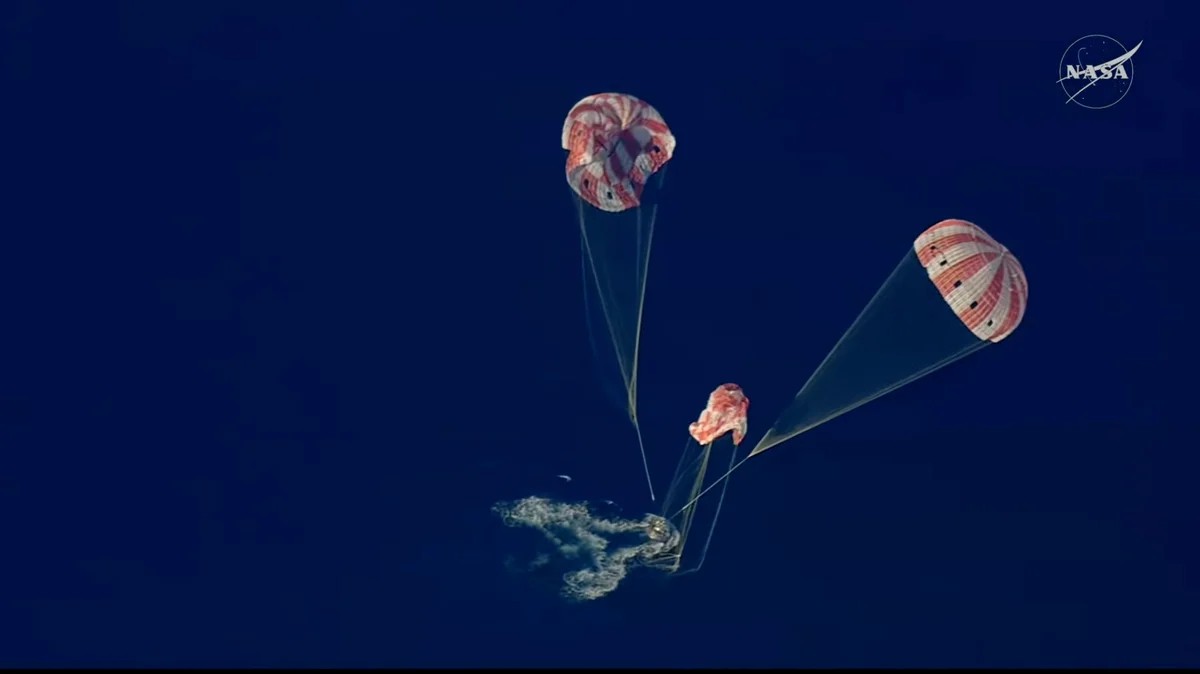
The Artemis II mission has successfully concluded, with the Orion capsule splashing down in the Pacific Ocean off the coast of San Diego at 8:07 P.M. EDT on April 10. The mission marks the end of a 10-day journey that saw four astronauts travel nearly 700,000 miles, orbiting the moon and returning safely to Earth.
A High-Stakes Return to Earth
The final phase of the mission was one of the most physically demanding segments of the flight. As the Orion capsule, named Integrity, reentered Earth’s atmosphere, it endured several extreme conditions:
- Extreme Heat: The capsule plummeted through the atmosphere, facing external temperatures reaching nearly 5,000 degrees Fahrenheit (2,760 degrees Celsius).
- Intense G-Forces: During the descent, the crew experienced heavy gravitational pressure, a physical phenomenon caused by the rapid deceleration of the craft.
- Atmospheric Impact: The reentry process was powerful enough to create a noticeable sonic boom.
Following the splashdown, the crew—Commander Reid Wiseman, Pilot Victor Glover, and Mission Specialists Christina Koch and Jeremy Hansen —were recovered by divers from the USS John P. Murtha. Once cleared of any debris risks, the astronauts were transferred via helicopter to the Navy ship. Upon arrival, Commander Wiseman confirmed the crew’s well-being, reporting they were all “green.”
Breaking Records and Paving the Way
Artemis II was not merely a flight; it was a series of unprecedented milestones for human spaceflight. The mission set several new benchmarks:
- Distance from Earth: The crew holds the record for the farthest any human has ever traveled from our planet, reaching a distance of 252,756 miles.
- New Perspectives: The astronauts were able to directly observe areas of the moon’s far side that have never been viewed by humans before.
- Scientific Data: The mission collected vital observations, including data from a total solar eclipse, which will serve as a foundation for future lunar research.
Why This Matters: The Road to a Lunar Base
This mission serves as the critical “proof of concept” for NASA’s broader lunar ambitions. While the Apollo missions of the 1960s and 70s were focused on landing humans on the moon, the Artemis program is designed with a different long-term goal: sustained presence.
By successfully testing the Space Launch System (SLS) rocket and the Orion capsule with a human crew on board, NASA has validated the technology required for much more complex missions. This successful test flight provides the confidence and technical data necessary to move toward landing astronauts on the lunar surface and, eventually, establishing a permanent moon base.
“We made a big step tonight to get us on the path towards the surface,” stated Amit Kshatriya, NASA’s associate administrator. “This was an incredible test of an incredible machine.”
The crew is currently being transported to the Johnson Space Center in Houston to reunite with their families.
Conclusion
The successful completion of Artemis II validates NASA’s next-generation deep-space hardware and marks a decisive transition from theoretical planning to the active pursuit of long-term lunar habitation.